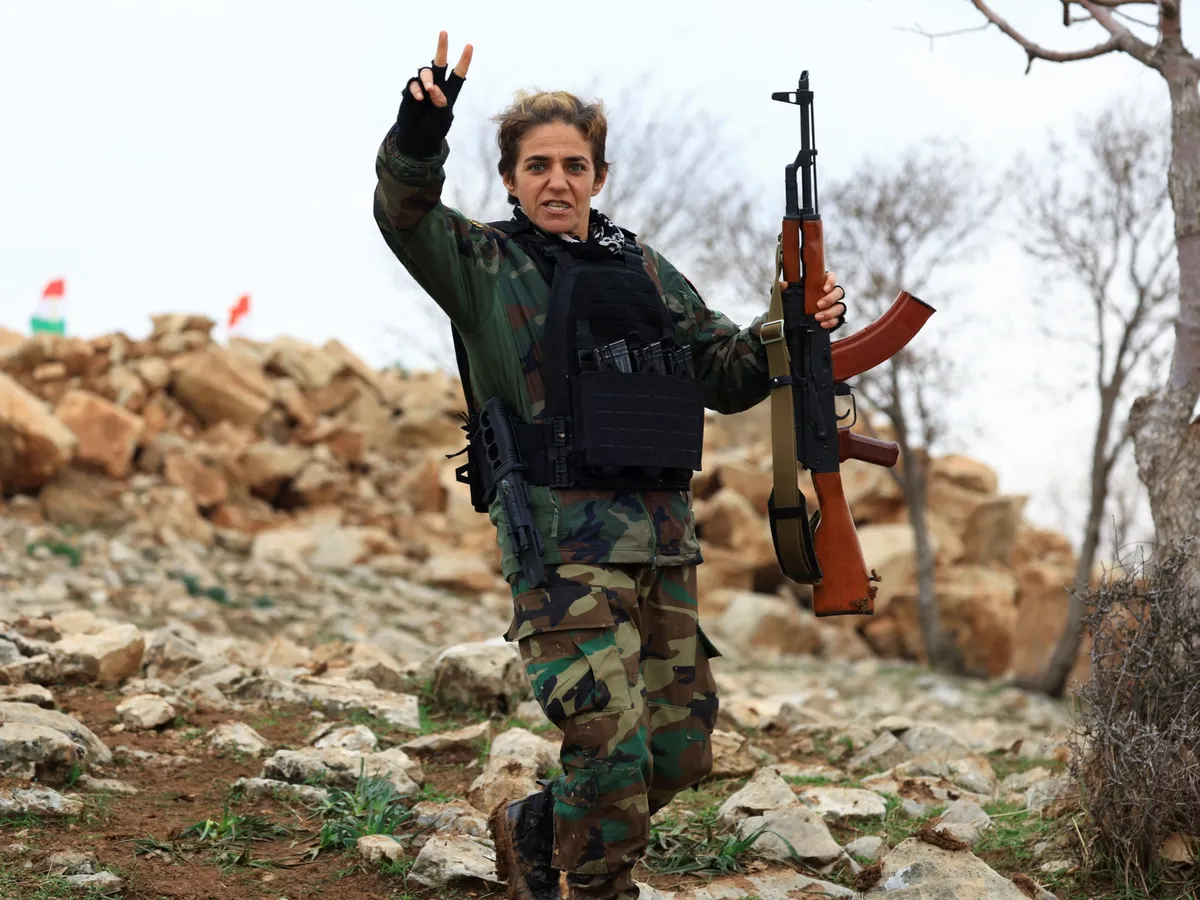
Iranian Kurds weigh risks of fighting government, uncertain of US and Israeli support for any uprising.A fighter from the Kurdistan Freedom Party (PAK), an Iranian Kurdish group, carries a rifle and gestures while standing on rocky terrain, at a training session at a base near Erbil, Iraq February 12, 2026 [File: Thaier Al-Sudani/Reuters]Published On 6 Mar 2026Uncertainty over US and Israeli war aims is slowing the Iranian Kurdish opposition groups urged by President Donald Trump to rise up against the Islamic Republic, Kurdish analysts have told Al Jazeera.From Trump’s call for Iranians to topple their government, to arguments from the United States that it was forced into attacking Iran by its ally Israel, to discredited claims that the strikes on Tehran were somehow defensive, Washington has yet to offer a clear explanation for its attacks on Iran or what its plans might be beyond them.Recommended Stories list of 4 itemslist 1 of 4Which Kurdish groups is the US rallying to fight Iran?list 2 of 4Emotional turmoil grips Iranians watching conflict unfold overseaslist 3 of 4Trump voices support for possible Kurdish offensive in Iranlist 4 of 4Iranian Kurd fighters ready for a ground operation ‘if opportunity arises’end of listThat leaves potential allies, including Iranian Kurdish opposition groups, uncertain of what comes next. Of the various ethnic groups within Iran, it is the Kurds who are arguably the most organised and militarily experienced. Opposition sentiment towards the government in Tehran is also widespread.Iranian Kurdish opposition groups have established political networks, fought rebellions against central government forces, endured repression and splits, and gained combat experience alongside other Kurdish movements from other countries, making them one of the few organised armed challenges to the Islamic Republic.Kurdish opposition groups have also recently worked to heal divisions between themselves.The Coalition of Political Forces of Iranian Kurdistan, a forum allowing many of Iran’s Kurdish opposition groups to coordinate activity against the Iranian state from their strongholds in the semi-autonomous Kurdish region of Iraq, was announced on February 22, less than a week before US-Israeli strikes began on Iran, killing Supreme Leader Ayatollah Ali Khamenei.The strikes have devastated Iran, but many observers believe that a full defeat of the Iranian government is not possible with just air power. But with the US public largely opposed to the Iran war, and particularly the prospect of US soldiers on the ground following the Iraq war in the 2000s, the possibility of Iranian Kurdish forces leading the charge has been raised by Trump himself.Trump said that he would be “all for it” in comments made on Thursday,Several US media outlets have already reported that US officials have contacted leaders within the Kurdish region of northern Iraq, where many Iranian Kurdish opposition groups are based, to discuss facilitating a ground operation inside Iran.Massively outnumbered by Iranian ground forces, estimated at around half a million, Iranian Kurdish opposition groups could likely only muster a maximum of 10,000 fighters, leading analysts to believe that they would be heavily reliant on US or Israeli support, including air strikes and supplying weapons.However, given the experience of US alliances and the fickle nature of Trump, who has repeatedly shown himself willing to turn on even close allies, it remains unclear whether Iranian Kurds are prepared to risk the prospect of what Tehran warned on Friday would be widespread reprisals.Iran’s army is estimated to number around half a million, dwarfing the 10,000 or so fighters analysts believe the combined Kurdish groups could muster [File: Vahid Salemi/AP Photo]Past betrayals“Kurdish political opposition to the Islamic Republic goes back decades,” Kamran Matin, a lecturer in international relations at the University of Sussex, told Al Jazeera.“Since the early 1990s, they’ve been pushed into northern Iraq, where they’ve established a kind of modus vivendi with the Kurdistan Regional Government [KRG, or Kurdish region of northern Iraq],” Matin, who is Kurdish Iranian, said. “Given the stakes, any Kurdish offensive on the Islamic Republic would need the KRG’s buy-in.”“If Trump declares victory halfway through and leaves a wounded republic in place, it will likely have both the means and the desire to punish the KRG and, importantly, the people there,” Matin added. “At the same time, they are not in a position to outright reject Trump’s request.”The Kurdish experience of past US operations in the Middle East is far from reassuring. In 1991, after President George HW Bush called upon Kurds to rise against Iraqi President Saddam Hussein, the ensuing rebellion went unsupported, resulting in tens of thousands of deaths and years of displacement.Later, during the fight against ISIL (ISIS), Syrian Kurds became key US partners, only to see US support falter during the fallout from the 2017 Kurdish independence referendum in Iraq and again in 2019, when partial US withdrawals from northern Syria exposed Kurdish forces to Turkish offensives, forcing mass evacuations and deepening political marginalisation.Frantic Kurdish refugees struggle for a loaf of bread during a humanitarian aid distribution at the Iraqi-Turkish border, April 5, 1991 [File: Yannis Behrakis/Reuters]Despite that, Shukriya Bradost, a Kurdish-Iranian security analyst and researcher at Virginia Tech University, said that there was “cautious hope” among opposition groups that Iranian Kurds would be supported by the US.“However, there is also concern that if Washington reaches an agreement with the remaining elements of the Iranian regime to end the war, Kurdish groups could once again be sidelined and left alone to face a new central government that might continue the same policies of repression,” Bradost said.Knock-on effect on IraqThe majority of the Iranian Kurdish armed opposition groups are based in the Kurdish region of northern Iraq, which operates a regional government largely autonomous from Baghdad. Those groups include the Democratic Party of Iranian Kurdistan (PDKI), the Kurdistan Freedom Party (PAK), Kurdistan Free Life Party (PJAK) and Komala.The groups have been exiled there since the 1980s and 1990s.Any move in response to Trump’s invitation could have serious consequences for the Kurdish region of northern Iraq, its fragile institutions, and its population of some 5 million people.A plume of smoke rises near Erbil International Airport in Erbil on March 1, 2026 [File: Shvan Harki/AFP]On Friday, Iran launched missile and drone strikes targeting the Democratic Party of Iranian Kurdistan.That followed comments from Ali Akbar Ahmadian, a member of Iran’s Defence Council, who told the semi-official Mehr news agency that Tehran could launch widespread attacks in the Kurdish region of northern Iraq, if local authorities failed to crack down on what he described as US and Israeli-backed rebel groups, allegedly plotting to enter Iran.“The KRG has been very clear that it does not want to be part of a war with Iran,” Bradost said. “As a non-sovereign entity within Iraq, it is one of the weakest actors compared to sovereign states in the region and has therefore been among the first targets of Iranian retaliation.”The Kurdish region of northern Iraq has faced repeated Iranian missile and drone strikes in recent years, Bradost said, with the United States offering little in the way of protection during those attacks.“In addition, after the 2017 Kurdish independence referendum, Washington ultimately supported the Iraqi central government and Iran-backed Shia militia forces that moved against Kurdish-controlled areas,” Bradost continued. “Because of this history, despite the KRG’s long and up-and-down relationship with the United States since the 1960s, there is deep caution about becoming involved in any US or Israeli confrontation with Iran.”However, despite that caution, as well as the ideological misgivings among many of the leftist Kurdish groups over partnering with the US and Israel, the timing may prove too great an opportunity to turn down.
SRCAl Jazeera
LANGEN
LEANCenter
WORDS1 254
ENT10
FRI · 2026-03-06 · 15:24 GMTBRIEF NSR-2026-0306-22086
NSR-2026-0306-22086News Report·EN·Political Strategy
Kurdish opposition mulls whether to trust Trump after Iran uprising call
Following US-Israeli strikes on Iran, Iranian Kurdish opposition groups are hesitant to act on President Trump's call for an uprising due to uncertainty about US and Israeli war aims. These groups, based in Iraqi Kurdistan, represent a potentially organized and experienced challenge to the Iranian government.
Simon Speakman CordallAl JazeeraFiled 2026-03-06 · 15:24 GMTLean · CenterRead · 6 min
Al JazeeraFIG 01
Reading time
6min
Word count
1 254words
Sources cited
2cited
Entities identified
10entities
Quality score
100%
§ 01
Briefing Summary
AI-generatedNEWSAR · AI
Following US-Israeli strikes on Iran, Iranian Kurdish opposition groups are hesitant to act on President Trump's call for an uprising due to uncertainty about US and Israeli war aims. These groups, based in Iraqi Kurdistan, represent a potentially organized and experienced challenge to the Iranian government. Despite recent efforts to unify and coordinate, they are wary of committing to action without a clear understanding of Washington's long-term plans and goals in Iran. The US has not clearly explained the reasons for the attacks on Iran or what its plans might be beyond them. The Kurdish groups are assessing the risks of fighting the Iranian government without assurances of sustained support.
Confidence 0.90Sources 2Claims 5Entities 10
§ 02
Article analysis
Model · rule-basedFraming
Political Strategy
National Security
Tone
Measured
AI-assessed
CalmNeutralAlarmist
Factuality
0.70 / 1.00
Factual
LowHigh
Sources cited
2
Limited
FewMany
§ 03
Key claims
5 extracted01
Trump said that he would be “all for it” regarding a Kurdish offensive in Iran.
quoteTrump
Confidence
1.00
02
US-Israeli strikes began on Iran, killing Supreme Leader Ayatollah Ali Khamenei.
factualAl Jazeera
Confidence
1.00
03
The Coalition of Political Forces of Iranian Kurdistan was announced on February 22.
factualAl Jazeera
Confidence
1.00
04
Trump called for Iranians to topple their government.
factualAl Jazeera
Confidence
1.00
05
Uncertainty over US and Israeli war aims is slowing Iranian Kurdish opposition groups.
quoteKurdish analysts
Confidence
0.80
§ 04
Full report
6 min read · 1 254 words§ 05
Entities
10 identifiedKey playerOppositionContextPositiveNeutralNegative
Organizations2
§ 06
Keywords & salience
10 termsiranian kurds
0.90
iran
0.90
kurdish opposition
0.80
uprising
0.80
us-israeli strikes
0.70
opposition groups
0.70
donald trump
0.60
islamic republic
0.50
military experienced
0.40
political networks
0.40
§ 07
Topic connections
Interactive graph Network visualization showing 51 related topics
View Full Graph Person Organization Location Event|Click node to navigate|Edge numbers = shared articles