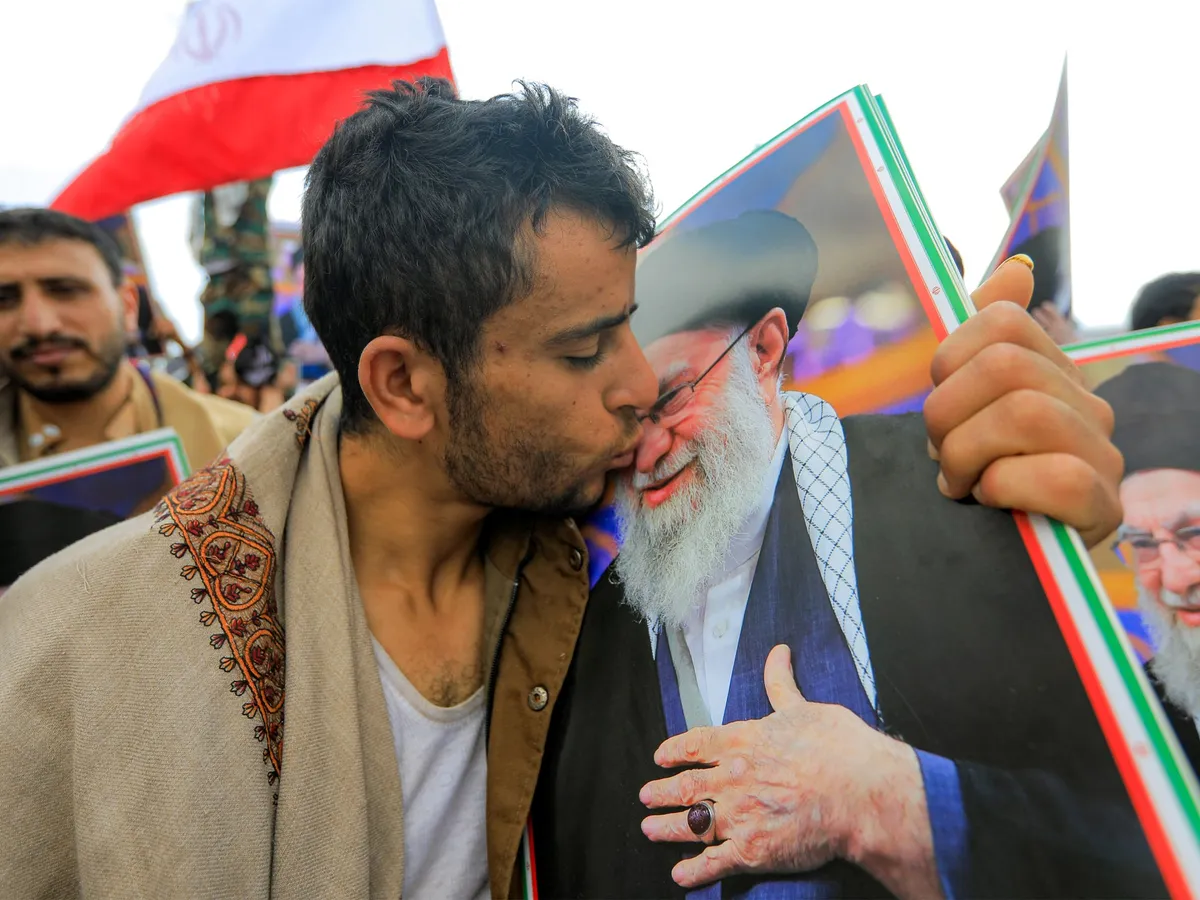
Yemen’s Houthi leadership cautious, fearing Israeli retaliation following past air strikes and leadership losses.A man kisses a picture of Iran's former Supreme Leader Ali Khamenei during a memorial rally held by supporters of Yemen's Houthis, in the Houthi-held capital Sanaa on March 1, 2026 [File: AFP]Published On 7 Mar 2026Sanaa, Yemen – The Israel-US attacks on Iran have plunged the wider Middle East region into turmoil. From Tehran, tensions have spread, affecting multiple Arab cities, including Abu Dhabi, Doha, Kuwait City, Manama, and Beirut.Amid this wave of military escalation hitting several countries, Yemen has remained – perhaps surprisingly – quiet. The Houthi Movement, the Iran-allied de facto authority in northwestern Yemen, has made repeated attacks on US and Israeli targets since the start of Israel’s genocidal war on Gaza in October 2023.Recommended Stories list of 3 itemslist 1 of 3The end of Iran’s strategic patiencelist 2 of 3A weak Iran would backfire on the United Stateslist 3 of 3A long and troubled trail: Qatar’s IRGC cell arrests strain Iran relationsend of listBut in the week since the US-Israeli attacks on Iran began on February 28, the Houthis have limited their support for Tehran to rhetoric and a mass protest denouncing the strikes.Whether they will continue to remain detached from the conflict remains uncertain. Analysts say the rebel group’s involvement is still possible, and its current restraint appears part of a strategy of patience.“Houthi intervention remains a possibility, and it could take the form of a phased escalation,” Luca Nevola, senior analyst for Yemen and the Gulf at the ACLED conflict monitor, told Al Jazeera. “At the current stage, the main Houthi priority remains avoiding direct US and Israeli retaliation.”Last August, Israeli strikes killed at least 12 Houthi high-ranking government members, including Prime Minister Ahmed al-Rahawi and chief of staff Mohammed al-Ghumari, in air strikes in Sanaa. The losses were among the heaviest the group has endured during its confrontation with the US and Israel.That incident, coupled with other attacks last year, has left the Houthi leadership more careful and wary of risking a heavy aerial campaign on areas under its control.“The group seems to fear Israeli intelligence and the possibility of leadership decapitation,” Nevola said.Despite the losses the Houthi group endured last year, it is not entirely incapacitated, and it could launch assaults on adversaries.Nevola explained, “The Houthis would likely resume attacks if they were directly drawn into the conflict, either through US or Israeli strikes or through a renewed domestic advance by anti-Houthi forces in Yemen.”Houthi chief Abdel-Malik al-Houthi said this week that “Yemen stands clearly with the Islamic Republic of Iran and the Muslim Iranian people.”He emphasised that “hands are on the trigger” regarding military escalation, adding that his group’s engagement in the war could occur at any moment depending on developments.Holding a card in reserveSadam al-Huraibi, a Yemeni political commentator, said Yemen’s Houthis will enter the war if Iran requests it to. “Tehran does not want to use all its cards at once, and it aims to save the Houthi group for the coming phase,” Huraibi told Al Jazeera.“I believe that the Houthis’ entry into the war is only a matter of time,” he added. “If the Israeli-American attacks on Iran do not stop, the Yemeni group will not stand idly by endlessly. The Houthis are preparing for war in Sanaa and the provinces they control.”The Houthis are still capable of creating chaos in the Red Sea – where they have launched repeated attacks on shipping as part of a campaign they say was in support of Gaza – and can launch drones and missiles towards Israel, said Huraibi. “This move will likely materialise, and this depends on the timing set by the Houthis and Iran.”Nevola agreed with Huraibi, saying, “Now that all axis [of resistance, or pro-Iran regional groups] actors are under direct attack, ensuring long-term operational continuity from Yemen – and preserving the Houthi regime as a safe haven – may have become a strategic priority.”Adel Dashela, a Yemeni researcher and non-resident fellow at Mesa Global Academy, said that the Houthis do not want to officially declare war at the present time in order to portray themselves as an independent faction, not subject to Tehran’s directives.Dashela told Al Jazeera, “In practice, the group is part of the axis of resistance, and the war could reach it. The Houthi leadership is still waiting to see how the situation develops. It does not want to take rash decisions on the involvement in the US-Israel war on Iran.”Possible targetsThe Houthis are capable of striking multiple targets with missiles and drones.“Should the conflict persist, and the Houthis feel threatened by direct attacks, they could expand their target set to include Israeli territory, US warships and military assets in the region, and Israel’s partners in the region, such as the UAE and Somaliland,” said Nevola.The continued barrage of Iranian missiles on Israel and the Gulf states may have compromised interception systems over the past week. Houthi attacks could therefore become more destructive.Nevola explained, “Houthi long-range drone and missile attacks against Gulf states and Israel could prove more effective at a later stage of the conflict, when air defence systems may face resupply constraints. The opening of an additional southern front could place further strain on Israel’s air defence.”From late 2023 to 2025, the Houthis carried out a military campaign of attacks on ships through the Red Sea corridor.The campaign killed at least nine mariners and sank four ships, disrupting shipping in the Red Sea, through which about $1 trillion of goods passed each year before the war.The US-Israel strikes have wiped out many of Iran’s political and military leaders within a few days.The killing of senior figures could weaken the Iranian regime, whose fall remains a priority for US and Israeli leadership.Whether weakened or ousted, the fallout would be “detrimental” to the Houthi group in Yemen, said al-Huraibi.He added, “The group will be militarily affected as the flow of smuggled Iranian weapons to Yemen will shrink or entirely cease. This is a formidable challenge for the group.”In 2022, the United Nations found thousands of weapons seized in the Arabian Sea likely came from a single port in Iran.A report by a UN Security Council panel of experts on Yemen indicated that boats and land transport were used to smuggle weapons made in Russia, China, and Iran into Yemen. Iran has repeatedly denied smuggling weapons into Yemen.Moreover, the recent attacks on Iran’s leadership, according to Huraibi, dealt a significant blow to the Houthi group’s morale.“Iran is the religious icon for the [Houthis]. When the icon is defeated, morale cannot remain the same. The Iranian regime’s fall could be a prologue to the collapse of its proxies in the region, including in Yemen.”Shock and anxietyAt the grassroots level in Yemen, the US-Israel attacks on Iran were a massive shock, and it is still a cause of continued anxiety.Mohammed Yahia, a 28-year-old resident of Sanaa, told his family on the first day of the strikes to stock up on cooking gas and food items such as flour, rice, and cooking oil. Prices go up every time tensions escalate, he said.Yahia expected the Houthis would soon launch missiles and drones in support of Tehran, which would invite war to Sanaa.“I thought the air strikes on Sanaa would begin within hours. I made sure to buy the basics and stay home at least in the first few days of the war.”Contrary to his expectation, the Houthis have not yet stepped in.“I did not imagine that such a day would happen: the region is at war, and Yemenis are watching,” Yahia said. “Ultimately, it is the Houthis who will decide whether Yemen enters this conflict.”
SRCAl Jazeera
LANGEN
LEANCenter
WORDS1 279
ENT10
SAT · 2026-03-07 · 04:21 GMTBRIEF NSR-2026-0307-22258
NSR-2026-0307-22258Analysis·EN·Political Strategy
Why Yemen’s Houthis are staying out of Israel-US fight with Iran – for now
Despite previously attacking US and Israeli targets, Yemen's Houthi movement has largely remained quiet following recent US-Israeli attacks on Iran. While offering rhetorical support and holding protests, the Houthis have avoided direct military involvement.
Al Jazeera StaffAl JazeeraFiled 2026-03-07 · 04:21 GMTLean · CenterRead · 6 min
Al JazeeraFIG 01
Reading time
6min
Word count
1 279words
Sources cited
1cited
Entities identified
10entities
Quality score
100%
§ 01
Briefing Summary
AI-generatedNEWSAR · AI
Despite previously attacking US and Israeli targets, Yemen's Houthi movement has largely remained quiet following recent US-Israeli attacks on Iran. While offering rhetorical support and holding protests, the Houthis have avoided direct military involvement. Analysts suggest this restraint is strategic, prioritizing the avoidance of direct retaliation from the US and Israel. The Houthis are likely wary of repeating the heavy losses they endured last year, including the deaths of high-ranking members in Israeli air strikes in Sanaa. The possibility of future Houthi intervention remains, potentially in a phased escalation, but for now, self-preservation appears to be the primary motivator.
Confidence 0.90Sources 1Claims 5Entities 10
§ 02
Article analysis
Model · rule-basedFraming
Political Strategy
National Security
Tone
Measured
AI-assessed
CalmNeutralAlarmist
Factuality
0.70 / 1.00
Factual
LowHigh
Sources cited
1
Limited
FewMany
§ 03
Key claims
5 extracted01
Yemen stands clearly with the Islamic Republic of Iran and the Muslim Iranian people.
quoteAbdel-Malik al-Houthi
Confidence
1.00
02
Last August, Israeli strikes killed at least 12 Houthi high-ranking government members in Sanaa.
factualAl Jazeera
Confidence
0.90
03
The Houthi movement has made repeated attacks on US and Israeli targets since the start of Israel’s war on Gaza in October 2023.
factualAl Jazeera
Confidence
0.90
04
The group seems to fear Israeli intelligence and the possibility of leadership decapitation.
quoteLuca Nevola
Confidence
0.80
05
Houthi intervention remains a possibility, and it could take the form of a phased escalation.
predictionLuca Nevola, senior analyst for Yemen and the Gulf at ACLED
Confidence
0.70
§ 04
Full report
6 min read · 1 279 words§ 05
Entities
10 identifiedKey playerOppositionContextPositiveNeutralNegative
People1
Organizations1
§ 06
Keywords & salience
9 termshouthi
1.00
yemen
0.90
israel
0.80
us
0.70
air strikes
0.60
retaliation
0.60
military escalation
0.50
iran
0.50
strategic patience
0.40
§ 07
Topic connections
Interactive graph No topic relationship data available yet. This graph will appear once topic relationships have been computed.