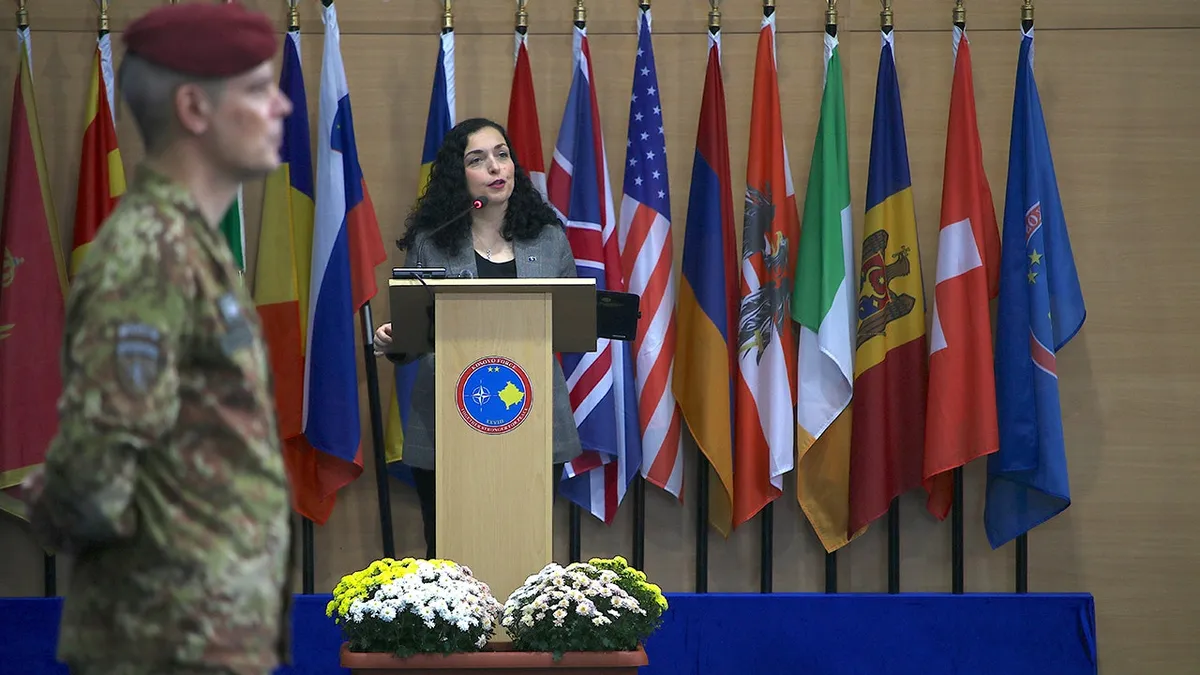
The Balkan nation of Kosovo is facing a constitutional crisis after a deadline passed for electing a new head of state. Kosovo President Vjosa Osmani, an ally of President Donald Trump , dissolved parliament and called for snap elections. With conflicts raging around the globe and pressure on the NATO contingent based in the West Balkan nation to keep the peace, Osmani told reporters that "precisely because the geopolitical situation is that complex, it is important to finish this electoral process which is coming up. It is very hard now to imagine what will happen next," she said, according to Kiro7. Trump recently praised Kosovo’s president for the "great job" she is doing in her country in a February speech. Osmani accepted an invitation from Trump to join the Board of Peace in January and has pledged resources to the International Stabilization Force for Gaza. EUROPEAN LEADER PRAISES TRUMP'S 'PEACE THROUGH STRENGTH' FOR KEEPING COUNTRY SAFE FROM CONFLICT Kosovo faces another possible domestic change that could impact Osmani’s standing. There is chatter of an impending reduction or reorganization of the international NATO peacekeeping mission in Kosovo, KFOR, which has been in place since 1999 to stabilize the country following war in the Balkans. The commander of the peacekeeping force, Maj. Gen. Özkan Ulutaş, said in February that the U.S. does not plan to reduce its troop numbers in Kosovo, according to Reporteri. About 600 American troops are currently deployed in the country. Following Kosovo’s declaration of independence from Serbia in 2008, tensions between the countries have remained high. Former Albanian Prime Minister Pandeli Majko told Fox News Digital, "Kosovo needs governance and then a compromise for the election of the president." He said he "hopes that the Constitutional Court will provide a solution." EUROPEAN NATION AGREES TO 'TEMPORARILY' HOST DEPORTED IMMIGRANTS FROM US AMID TRUMP PUSH The Kosovo Parliament has been besieged by stalemate for more than a year. Balkan Insight reported that a February 2025 poll failed to result in the formation of a government. Snap elections in December resulted in a win for the Vetevendosje party of Prime Minister Albin Kurti, but the party could not garner enough support from the opposition to elect a president. Friday’s vote failed because the session fell 14 members short of a quorum. Opposition members boycotted the vote because they did not support Kurti’s nominee, Minister of Foreign Affairs and Diaspora of Kosovo Glauk Konjufca. Osmani met with opposition party leaders Friday, a meeting Kurti chose not to attend. The prime minister said that "there should be a failure to elect a president in the third round before dissolving parliament and going to new elections." Kurti’s party has appealed to the Constitutional Court for a review of the constitutionality of the election process, according to the European Western Balkans site. New elections may be held as early as April 5, opposition leader Ramush Haradinaj suggested. Majko told Fox News Digital that he does not see the debate between the parties as a problem, explaining that their ranking in the elections would not change even if they were held again. He said the idea of early elections is an exhausting political crisis that does not produce solutions.
SRCFox News - World
LANGEN
LEANCenter-Right
WORDS534
ENT9
SUN · 2026-03-08 · 17:01 GMTBRIEF NSR-2026-0308-22605
NSR-2026-0308-22605News Report·EN·Political Strategy
Balkans on edge: Kosovo political crisis sparks fears of renewed instability
Kosovo is facing a political crisis after failing to elect a new head of state by the deadline, prompting President Vjosa Osmani to dissolve parliament and call for snap elections. The political instability occurs amidst concerns about a potential reduction of the NATO peacekeeping force (KFOR), present since 1999, despite assurances from the U.S.
Beth BaileyFox News - WorldFiled 2026-03-08 · 17:01 GMTLean · Center-RightRead · 3 min
Fox News - WorldFIG 01
Reading time
3min
Word count
534words
Sources cited
6cited
Entities identified
9entities
Quality score
100%
§ 01
Briefing Summary
AI-generatedNEWSAR · AI
Kosovo is facing a political crisis after failing to elect a new head of state by the deadline, prompting President Vjosa Osmani to dissolve parliament and call for snap elections. The political instability occurs amidst concerns about a potential reduction of the NATO peacekeeping force (KFOR), present since 1999, despite assurances from the U.S. that it will maintain its troop levels. Tensions between Kosovo and Serbia remain high since Kosovo's 2008 declaration of independence. The Kosovo Parliament has been in a stalemate for over a year, with a failed attempt to form a government after a February 2025 poll and a boycott of the presidential vote due to opposition to the Prime Minister's nominee. The situation has sparked fears of renewed instability in the Balkans.
Confidence 0.90Sources 6Claims 5Entities 9
§ 02
Article analysis
Model · rule-basedFraming
Political Strategy
National Security
Tone
Measured
AI-assessed
CalmNeutralAlarmist
Factuality
0.80 / 1.00
Factual
LowHigh
Sources cited
6
Well sourced
FewMany
§ 03
Key claims
5 extracted01
Former Albanian Prime Minister Pandeli Majko told Fox News Digital, 'Kosovo needs governance and then a compromise for the election of the president.'
quotePandeli Majko
Confidence
1.00
02
Following Kosovo’s declaration of independence from Serbia in 2008, tensions between the countries have remained high.
factual
Confidence
1.00
03
The commander of the peacekeeping force, Maj. Gen. Özkan Ulutaş, said in February that the U.S. does not plan to reduce its troop numbers in Kosovo.
quoteMaj. Gen. Özkan Ulutaş
Confidence
1.00
04
Osmani accepted an invitation from Trump to join the Board of Peace in January and has pledged resources to the International Stabilization Force for Gaza.
factual
Confidence
1.00
05
Kosovo is facing a constitutional crisis after a deadline passed for electing a new head of state.
factual
Confidence
1.00
§ 04
Full report
3 min read · 534 words§ 05
Entities
9 identifiedKey playerOppositionContextPositiveNeutralNegative
People3
Organizations3
§ 06
Keywords & salience
10 termskosovo political crisis
1.00
political instability
0.80
snap elections
0.70
peacekeeping mission
0.60
nato
0.60
kfor
0.60
vjosa osmani
0.50
balkans
0.50
serbia
0.40
constitutional court
0.40
§ 07
Topic connections
Interactive graph Network visualization showing 15 related topics
View Full Graph Person Organization Location Event|Click node to navigate|Edge numbers = shared articles