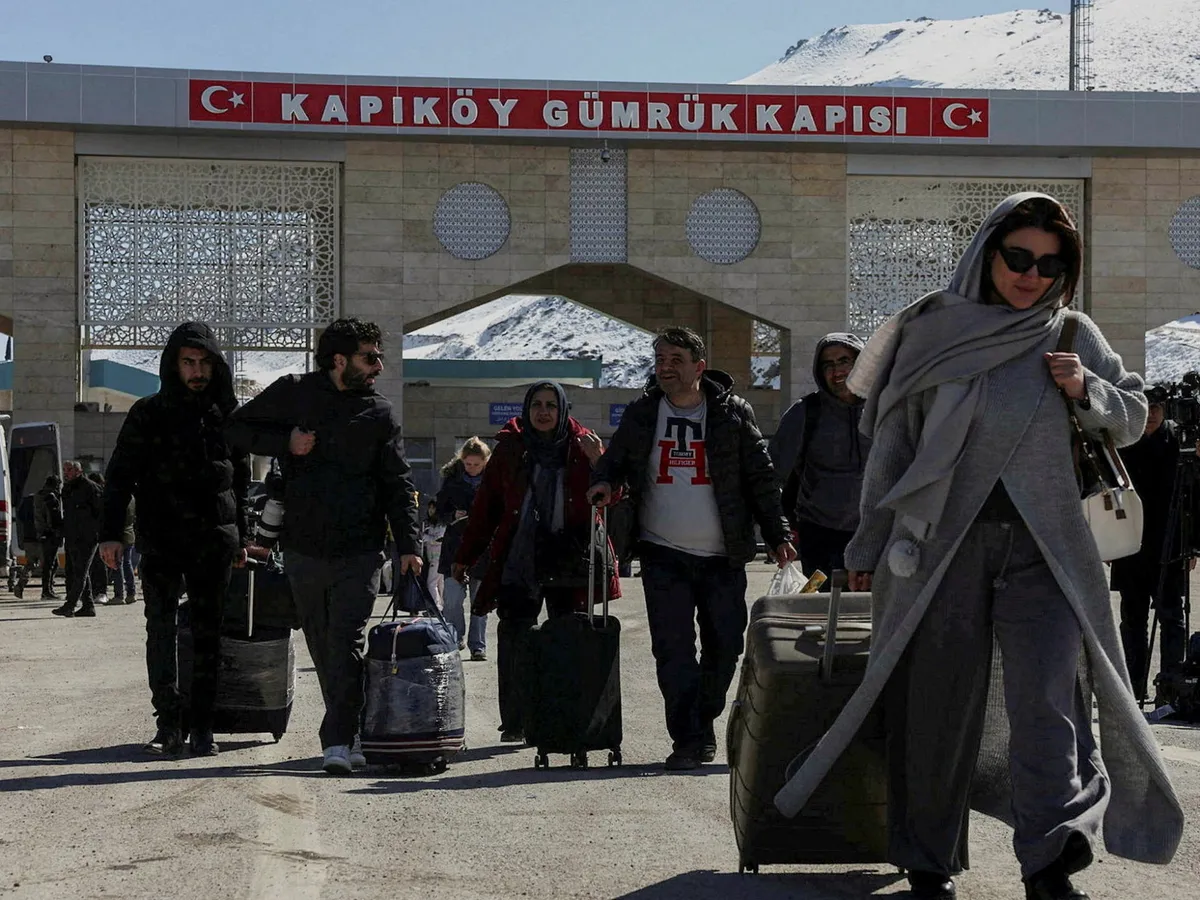
‘If there is peace, I will return’: People flee US-Israeli bombing of IranIranians and foreign workers flee US-Israeli bombardment of Iran, crossing snowy Turkiye border to seek safety.Iranians cross into Turkiye at the Kapikoy border gate in the eastern Van province. [Dilara Senkaya/Reuters]Published On 10 Mar 2026At a remote mountain pass in eastern Turkiye, travellers from Iran step across the threshold with a mix of fear, exhaustion and relief, arriving after a week marked by war, long journeys by train or car, communications blackouts and borrowed phones.Snow-covered hills surround the Iranian side of the frontier at the Kapikoy border gate in Turkiye’s Van province, where families and lone travellers emerge, many after days on the road.Hundreds have crossed in recent days, and there is now a steady flow in both directions as the US-Israel war on Iran expands across the region.Some say they fled because bombs were falling on their cities. Others decided to leave after losing contact with loved ones, travelling by land when flights were cancelled.Egyptian factory worker Mohammad Fauzi, 46, crossed from Iran with no Turkish SIM card, no local currency and no knowledge of the language. He only had the phone numbers of two Egyptian friends in Ankara and Izmir – and a plan to reach Cairo.He had watched work grind to a halt in Iran during his three months there in the marble and granite sector, with many factories closing.“The situation is very difficult, and working has stopped. I can’t work, I can’t stay because the situation is dangerous now, so I want to go to my home, my country.”Jalileh Jabari, 63, said she fled Tehran because “bombs are falling” and the situation had become unbearable. The highways to the border were calm, but uncertainty in the capital pushed her to leave. She was travelling to Istanbul, where her daughter studies.“If things become good there, if Iran becomes good, I will come back. If there is peace, I will return.”As many leave Iran, some are returning.Leila, 45, who did not give the Reuters news agency her last name, decided to head back from Istanbul – where she occasionally assists academics working with a German historical research institution – after she lost contact with her family in Shiraz.“How can I be safe when I feel my family, maybe they are in danger?” she asked.One of her brothers is seriously ill and in a coma, increasing her worry. For her, being physically with her family, even in danger, feels more bearable than waiting abroad.She plans to remain in Iran until the war is over.“I cannot guard them against bombs. But when I feel I can be with them together, maybe we die together, or I can help them as long as we are alive.”
SRCAl Jazeera
LANGEN
LEANCenter
WORDS457
ENT12
TUE · 2026-03-10 · 09:58 GMTBRIEF NSR-2026-0310-23113
NSR-2026-0310-23113News Report·EN·Human Interest
‘If there is peace, I will return’: People flee US-Israeli bombing of Iran
Following US-Israeli bombing in Iran in March 2026, people are fleeing the country, seeking safety across the border into Turkiye. Travelers are arriving at the Kapikoy border gate in Van province, many after enduring long journeys and communication disruptions.
By ReutersAl JazeeraFiled 2026-03-10 · 09:58 GMTLean · CenterRead · 2 min
Al JazeeraFIG 01
Reading time
2min
Word count
457words
Sources cited
4cited
Entities identified
12entities
Quality score
100%
§ 01
Briefing Summary
AI-generatedNEWSAR · AI
Following US-Israeli bombing in Iran in March 2026, people are fleeing the country, seeking safety across the border into Turkiye. Travelers are arriving at the Kapikoy border gate in Van province, many after enduring long journeys and communication disruptions. Some are leaving due to bombings and the dangerous situation, while others lost contact with family. Foreign workers are also departing, seeking to return to their home countries after work in Iran halted. Conversely, some Iranians are returning to Iran from Turkiye, driven by concern for family safety despite the ongoing conflict.
Confidence 0.90Sources 4Claims 5Entities 12
§ 02
Article analysis
Model · rule-basedFraming
Human Interest
Conflict
Tone
Mixed Tone
AI-assessed
CalmNeutralAlarmist
Factuality
0.70 / 1.00
Factual
LowHigh
Sources cited
4
Well sourced
FewMany
§ 03
Key claims
5 extracted01
People are fleeing Iran into Turkiye due to US-Israeli bombardment.
factualArticle
Confidence
0.90
02
Working has stopped in Iran's marble and granite sector.
quoteMohammad Fauzi
Confidence
0.80
03
The US-Israel war on Iran expands across the region.
factualArticle
Confidence
0.80
04
Hundreds have crossed the Kapikoy border gate in recent days.
factualArticle
Confidence
0.80
05
Bombs are falling on Tehran.
quoteJalileh Jabari
Confidence
0.70
§ 04
Full report
2 min read · 457 words§ 05
Entities
12 identifiedKey playerOppositionContextPositiveNeutralNegative
Organizations1
§ 06
Keywords & salience
9 termsiran
1.00
us-israeli bombing
0.90
fleeing
0.80
turkiye border
0.70
war
0.70
peace
0.60
refugees
0.60
foreign workers
0.50
communications blackout
0.50
§ 07
Topic connections
Interactive graph Network visualization showing 51 related topics
View Full Graph Person Organization Location Event|Click node to navigate|Edge numbers = shared articles