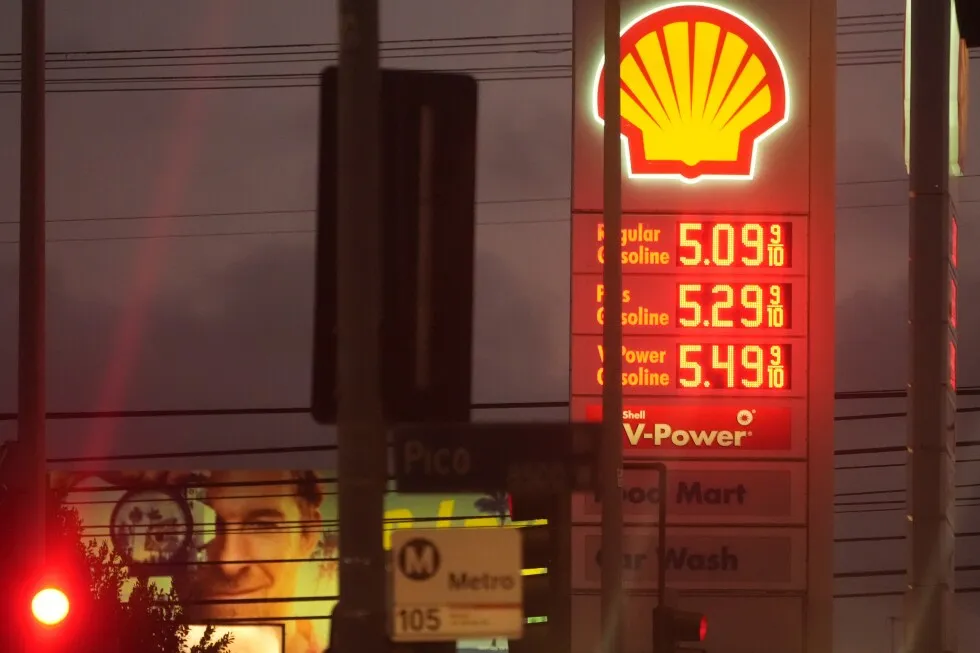
Gas prices are displayed, Monday, March 9, 2026, in Los Angeles. (AP Photo/Damian Dovarganes) Updated [hour]:[minute] [AMPM] [timezone], [monthFull] [day], [year] WASHINGTON (AP) — Inflation likely was elevated last month even before the spike in oil and gas prices of the past two weeks that is expected to send consumer costs soaring in the months ahead. Consumer prices are forecast to have risen 2.5% in February from a year earlier when the Labor Department reports last month’s figures Wednesday, according to a survey of economists by data provider FactSet. That would be up slightly from 2.4% in the previous month. Core prices, which exclude the volatile food and energy categories, are expected to have also risen 2.5% in February, matching January’s figure for the lowest in five years. But the data will represent an already-faded snapshot of inflation before the Iran-war" class="entity-link entity-event" data-entity-id="38748" data-entity-type="event">Iran war was launched Feb. 28, which has caused violent gyrations in oil prices as shipping lanes through the Persian Gulf have suffered a rare shutdown. Gas prices have already jumped and are expected to push inflation much higher when March figures are released next month. The price spike will unnerve the inflation fighters at the Federal Reserve and could slow consumer spending and weigh on the broader economy. The increase could be a one-time event and potentially reverse if the war ends soon, as President Donald Trump has hinted. But the spike in gas prices threatens to worsen inflation for at least a few months even as Americans are already weary from nearly five years of stubbornly high prices that have made “affordability” a thorny political issue for congressional Republicans who will soon face voters in midterm elections later this year. Oil prices soared as high as nearly $120 a barrel late Sunday before rapidly falling back Monday after Trump suggested that the conflict would be a “short-term excursion.” Still, he has also threatened ongoing attacks and it isn’t clear when the conflict might end. Some analysts warn prices will move much higher if the Strait of Hormuz remains closed, which has removed roughly three-quarters of the Persian Gulf region’s oil production from world markets, according to Wood Mackenzie, an energy analytics firm. Oil prices could soar to $150 a barrel in the coming weeks, the firm forecasts, if shipments don’t resume. That would push gas prices still higher in the United States, where they jumped to $3.54 a gallon on average nationwide Tuesday, according to AAA, an increase of about 20% just in one month. Over time, higher gas prices will lift some other costs as well, including air fares and shipping costs, which could make groceries and restaurant meals more expensive. At the same time, given the ups-and-downs of oil prices — U.S. crude prices fell nearly 9% to $86.55 Tuesday afternoon — it is difficult to forecast how big the impact will be over time. If shipments resume in a week or so, gas prices will likely decline fairly soon, though they typically fall much more slowly than they rise. Laura Rosner-Warburton, senior economist at MacroPolicy Perspectives, a consulting firm, expects inflation could jump by as much 0.8% or 0.9% just in March from the previous month, when that data is reported next month. It would be the largest monthly gain in nearly four years. Yearly inflation could easily surpass 3% in that case and potentially near 4% in the following months. By comparison, overall prices are projected to climb just 0.3% in February from the previous month. The jump in gas prices so far this month has been the largest since March 2022, and before that since June 2009, Rosner-Warburton said. “That is enormous,” she said. “Increases of that magnitude are highly unusual.”Core prices will be much less affected this month, but could tick higher over time as more expensive gas pushes up airline fares and other transportation costs. Core inflation is expected to have increased 0.3% in February from the previous month. Even if the sharp rise is short-lived, it will almost certainly delay any interest-rate cut by the Federal Reserve, which meets next week. It cut its key rate three times last year before leaving it unchanged at its last meeting in January. The Fed is already deeply divided over whether it needs to keep its rate at its current level of about 3.6% to push inflation down closer to its 2% goal, or whether it should reduce the rate to support borrowing, spending, and hiring. Last Friday, the government reported an unexpectedly sharp job loss in February, as employers slashed 92,000 jobs and the unemployment rate ticked up to a still-low 4.4% from 4.3%.The weak jobs report puts the Fed in an especially difficult position: It would normally reduce rates to boost growth and hiring, but it typically raises rates — or at least keeps them where they are — if they are worried about inflation. “That’s always the worst-case scenario for the central bank,” said Austan Goolsbee, president of the Federal Reserve Bank of Chicago, on Bloomberg Friday. “As we get more uncertainties, I kind of think that the time at which it makes sense to act keeps getting pushed back.” Gregory Daco, chief economist at EY-Parthenon, a consulting firm, said that normally the Fed would expect an oil price shock to have at most a temporary impact on inflation and might still cut rates if the economy needed lower borrowing costs. But Fed policymakers were burnt just a few years ago when they initially said the post-COVID inflation spike in 2022-23 — the worst in four decades — would be temporary, Daco said. As a result, they will be reluctant to take the risk of prematurely lowering rates. A few officials even mentioned during the January meeting that they might have to hike rates soon, rather than cut them, according to the meeting’s minutes — and that was before the Iran-war" class="entity-link entity-event" data-entity-id="38748" data-entity-type="event">Iran war. “They do not want to be burned again,” Daco said. Rugaber has covered the Federal Reserve and the U.S. economy for the AP for 16 years. He is a two-time finalist for the Gerald Loeb award for business reporting.
SRCAssociated Press (AP)
LANGEN
LEANCenter
WORDS1 021
ENT11
WED · 2026-03-11 · 07:53 GMTBRIEF NSR-2026-0311-23419
NSR-2026-0311-23419News Report·EN·Economic Impact
Inflation likely to spike in coming months after tame February reading
A new report indicates that U.S. inflation was likely elevated in February, with consumer prices expected to have risen 2.5% year-over-year.
By
CHRISTOPHER RUGABERAssociated Press (AP)Filed 2026-03-11 · 07:53 GMTLean · CenterRead · 5 min
Associated Press (AP)FIG 01
Reading time
5min
Word count
1 021words
Sources cited
4cited
Entities identified
11entities
Quality score
100%
§ 01
Briefing Summary
AI-generatedNEWSAR · AI
A new report indicates that U.S. inflation was likely elevated in February, with consumer prices expected to have risen 2.5% year-over-year. However, this data precedes the recent surge in oil and gas prices following the launch of the Iran war on February 28th. The conflict has disrupted shipping lanes in the Persian Gulf, causing a rare shutdown and significant volatility in oil markets. Experts predict that rising gas prices will further inflate consumer costs in the coming months, potentially unsettling the Federal Reserve and impacting consumer spending. While the price spike could be temporary depending on the war's duration, continued disruptions, particularly the closure of the Strait of Hormuz, could drive oil prices to $150 a barrel, exacerbating inflation concerns.
Confidence 0.90Sources 4Claims 5Entities 11
§ 02
Article analysis
Model · rule-basedFraming
Economic Impact
Political Strategy
Tone
Measured
AI-assessed
CalmNeutralAlarmist
Factuality
0.70 / 1.00
Factual
LowHigh
Sources cited
4
Well sourced
FewMany
§ 03
Key claims
5 extracted01
Gas prices jumped to $3.54 a gallon on average nationwide Tuesday.
statisticAAA
Confidence
1.00
02
Oil prices soared as high as nearly $120 a barrel late Sunday.
factual
Confidence
1.00
03
The Iran war launched Feb. 28 has caused violent gyrations in oil prices.
factual
Confidence
0.90
04
Consumer prices are forecast to have risen 2.5% in February from a year earlier.
statisticFactSet survey of economists
Confidence
0.90
05
Oil prices could soar to $150 a barrel in the coming weeks if shipments don’t resume.
predictionWood Mackenzie
Confidence
0.70
§ 04
Full report
5 min read · 1 021 words§ 05
Entities
11 identifiedKey playerOppositionContextPositiveNeutralNegative
Organizations4
Locations5
§ 06
Keywords & salience
9 termsinflation
1.00
gas prices
0.90
oil prices
0.80
consumer prices
0.70
iran war
0.60
federal reserve
0.60
economic impact
0.50
consumer spending
0.50
strait of hormuz
0.40
§ 07
Topic connections
Interactive graph Network visualization showing 51 related topics
View Full Graph Person Organization Location Event|Click node to navigate|Edge numbers = shared articles