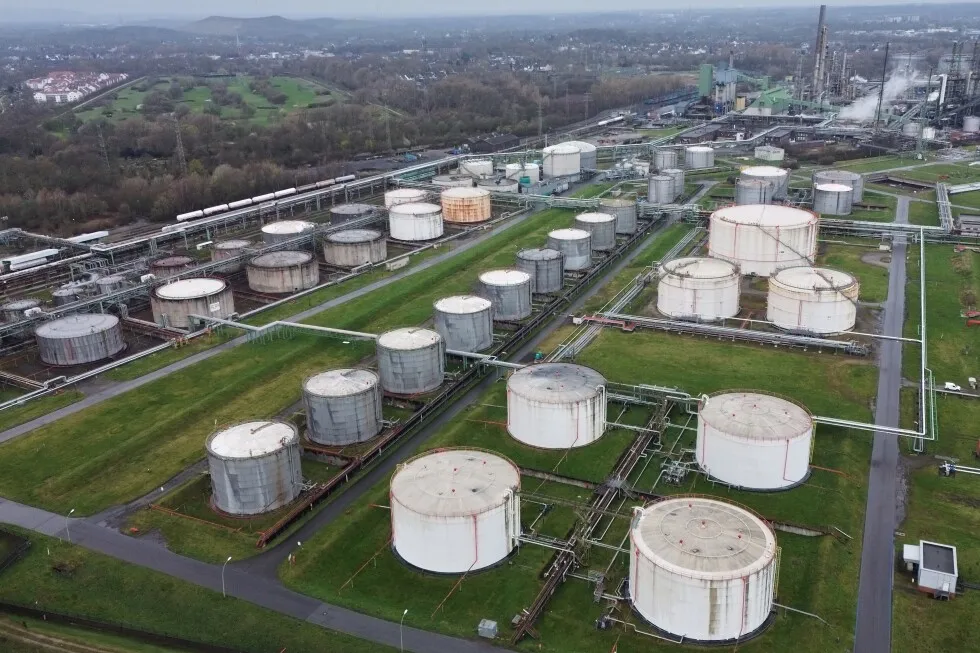
IEA agrees to record release of emergency oil reserves in an effort to calm surging prices 1 of 4 | Big oil tanks are pictured in front of the BP refinery in Gelsenkirchen, one of the biggest fuel producers in Germany, Wednesday, March 11, 2026. (AP Photo/Martin Meissner) 2 of 4 | Fishermen work in front of oil tankers south of the Strait of Hormuz Jan. 19, 2012, offshore the town of Ras Al Khaimah in United Arab Emirates. (AP Photo/Kamran Jebreili, File) 3 of 4 | Signs show the gas prices at a gas station, Tuesday, March 10, 2026, in New York. (AP Photo/Yuki Iwamura) 4 of 4 | Big oil tanks are pictured in front the BP refinery in Gelsenkirchen, one of the biggest fuel producers in Germany, Wednesday, March 11, 2026. (AP Photo/Martin Meissner) 1 of 4 Big oil tanks are pictured in front of the BP refinery in Gelsenkirchen, one of the biggest fuel producers in Germany, Wednesday, March 11, 2026. (AP Photo/Martin Meissner) Add AP News on Google Add AP News as your preferred source to see more of our stories on Google. 2 of 4 Fishermen work in front of oil tankers south of the Strait of Hormuz Jan. 19, 2012, offshore the town of Ras Al Khaimah in United Arab Emirates. (AP Photo/Kamran Jebreili, File) Add AP News on Google Add AP News as your preferred source to see more of our stories on Google. 3 of 4 Signs show the gas prices at a gas station, Tuesday, March 10, 2026, in New York. (AP Photo/Yuki Iwamura) Add AP News on Google Add AP News as your preferred source to see more of our stories on Google. 4 of 4 Big oil tanks are pictured in front the BP refinery in Gelsenkirchen, one of the biggest fuel producers in Germany, Wednesday, March 11, 2026. (AP Photo/Martin Meissner) Add AP News on Google Add AP News as your preferred source to see more of our stories on Google. Updated [hour]:[minute] [AMPM] [timezone], [monthFull] [day], [year] Paris (AP) — The International Energy Agency agreed Wednesday to release the largest volume of emergency oil reserves in its history, in a bid to counter the effects on energy markets of the war in the Middle East.The Paris-based organization said it will make 400 million barrels of oil available from its members’ emergency reserves. It’s a larger stock than the 182.7 million barrels that were released in 2022 by the IEA’s 32 member countries in response to Russia’s full-scale invasion of Ukraine.“Without sufficient routes to market and with no more available storage, Middle East oil producers have started to reduce production,” IEA executive director Fatih Birol said. “And we have seen further attacks and damage to energy and energy-related infrastructure. Refinery operations have also been disrupted, with major implications for jet fuel and diesel supplies in particular.” IEA member countries currently hold over 1.2 billion barrels of public emergency oil stocks, with a further 600 million barrels of industry stocks held under government obligation.In response to U.S. and Israeli strikes, Iran has attacked commercial ships across the Persian Gulf, escalating a campaign of squeezing the oil-rich region as global energy concerns mount. AP AUDIO: IEA agrees to record release of emergency oil reserves in an effort to calm surging prices AP’s Lisa Dwyer reports on an international move to release oil reserves to help tamper down high prices and limited supply. Iran has effectively stopped cargo traffic in the narrow Strait of Hormuz through which about a fifth of all oil is shipped from the Persian Gulf toward the Indian Ocean. It has also targeted oil fields and refineries in Gulf Arab nations, aiming at generating enough global economic pain to pressure the United States and Israel to end their strikes. Germany and Austria said earlier Wednesday they would release parts of their oil reserves following an IEA request for members to release the record 400 million barrels to help temper energy price spikes due to the Iran war. Japan also said it will release some of its reserves starting Monday. Group of Seven energy ministers met Tuesday at IEA headquarters in Paris to look at ways to bring down prices. Birol said afterward that they discussed all available options, including making IEA emergency oil stocks available to the market.The IEA reserves were established in 1974 following the Arab oil embargo.“This is a major action aiming to alleviate the immediate impacts of the disruption in markets,” Birol added. “But, to be clear, the most important thing for a return to stable flows of oil and gas is the resumption of transit through the Strait of Hormuz.” The G7 is comprised of the leading industrialized nations of Canada, the United States, France, Italy, Japan, Germany and Britain. Austria is not a member. The group’s leaders, including U.S. President Donald Trump, met Wednesday via videoconference to discuss energy issues. During his introductory remarks, French President Emmanuel Macron praised the IEA decision to release emergency oil stocks, saying it amounted to the equivalent of “20 days of the volume being exported through the Strait of Hormuz.” The amount being released by G7 nations, alone, comprises 70% of the total, he said. “I think it’s very important to see as well everything we can do in order to increase our global production,” Macron added.Germany’s economy ministry, Katherina Reiche, said the IEA asked Germany to release 2.64 million tons of its oil reserves. It was not immediately clear how much Austria was releasing.She said it would take a couple of days before the delivery of the first quantities.“Germany stands behind the IEA’s most important principle of mutual solidarity,” Reiche said.The G7 energy ministers announced Tuesday that they supported in principle “the implementation of proactive measures to address the situation, including the use of strategic reserves.”According to the IEA, export volumes of crude and refined products are currently at less than 10% of prewar levels.Austrian Economy Minister Wolfgang Hattmannsdorfer said his country was releasing part of the emergency oil reserve and extending the national strategic gas reserve, adding: “One thing is clear: in a crisis, there must be no crisis winners at the expense of commuters and businesses.” The German government also said it will introduce a measure to allow gas stations in Germany to raise fuel prices no more than once a day. The federal government wants to introduce this as quickly as possible, Reiche said.In Austria, starting Monday, price increases at gas stations will be allowed only three times a week, the country’s economy minister said.IEA nations have released emergency stocks on five previous occasions: During the 1990-1991 Gulf War, after Hurricane Katrina in 2005, during the Libyan civil war in 2011, and twice after the Russian invasion of Ukraine.___Grieshaber reported from Berlin. Associated Press reporters John Leicester and Sylvie Corbet in Paris contributed to this report. Petrequin has been covering sports and general news for The Associated Press for more than two decades. Grieshaber is a Berlin-based reporter covering Germany and Austria for The Associated Press. She covers general news as well as migration, populism and religion.
SRCAssociated Press (AP)
LANGEN
LEANCenter
WORDS1 186
ENT12
WED · 2026-03-11 · 14:23 GMTBRIEF NSR-2026-0311-23507
NSR-2026-0311-23507News Report·EN·Economic Impact
IEA agrees to record release of emergency oil reserves in an effort to calm surging prices
The International Energy Agency (IEA) agreed on Wednesday to release a record 400 million barrels of oil from its members' emergency reserves. This decision aims to stabilize energy markets amid concerns stemming from the war in the Middle East.
By
SAMUEL PETREQUIN and KIRSTEN GRIESHABERAssociated Press (AP)Filed 2026-03-11 · 14:23 GMTLean · CenterRead · 5 min
Associated Press (AP)FIG 01
Reading time
5min
Word count
1 186words
Sources cited
1cited
Entities identified
12entities
Quality score
100%
§ 01
Briefing Summary
AI-generatedNEWSAR · AI
The International Energy Agency (IEA) agreed on Wednesday to release a record 400 million barrels of oil from its members' emergency reserves. This decision aims to stabilize energy markets amid concerns stemming from the war in the Middle East. The Paris-based organization's action is larger than the 182.7 million barrels released in 2022 following Russia's invasion of Ukraine. The IEA's move comes as Middle East oil producers are reportedly reducing production due to insufficient market access and storage capacity. The release is intended to alleviate pressure on global oil prices.
Confidence 0.90Sources 1Claims 5Entities 12
§ 02
Article analysis
Model · rule-basedFraming
Economic Impact
Political Strategy
Tone
Measured
AI-assessed
CalmNeutralAlarmist
Factuality
0.80 / 1.00
Factual
LowHigh
Sources cited
1
Limited
FewMany
§ 03
Key claims
5 extracted01
It’s a larger stock than the 182.7 million barrels that were released in 2022.
factualAP
Confidence
1.00
02
IEA member countries currently hold over 1.2 billion barrels of public emergency oil stocks.
factualAP
Confidence
1.00
03
The IEA will make 400 million barrels of oil available from its members’ emergency reserves.
factualAP
Confidence
1.00
04
IEA agrees to release the largest volume of emergency oil reserves in its history.
factualAP
Confidence
1.00
05
Middle East oil producers have started to reduce production.
quoteFatih Birol, IEA executive director
Confidence
0.90
§ 04
Full report
5 min read · 1 186 words§ 05
Entities
12 identifiedKey playerOppositionContextPositiveNeutralNegative
§ 06
Keywords & salience
6 termsiea emergency release
0.90
war in the middle east
0.80
oil reserves
0.80
energy markets
0.70
middle east oil
0.60
energy crisis
0.50
§ 07
Topic connections
Interactive graph Network visualization showing 28 related topics
View Full Graph Person Organization Location Event|Click node to navigate|Edge numbers = shared articles