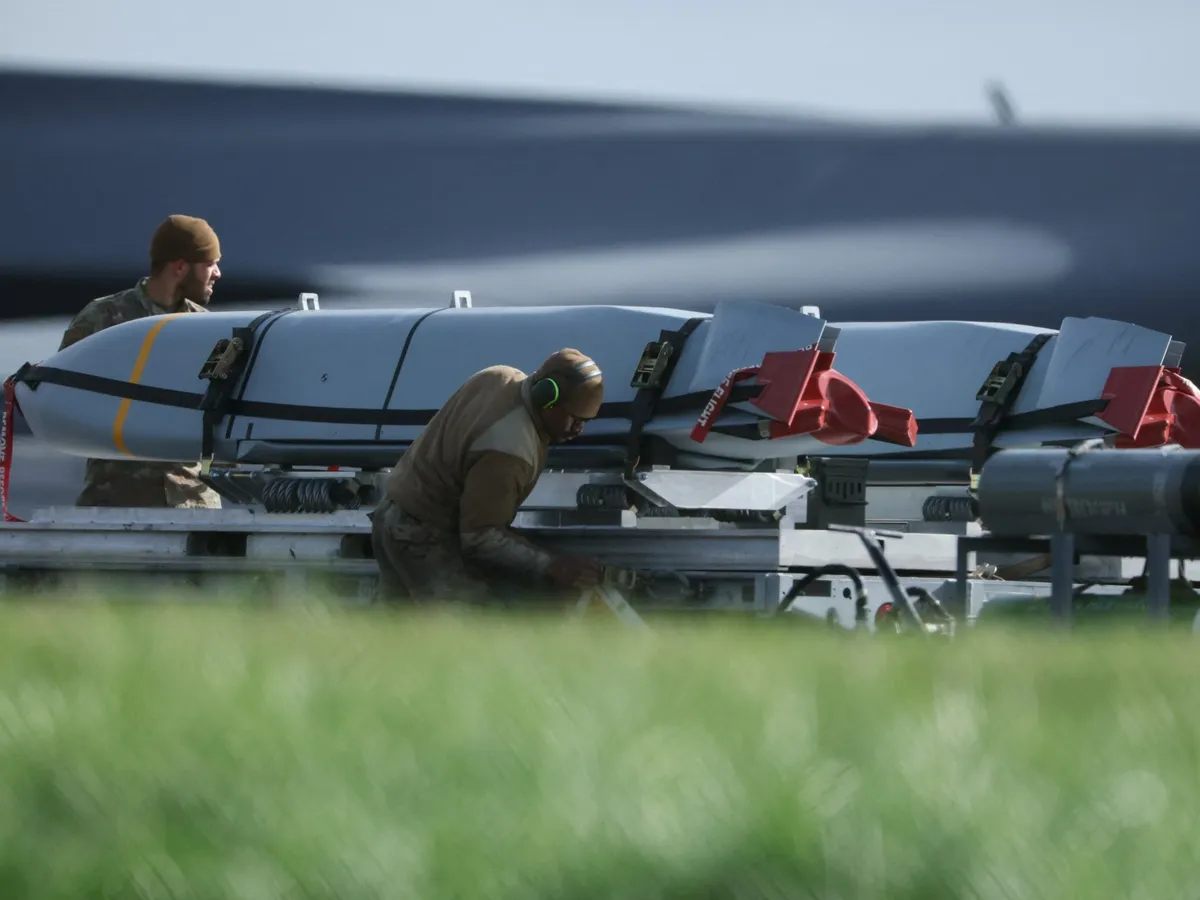
EXPLAINERExperts say Iran’s vast, mountainous terrain would make an invasion difficult but a small, precise mission is possible.US Air Force personnel secure munitions offloaded from a B-1B bomber at RAF Fairford, an airbase in Fairford, England, during the US-Israeli war on Iran on March 11, 2026 [Phil Noble/Reuters]Published On 11 Mar 2026Speculation has been mounting in the United States about whether American soldiers will be deployed on the ground in Iran as the US-Israeli war entered its 12th day on Wednesday.Democratic Senator Richard Blumenthal said he was the angriest he had been in his political career after he attended a classified Iran war briefing for the Senate Armed Services Committee on Tuesday.Recommended Stories list of 4 itemslist 1 of 4Iran reports hospitals, civilians affected during war with US, Israellist 2 of 4Iran declares US-Israeli economic, banking interests in region are targetslist 3 of 44 day week, fewer car trips in Philippines as Iran fallout biteslist 4 of 4How much a day of war on Iran costs the USend of list“I emerge from this briefing as dissatisfied and angry, frankly, as I have from any past briefing in my 15 years,” Blumenthal told reporters, adding that he had more questions than answers concerning the US goals.“I am most concerned about the threat to American lives of potentially deploying our sons and daughters on the ground in Iraq. We seem to be on a path toward deploying American troops on the ground in Iran to accomplish any of the potential objectives here.”It was the latest condemnation of the war on Iran by Democrats, who have faced Republican opposition in their attempts to rein in US President Donald Trump’s powers to go to war without the approval of Congress.Democrats accused Trump’s Republican administration of failing to adequately justify why the US attacked Iran in the first place and why the war should continue.Senator Chris Murphy, another Democrat who also attended the briefing, wrote in a post on X on Wednesday that while officials claimed the goal of the war was to destroy Iran’s military assets, they could not detail any long-term plan.Trump said at the start of the war that the US aimed to stop Iran from producing nuclear weapons although Tehran has maintained that its nuclear programme is for civilian purposes only.Analysts said a ground operation would be “extremely” difficult in Iran’s vast, rugged terrain but not impossible.Here’s what we know about a possible US deployment and what such a mission could look like:Smoke rises from air strikes near Azadi Tower in western Tehran on March 10, 2026 [AFP]What are US officials saying?The US government has not confirmed whether American soldiers would be deployed in Iran, but officials have also not ruled out the possibility.Defense Secretary Pete Hegseth told the CBS TV network this week that the US is “willing to go as far as we need to” and Washington will ensure Iran’s “nuclear ambitions are never achieved”.White House Press Secretary Karoline Leavitt said last week that ground operations are “not part of the plan right now” but Trump was keeping options open.Secretary of State Marco Rubio’s speech at a congressional briefing last week provided some clues as to why a ground force might be needed.Rubio said the US needed to physically secure nuclear material in Iran.“People are going to have to go and get it,” Rubio said without clarifying who that would be.His statement came around the same time that it emerged Trump had spoken to Iranian Kurdish rebel groups based in Iraq along its border with Iran.It’s unclear what was discussed, but analysts said it could involve the US seeking to use Kurdish armed forces as a proxy on the ground.Most Americans oppose deploying US troops in Iran, polls suggested.About 74 percent of respondents, most of whom leaned to the political left, were against it, according to a Quinnipiac University poll this week. In a snap text message poll at the start of the war, most respondents also told The Washington Post they were against the war.According to a Reuters-Ipsos poll conducted in the hours after the war began on February 28, 43 percent of respondents said they disapproved of the war and another 29 percent said they were unsure. Only one in four respondents approved of the US-Israeli attacks.An American soldier wipes his face during a sandstorm in the Iraqi desert south of Baghdad in 2003 [File: Peter Andrews/PA/CMC via Reuters]Which countries has the US invaded in recent decades?The US has engaged in multiple combat operations since the end of the Cold War.Washington and its NATO allies invaded Afghanistan in October 2001 in the wake of the September 11 al-Qaeda attacks that year on New York and the Pentagon. Then-US President George W Bush stated that the aim was to dislodge al-Qaeda fighters and capture Osama bin Laden, the armed group’s leader.The invasion was the start of a 20-year-long war and occupation in Afghanistan, during which 170,000 to 210,000 people were killed. About 130,000 NATO soldiers were involved. When the US finally withdrew in 2021, 2,500 US soldiers were still stationed there.Similarly, US troops and allied forces invaded and occupied Iraq in March 2003 to destroy alleged “weapons of mass destruction” and remove Saddam Hussein from power. It sparked the Iraq war, which led to between 150,000 and a million deaths. About 295,000 soldiers were involved at the start, and about 170,300 were withdrawn at the end of the war in December 2011.Recently, US special forces attacked Venezuela and abducted President Nicolas Maduro and his wife. During the limited mission on January 3, the US military bombed Venezuelan air defences before a ground unit moved into Maduro’s Caracas compound. Venezuelan officials said at least 23 Venezuelan security officials were killed, and Cuba said 32 of its nationals who formed part of Maduro’s security detail were killed.How might a ground invasion in Iran unfold?Iran is four times larger than Iraq and features difficult mountainous terrain.Unlike the Iraq invasion, a mission to physically recover nuclear material in Iran would likely be tightly defined with precise goals and involve far fewer soldiers to reduce risk, analysts said.“It is far more likely to refer to limited, specialised operations involving small units targeting specific facilities, potentially supported by rapid-deployment forces, such as the 82nd Airborne Division,” Thomas Bonnie James, a professor at Qatar’s AFG College with The University of Aberdeen, told Al Jazeera.The elite US Air Force division is trained for rapid parachute deployments in conflict zones to capture airfields or other key locations. The same unit was deployed during World War II, in Afghanistan and the Iraq wars.The mission’s goal would be to locate and neutralise enriched uranium in Iran.The target, the analyst said, would be Iran’s most critical nuclear facilities: the Natanz Nuclear Facility, the Fordow Fuel Enrichment Plant and the Isfahan Nuclear Technology Center. Kharg Island, the economically important coral island from which most of Iran’s oil exports flow, could also be targeted.“Any limited ground operation would likely begin with gaining air superiority and suppressing Iranian air defences to allow aircraft and support assets to reach targets safely,” James said.Rapid-deployment forces, such as the 82nd Airborne Division, would secure entry points, including airfields or staging areas. Specialised units like the US Navy SEALs or the US Army Special Forces would then carry out the most sensitive tasks on the ground, he said.The mission would likely involve “penetrating hardened facilities, collecting intelligence, and locating or securing sensitive nuclear materials with the overall emphasis on speed, precision and limited exposure”, James said.Once complete, a rapid exit strategy would likely kick in, he added, with troops moving swiftly to extraction points and exiting the country in a short period.A satellite image shows the Natanz Nuclear Facility with new damage from the US-Israeli war with Iran near Natanz, Iran, on March 2, 2026 [Reuters]How could Iran respond?After the US and Israel’s ignition of the war on Iran, Iran has launched multiple strikes on Israel and US military assets across the Gulf.
SRCAl Jazeera
LANGEN
LEANCenter
WORDS1 326
ENT12
WED · 2026-03-11 · 14:42 GMTBRIEF NSR-2026-0311-23591
NSR-2026-0311-23591News Report·EN·Conflict
Could the US deploy troops to Iran, and how could that play out?
In March 2026, speculation arose about the potential deployment of US troops to Iran amidst the ongoing US-Israeli war, then in its 12th day. Democratic senators, after a classified briefing, expressed concerns about the lack of clear objectives and the potential for American casualties in a ground war.
Shola LawalAl JazeeraFiled 2026-03-11 · 14:42 GMTLean · CenterRead · 6 min
Al JazeeraFIG 01
Reading time
6min
Word count
1 326words
Sources cited
5cited
Entities identified
12entities
Quality score
100%
§ 01
Briefing Summary
AI-generatedNEWSAR · AI
In March 2026, speculation arose about the potential deployment of US troops to Iran amidst the ongoing US-Israeli war, then in its 12th day. Democratic senators, after a classified briefing, expressed concerns about the lack of clear objectives and the potential for American casualties in a ground war. Senator Blumenthal voiced strong dissatisfaction, fearing a path towards deploying troops in Iran. Democrats have criticized the Trump administration for insufficient justification for the war and its continuation. While analysts acknowledge the challenges posed by Iran's terrain, they do not rule out the possibility of a US ground operation. The stated US aim is to prevent Iran from developing nuclear weapons, though Iran maintains its program is for civilian purposes.
Confidence 0.90Sources 5Claims 5Entities 12
§ 02
Article analysis
Model · rule-basedFraming
Conflict
National Security
Tone
Mixed Tone
AI-assessed
CalmNeutralAlarmist
Factuality
0.60 / 1.00
Mixed
LowHigh
Sources cited
5
Well sourced
FewMany
§ 03
Key claims
5 extracted01
Defense Secretary Pete Hegseth said the US is willing to go as far as needed to ensure Iran's nuclear ambitions are never achieved.
quotePete Hegseth
Confidence
1.00
02
Trump said the US aimed to stop Iran from producing nuclear weapons.
quoteDonald Trump
Confidence
1.00
03
Senator Chris Murphy stated officials could not detail any long-term plan for the war with Iran.
quoteChris Murphy
Confidence
1.00
04
Democratic Senator Richard Blumenthal expressed anger and dissatisfaction after a classified Iran war briefing.
quoteRichard Blumenthal
Confidence
1.00
05
The US government has not confirmed or ruled out deploying American soldiers in Iran.
factualnull
Confidence
0.90
§ 04
Full report
6 min read · 1 326 words§ 05
Entities
12 identifiedKey playerOppositionContextPositiveNeutralNegative
People3
Organizations3
Locations5
§ 06
Keywords & salience
9 termsiran war
0.90
iran
0.90
us deployment
0.90
us troops
0.80
us-israeli war
0.70
ground operation
0.70
united states
0.70
military assets
0.60
nuclear weapons
0.50
§ 07
Topic connections
Interactive graph Network visualization showing 51 related topics
View Full Graph Person Organization Location Event|Click node to navigate|Edge numbers = shared articles