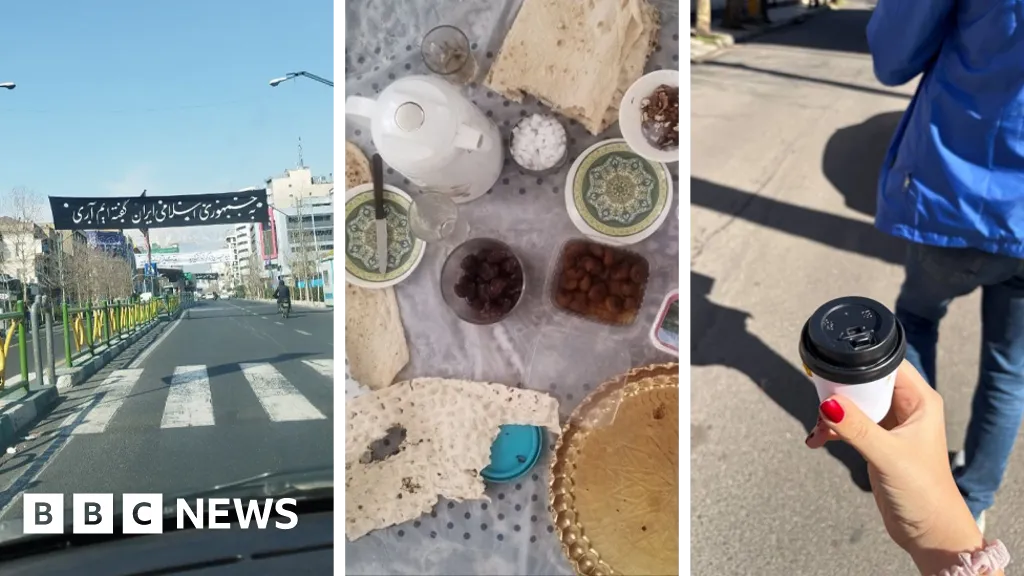
3 hours agoGhoncheh HabibiazadBBC PersianBBCParts of Tehran are covered in snow, days after black rain fell on the capitalSnow fell in parts of Tehran on Tuesday night, blanketing the Iranian capital with a layer of white after air strikes on oil depots caused days of dark skies and black rain.But life goes on, even as the war drags on.Sahar, a woman in her 20s, told BBC Persian that she was spending most days sheltering at home in Tehran, cooking, reading, and playing a life simulation video game."I think my creativity has increased during the war. I'm constantly stressed and end up building prettier homes in the game," she said.Sahar - whose name, as with the other contributors, has been changed for safety reasons - found out on Tuesday that a woman she had gone to school with had been killed."Her body hasn't been found. I felt horrible after hearing it," she said."Why do we have to experience such horror when we're in the prime years of our youth? I just want this to end before Nowruz. My favourite days in life are the early days of spring."Fewer than 10 days remain until Nowruz, the Persian New Year festival, which marks the arrival of spring.It is usually a time when families gather to celebrate. Markets and streets across Iran are crowded with people buying sweets and nuts for guests ahead of the holiday.But this year that has not been the case, according to those living in Tehran.Pictures of life in Tehran after more than a week of war"It doesn't feel like the run-up to Nowruz. But even under missiles, we carry on living. We have no choice but to live," said Peyman, a man in his 30s."The metro is empty. So empty that for every person there are 30 or 40 empty seats. The streets are very quiet as well... so quiet that you could easily play football in the middle of a street," he added.Another man in his 30s said: "My sleep schedule depends on the bombings now. I go to sleep at around six or seven in the morning and wake up at 2pm. Sometimes, I have to go out to buy groceries, but Tehran is very empty."Tehran and its surrounding province have a population of 14 million, but some residents have left to seek safety elsewhere since the US and Israel began attacking Iran on 28 February.Some headed north towards the Caspian Sea, where there have been fewer attacks.ReutersThick, black smoke filled the sky over Tehran after a strike on Shahran oil depot on SaturdayMina, a woman in her 20s, is one of them. She is now in the city of Rasht."My family kept insisting we go to Rasht to stay with my grandmother, but my best friend and flatmate didn't want to leave Tehran. I felt guilty about leaving without her, so I didn't want us to go," she recalled."The night they hit the [oil] depots, our flat was shaking all the way to the front door. All the windows lit up as if it were morning."She added: "I kept thinking that if anything happened to my family, it would be my fault for saying we shouldn't go to Rasht."The day after, we finally went to Rasht, in a car covered with patchy stains from the polluted rain."My best friend decided to stay in Tehran with her family, but I call her every day. We talk on the phone about all the exciting things we'll do after the war is over. Maybe we'll dye our hair lighter after this."Iran's Caspian Sea coast has been less affected by the war than TehranIt is still very difficult to contact those inside Iran amid the internet outage imposed by the government at the start of the war, but tech-savvy residents have been using Starlink devices and sharing their connection with others.The satellite internet system has become a vital communications lifeline for some trying to contact the outside world. It operates like a mobile phone mast in space, using a constellation of satellites to communicate with small dishes on the ground that have a built-in WiFi router.Using Starlink in Iran carries a punishment of up to two years in prison, and authorities have reportedly been searching for the dishes to stop people from connecting.Mehran, in his 20s and living in Tehran, said he had been sharing his Starlink connection with at least 25 other people. He added that he had hidden the device "somewhere remote" to prevent the authorities from "finding or jamming" it.He said he had allowed loved ones to connect to the service for free, though internet access is being sold on the Telegram messaging app for around $6 (£4.50) for1GB of data - a high price in a country where the average monthly salary is estimated to be between $200 and $300.Some residents have fled Tehran, which has been struck repeatedly by Israeli and US forcesShima, a woman in her 20s in Tehran who uses a Starlink connection to get online, said: "You have to buy it from someone you trust, otherwise there's a chance they will cut off your internet after you've paid a hefty sum."Monitoring organisation NetBlocks said on Wednesday that the internet blackout in Iran had entered its 12th day, with connectivity still at just 1% of ordinary levels after 264 hours."The ridiculously expensive Starlink VPN I bought for emergencies takes a long time to connect, making me doubt whether it was worth spending so much money," Shima said."But at least I can tell my loved ones abroad that I haven't burnt to a crisp and I'm still alive."
SRCBBC News - World
LANGEN
LEANCenter
WORDS934
ENT11
WED · 2026-03-11 · 16:00 GMTBRIEF NSR-2026-0311-23616
NSR-2026-0311-23616News Report·EN·Human Interest
'Even under missiles we carry on living' - how young Iranians are coping with war
Amidst ongoing attacks by the US and Israel since February 28th, residents of Tehran, Iran are coping with war. Despite strikes on oil depots causing black rain and darkened skies, life continues, though altered.
BBC News - WorldFiled 2026-03-11 · 16:00 GMTLean · CenterRead · 4 min
BBC News - WorldFIG 01
Reading time
4min
Word count
934words
Sources cited
4cited
Entities identified
11entities
Quality score
100%
§ 01
Briefing Summary
AI-generatedNEWSAR · AI
Amidst ongoing attacks by the US and Israel since February 28th, residents of Tehran, Iran are coping with war. Despite strikes on oil depots causing black rain and darkened skies, life continues, though altered. Many are staying home, seeking refuge and finding solace in simple activities. The upcoming Persian New Year, Nowruz, feels subdued, with empty streets and metro cars reflecting the somber mood. Some residents have fled Tehran to seek safety in less affected areas, such as the Caspian Sea region. While adapting to a new reality dictated by bombings, residents express a desire for peace and a return to normalcy.
Confidence 0.90Sources 4Claims 5Entities 11
§ 02
Article analysis
Model · rule-basedFraming
Human Interest
Conflict
Tone
Mixed Tone
AI-assessed
CalmNeutralAlarmist
Factuality
0.70 / 1.00
Factual
LowHigh
Sources cited
4
Well sourced
FewMany
§ 03
Key claims
5 extracted01
Mina's family went to Rasht to stay with her grandmother after strikes shook their flat.
quoteMina
Confidence
0.90
02
Some residents have left Tehran to seek safety elsewhere since the US and Israel began attacking Iran on 28 February.
factualBBC Persian
Confidence
0.90
03
Sahar is spending most days sheltering at home in Tehran, cooking, reading, and playing a life simulation video game.
quoteSahar
Confidence
0.90
04
Parts of Tehran are covered in snow after air strikes on oil depots caused days of dark skies and black rain.
factualBBC Persian
Confidence
0.90
05
The metro is empty. So empty that for every person there are 30 or 40 empty seats.
quotePeyman
Confidence
0.80
§ 04
Full report
4 min read · 934 words§ 05
Entities
11 identifiedKey playerOppositionContextPositiveNeutralNegative
Organizations2
Locations7
Events1
§ 06
Keywords & salience
9 termswar
1.00
tehran
0.90
iran
0.90
missiles
0.70
nowruz
0.60
bombings
0.60
air strikes
0.50
daily life
0.50
coping
0.50
§ 07
Topic connections
Interactive graph Network visualization showing 51 related topics
View Full Graph Person Organization Location Event|Click node to navigate|Edge numbers = shared articles