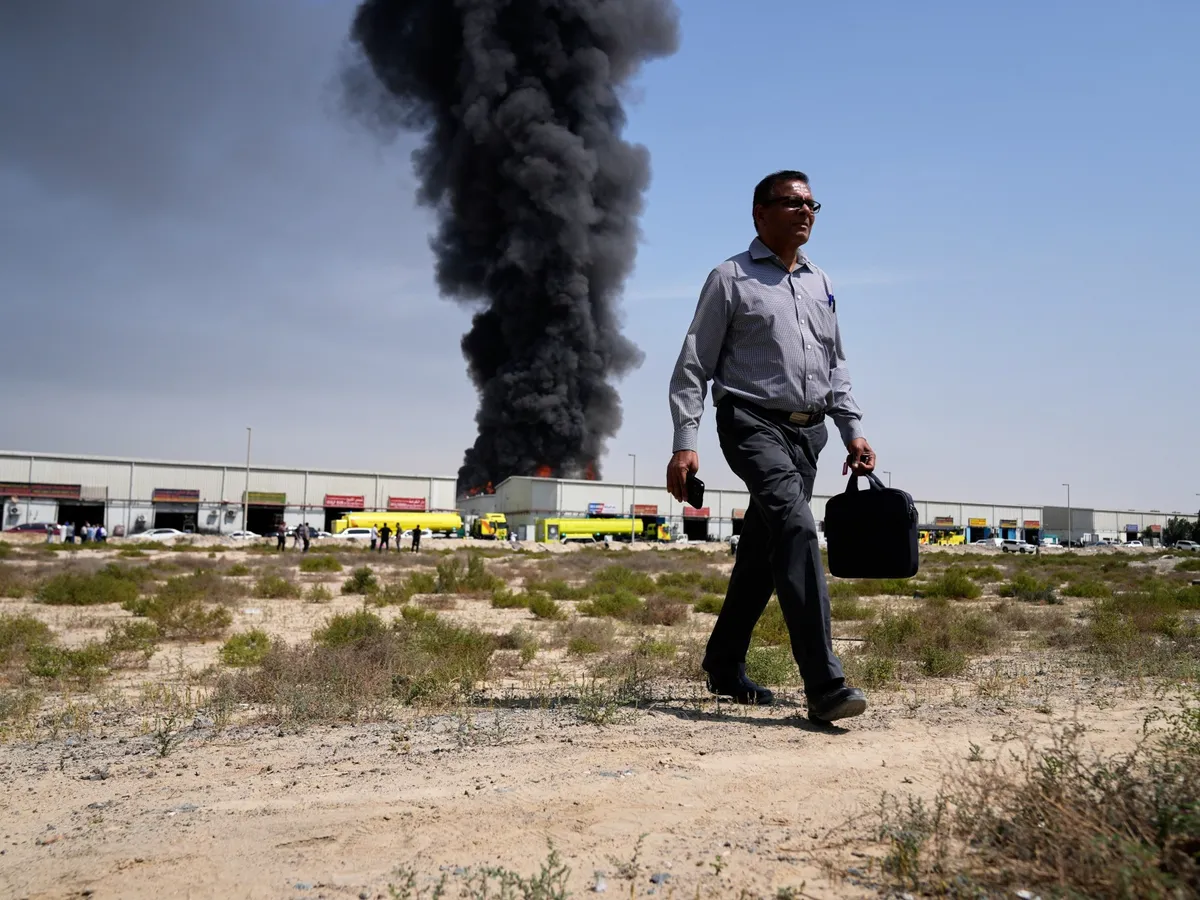
As the Strait of Hormuz chokes, energy infrastructure burns and interception costs soar into the billions, Gulf states are absorbing the staggering financial fallout of a conflict they tried to prevent.A man walks away after watching a black plume of smoke rising from a warehouse in the industrial area of Sharjah City, United Arab Emirates, on Sunday, March 1, 2026, following reports of Iranian strikes in Dubai [Altaf Qadri/AP]Published On 12 Mar 2026For decades, the Gulf Cooperation Council (GCC) states invested trillions of dollars to transform their oil-dependent economies into diversified global hubs.Today, those blueprints are under severe threat.Caught between a United States-Israeli prosecuted war against Iran and Tehran’s asymmetric retaliation, the Gulf is paying a heavy price for its geography.Salem Al-Jahouri, a journalist and researcher, told Al Jazeera Arabic the GCC finds itself “between the hammer and the anvil”.This geopolitical squeeze has generated profound political shockwaves.Qatar’s Prime Minister Sheikh Mohammed bin Abdulrahman bin Jassim Al Thani described the unprovoked Iranian strikes as a “betrayal,” noting that attacks on Gulf states began within an hour of the war starting, despite their active diplomatic efforts to prevent the conflict.Ultimately, these strikes leave Gulf capitals managing the economic fallout of a war they neither initiated nor endorsed, having pushed wholeheartedly for a diplomatic resolution that the US and Israel torpedoed on February 28.The cost of a closed chokepointThe most immediate shock is the virtual closure of the vital global artery, the Strait of Hormuz, which typically handles 20 million barrels per day (bpd) of oil, roughly 20 percent of the world’s seaborne oil trade. Export volumes have plummeted to less than 10 percent of pre-conflict levels.This blockade has triggered severe bottlenecks, with Iraq hit the hardest, possessing only a six-day storage capacity for crude oil.Al Jazeera correspondent Samer Alkubaisi reported from Basra that Iraq’s limited storage has reached maximum capacity, forcing a production cut from 3.3 million bpd down to 1.3 million. Iraqi oil ministry sources are now desperately seeking alternative outlets, including using Omani ports for strategic storage.To legally protect their unfulfilled global energy contracts, states like Qatar and Kuwait have declared “force majeure”, according to Abdullah Bandar Al-Otaibi, an assistant professor at Qatar University.To mitigate these disruptions, there is an urgent need for floating storage, says Mohammed Al-Sabban, former senior adviser to the Saudi petroleum minister. While Saudi Arabia can rely on its 1,200-kilometre (746-mile) East-West pipeline to bypass Hormuz, most other Gulf nations lack such alternatives, he noted. Saudi Aramco CEO Amin Nasser warned that continued disruption will have “catastrophic consequences” for global oil markets.Targeted infrastructure and daily lossesWhile Washington focuses on degrading Iranian military capabilities, Iran is fighting a war aimed at the global economy, which the US bestrides and Israel benefits hugely from, and Gulf infrastructure.The Qatari prime minister detailed that Iranian attacks on his country are distributed across energy facilities (40 percent), military sites (35 percent), and civilian infrastructure like drinking water reservoirs (25 percent). “What are the American interests in Qatar’s drinking water?” the prime minister asked. Al-Otaibi said this systematically undermines Tehran’s narrative that it differentiates between military and civilian targets.Saleh Al-Mutairi, head of the Madar Center for Political Studies, explained that expanding targets to Gulf economic facilities is a calculated pressure tactic aimed at forcing the US and Israel to hasten an end to the war.The aviation and tourism sectors are also bleeding capital. The GCC is a major global transit hub, typically handling up to 360 million passengers annually between Doha, Abu Dhabi and Dubai. Unprecedented airspace closures have resulted in the cancellation of approximately 40,000 flights, severing the Gulf’s connection to the global economy and stranding citizens abroad.The asymmetric cost of defenceAs missiles rain down, the financial burden of actively defending the Gulf’s airspace has revealed a staggering asymmetry.Iran’s estimated expenditure for its strikes ranges from $194m to $391m. This largely involves Shahed drones, which the Center for Strategic and International Studies (CSIS) estimates cost between $20,000 and $50,000 per unit.In stark contrast, Gulf states are deploying expensive interceptor systems like the Patriot PAC-3. According to the Missile Defense Advocacy Alliance, a single PAC-3 MSE interceptor costs between $3m and $5m.The resulting financial toll is monumental. Defence estimates suggest the UAE’s total expenditure on air defence has reached $1.31bn to $2.61bn, up to 13 times the amount Iran spent launching the attacks.Kuwait has spent an estimated $800m to $1.5bn defending the Ali al-Salem Air Base, while Qatar’s interception operations have cost between $600m and $900m.Bahrain and Jordan have also spent hundreds of millions neutralising incoming threats. Every interceptor fired represents resources that cannot be replaced overnight, raising fears that defence stockpiles could be rapidly depleted.The global ripple: A looming food crisisThe economic paralysis is also rapidly translating into a global agriculture crisis. The Gulf region exported $50bn worth of nitrogen fertilisers between 2020 and 2025, and about 30 percent of the global urea trade moves through the Strait of Hormuz.Following the shutdown of Qatari gas facilities, QatarEnergy’s fertiliser arm halted urea production. The resultant supply shock sent Egyptian urea prices soaring by 37 percent in mere days, according to Al Jazeera Arabic’s economic editor Hatem Ghandir.Economists warn this shortage will inflate production costs for staple crops, risking a severe wave of food inflation in developing nations already struggling with debt.Rebuilding and reassessing the futureAs the conflict grinds on, GCC governments face the unquantified burden of repairing damaged infrastructure. However, the war’s deepest impact may be strategic.The crisis has exposed the limits of the implicit historical trade-off between the US and the Gulf: Gulf capital and energy security in exchange for a United States defence umbrella.With US interceptor inventories drawing down and regional economies taking direct hits, analysts note a growing frustration in Gulf capitals over Washington’s unilateral escalation. As they manage the daily fallout of suspended flights and stalled export revenues, the GCC is likely to aggressively reassess its security partnerships in a region where their geography remains their greatest vulnerability.
SRCAl Jazeera
LANGEN
LEANCenter
WORDS990
ENT12
THU · 2026-03-12 · 13:59 GMTBRIEF NSR-2026-0312-23891
NSR-2026-0312-23891News Report·EN·Economic Impact
Caught in the crossfire: US-Israel war on Iran fractures Gulf economies
A US-Israeli war against Iran, beginning in late February 2026, is causing significant economic disruption in the Gulf states. The conflict has led to the near closure of the Strait of Hormuz, a critical oil transit route, drastically reducing oil exports and impacting countries like Iraq, which has been forced to cut production due to limited storage.
Mohammad MansourAl JazeeraFiled 2026-03-12 · 13:59 GMTLean · CenterRead · 4 min
Al JazeeraFIG 01
Reading time
4min
Word count
990words
Sources cited
7cited
Entities identified
12entities
Quality score
100%
§ 01
Briefing Summary
AI-generatedNEWSAR · AI
A US-Israeli war against Iran, beginning in late February 2026, is causing significant economic disruption in the Gulf states. The conflict has led to the near closure of the Strait of Hormuz, a critical oil transit route, drastically reducing oil exports and impacting countries like Iraq, which has been forced to cut production due to limited storage. Gulf states, despite actively pursuing diplomatic solutions to prevent the war, are now facing the financial consequences of the conflict, including the cost of intercepting attacks and managing disrupted energy contracts. Qatar has described Iranian strikes as a "betrayal," highlighting the political fallout alongside the economic strain. Gulf Cooperation Council (GCC) states are struggling to protect their diversified economies amidst the geopolitical instability.
Confidence 0.90Sources 7Claims 5Entities 12
§ 02
Article analysis
Model · rule-basedFraming
Economic Impact
Conflict
Tone
Mixed Tone
AI-assessed
CalmNeutralAlarmist
Factuality
0.70 / 1.00
Factual
LowHigh
Sources cited
7
Well sourced
FewMany
§ 03
Key claims
5 extracted01
Saudi Aramco CEO Amin Nasser warned that continued disruption will have “catastrophic consequences” for global oil markets.
quoteSaudi Aramco CEO Amin Nasser
Confidence
1.00
02
Qatar’s Prime Minister Sheikh Mohammed bin Abdulrahman bin Jassim Al Thani described the unprovoked Iranian strikes as a “betrayal”.
quoteQatar’s Prime Minister Sheikh Mohammed bin Abdulrahman bin Jassim Al Thani
Confidence
1.00
03
Iraq's limited storage has reached maximum capacity, forcing a production cut from 3.3 million bpd down to 1.3 million.
factualAl Jazeera correspondent Samer Alkubaisi
Confidence
0.90
04
Export volumes have plummeted to less than 10 percent of pre-conflict levels due to the Strait of Hormuz closure.
statistic
Confidence
0.90
05
Gulf states are absorbing the staggering financial fallout of a conflict they tried to prevent.
factual
Confidence
0.80
§ 04
Full report
4 min read · 990 words§ 05
Entities
12 identifiedKey playerOppositionContextPositiveNeutralNegative
People3
Organizations1
§ 06
Keywords & salience
9 termsgulf economies
0.90
us-israel war on iran
0.80
strait of hormuz
0.70
economic fallout
0.70
energy infrastructure
0.60
oil trade
0.60
gcc
0.50
production cut
0.50
force majeure
0.40
§ 07
Topic connections
Interactive graph Network visualization showing 51 related topics
View Full Graph Person Organization Location Event|Click node to navigate|Edge numbers = shared articles