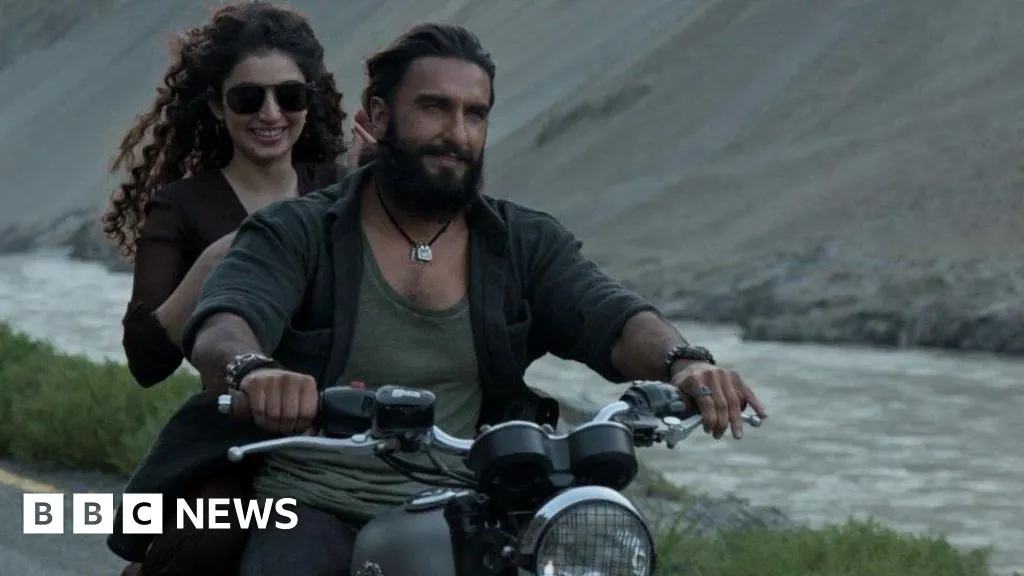
12 hours agoZoya Mateen & Azadeh MoshiriDelhiJio StudiosDhurandhar stars Ranveer Singh as an Indian spy on a dangerous mission in PakistanA new Bollywood spy film is generating praise - and unease - in India and Pakistan for its contentious portrayal of the longstanding hostilities between the South Asian neighbours.Dhurandhar, which hit cinemas last week, plunges audiences into a high-octane world of espionage, gang wars and patriotic fervour.Anchored by Bollywood star Ranveer Singh's swaggering performance as Hamza, an Indian spy on a perilous mission in Karachi in Pakistan, the film traces his battles against criminal networks, shadowy operatives and personal demons - all framed against the backdrop of India-Pakistan tensions.While the action-packed sequences and riveting plot have earned praise from many viewers, the film, directed by Aditya Dhar, has also provoked sharp debate over its political messaging and treatment of historical events.Dhar first gained national attention in 2019 with his debut Uri: The Surgical Strike, a dramatisation of India's 2016 airstrikes on Pakistan. The film was a major box-office hit and earned him a national film award.Though Dhurandhar is only his second directorial effort, he has co-written and produced other films, including last year's Article 370- about the 2019 revocation of Kashmir's autonomy - which was a major success and earned praise from Prime Minister Narendra Modi.Dhurandhar, arriving months after the worst India-Pakistan military clash in two decades, sees Dhar return to the political-thriller genre on a grander scale.Deadly fights erupt in cramped rooms, gunfire rattles through crowded alleys, leaving behind trails of bodies, and torture scenes linger uncomfortably long. The violence is graphic and filmed in tight, suffocating frames that heighten the sense of discomfort.Online, praise and criticism have flown in equal measure - some are impressed by the film's cinematic ambition and exhilarating plot, others find its hyper-nationalist tone and use of violence unsettling and inflammatory.Jio StudiosMost of Dhurandhar is set in Karachi and claims to tell the story of the gang wars rampant thereThe debate has grown so heated that some reviewers faced backlash, with Dhurandhar supporters accusing them of judging the film through political bias rather than cinematic merit.The Film Critics' Guild, an association of critics, issued a statement this week condemning "the targeted attacks, harassment, and hate directed toward film critics for their reviews of Dhurandhar".But despite the polarised reactions, the film has been drawing large audiences and has already become one of the year's biggest hits.The trend is not surprising. In recent years, Indian cinema has seen a surge in nationalist blockbusters that openly reference government policies and historical events.Films such as The Kashmir Files and The Kerala Story have become major commercial hits despite sparking intense debates over their historical accuracy and political messaging.Spy thrillers have also long featured prominently, often portraying Pakistan as the biggest threat to India - a familiar trope rooted in decades of geopolitical tension between the two countries.The makers of these films argue that they resonate with audiences because they address historical events and contemporary issues often overlooked by mainstream commercial cinema - sensitive, polarising subjects that touch on communal identity, national memory and contemporary politics."My films are not political, they are of human interest," Sudipto Sen, director of The Kerala Story, told the BBC last year. The 2023 film claimed to tell the "true story" of Hindu and Christian women lured into converting to Islam and joining the Islamic State (IS) group.But critics say such films, with their outright fabrications of key events, are increasingly blurring the line between entertainment and propaganda, flattening complex histories into oversimplified storylines.AFP via Getty ImagesCritics accused The Kerala Story of stoking communal hatred Dhurandhar, which presents itself as an espionage thriller with an unflinching nationalistic tone, falls squarely within this expanding genre, says film critic Uday Bhatia.Even before it was released, the film faced legal scrutiny after the family of a late army officer alleged that parts of the plot were based on his life without seeking permission. Dhar denied this and the film was eventually cleared by India's Central Board of Film Certification as a work of fiction.Yet, the film openly weaves several real-life events and historical flashpoints into the story, including news footage and real audio recordings of the attack on the Indian parliament in 2001 and the 26/11 Mumbai terror attack.In fact, the story starts with a reference to the 1999 hijacking of an Indian passenger plane.We see India's intelligence chief Ajay Sanyal, played by R Madhavan, reacting to the hijacking by vowing to strike Pakistan on its own soil.So, he sends his best man, Hamza, to destroy the alleged links between Karachi's gangsters and terror networks, which, in the film's telling, operate with tacit support from the Pakistan government.Dhar's portrayal of Karachi is bleak: a sprawling, lawless city where kidnappings and torture are rampant and revenge killings between rival gangs unfold with unrelenting brutality.Jio StudiosDhurandhar director Aditya Dhar (left) with R Madhavan, who plays a significant role in the filmSome critics have criticised the blending of real gang histories with cinematic exaggeration. "The film paints Pakistan as a lawless, almost barbaric land that's pathologically hostile towards India. It also frames the cross-border conflict in religious terms," Mr Bhatia says.But others feel the depictions were startlingly on point. "Where Dhar takes the biggest swing is in his portrayal of Pakistan. It is not caricatured, but surprisingly nuanced, especially politically," writes Vineeta Kumar on India Today's website.It's not just in India - there have been mixed reactions to Dhurandhar in Pakistan too.For decades, cultural exchanges have been limited, with cinema often the biggest casualty. Pakistan banned Indian films in 2019, while India frequently blocks Pakistani films and music.Yet Bollywood remains hugely popular in Pakistan and audiences often use VPNs or download films illegally.In Dhurandhar's case, editorials - including in Dawn newspaper - criticised its negative portrayal of Pakistan and lamented that local filmmakers often neglect their own history, leaving Bollywood to interpret the story.Jio StudiosA poster with former Pakistan PM Benazir Bhutto's photo in DhurandharCritics also flagged factual inaccuracies, such as the depiction of Karachi's Lyari gang - normally involved in extortion, kidnappings, and drug-trafficking - being cast into cross-border tensions with India.Content creator Bilal Hussain, who grew up in Karachi, said he was surprised the gang was portrayed at all, though he added that the film's action, performances, and music could still be appreciated despite its "propaganda".The sharpest criticism came from the Pakistan Peoples Party (PPP), which rules the Sindh province, to a scene featuring a fictional PPP rally, complete with party flags and images of former prime minister Benazir Bhutto, who was assassinated in 2007.A party leader called the film a "malicious distortion" that sought to portray the PPP as sympathetic to militants.Despite its inaccuracies, commentators say the film, like many before it, is unlikely to dent Bollywood's popularity in Pakistan, which lacks a comparable local film industry.The sentiment is somewhat echoed in India as well, where many viewers reject the political debates around the film, saying they watched it purely for entertainment."At the end of the day it is a fiction film and can make up whatever it likes," Mr Bhatia says."But it obviously has a slanted, selective worldview, which it expertly furthers."
SRCBBC News - World
LANGEN
LEANCenter
WORDS1 196
ENT6
FRI · 2025-12-12 · 23:27 GMTBRIEF NSR-2025-1213-2410
NSR-2025-1213-2410News Report·EN·Political Strategy
A new Bollywood film is dividing opinions in India and Pakistan
Aditya Dhar's Bollywood film, Dhurandhar, starring Ranveer Singh as an Indian spy in Pakistan, was released last week and is generating both praise and controversy in India and Pakistan. The film, set against the backdrop of India-Pakistan tensions, depicts espionage, gang wars, and patriotic fervor in Karachi.
BBC News - WorldFiled 2025-12-12 · 23:27 GMTLean · CenterRead · 5 min
BBC News - WorldFIG 01
Reading time
5min
Word count
1 196words
Sources cited
1cited
Entities identified
6entities
Quality score
100%
§ 01
Briefing Summary
AI-generatedNEWSAR · AI
Aditya Dhar's Bollywood film, Dhurandhar, starring Ranveer Singh as an Indian spy in Pakistan, was released last week and is generating both praise and controversy in India and Pakistan. The film, set against the backdrop of India-Pakistan tensions, depicts espionage, gang wars, and patriotic fervor in Karachi. While some viewers commend the action and plot, others criticize its hyper-nationalist tone and graphic violence. The film is Dhar's second directorial effort after "Uri: The Surgical Strike," and arrives after recent military clashes between India and Pakistan. The debate surrounding Dhurandhar has become heated, with some reviewers facing backlash and accusations of political bias. The Film Critics' Guild has condemned the harassment and hate directed at critics.
Confidence 0.90Sources 1Claims 5Entities 6
§ 02
Article analysis
Model · rule-basedFraming
Political Strategy
Conflict
Tone
Mixed Tone
AI-assessed
CalmNeutralAlarmist
Factuality
0.70 / 1.00
Factual
LowHigh
Sources cited
1
Limited
FewMany
§ 03
Key claims
5 extracted01
The Film Critics' Guild condemned "the targeted attacks, harassment, and hate directed toward film critics for their reviews of Dhurandhar".
quoteThe Film Critics' Guild
Confidence
1.00
02
Dhar first gained national attention in 2019 with his debut Uri: The Surgical Strike.
factual
Confidence
1.00
03
Dhurandhar stars Ranveer Singh as an Indian spy on a dangerous mission in Pakistan.
factual
Confidence
1.00
04
Dhurandhar has provoked sharp debate over its political messaging and treatment of historical events.
factual
Confidence
0.90
05
Dhurandhar has already become one of the year's biggest hits.
factual
Confidence
0.80
§ 04
Full report
5 min read · 1 196 words§ 05
Entities
6 identifiedKey playerOppositionContextPositiveNeutralNegative
People3
§ 06
Keywords & salience
9 termsdhurandhar
1.00
india-pakistan tensions
0.90
bollywood film
0.90
spy film
0.80
ranveer singh
0.70
political thriller
0.70
aditya dhar
0.60
nationalism
0.60
gang wars
0.50
§ 07
Topic connections
Interactive graph Network visualization showing 51 related topics
View Full Graph Person Organization Location Event|Click node to navigate|Edge numbers = shared articles