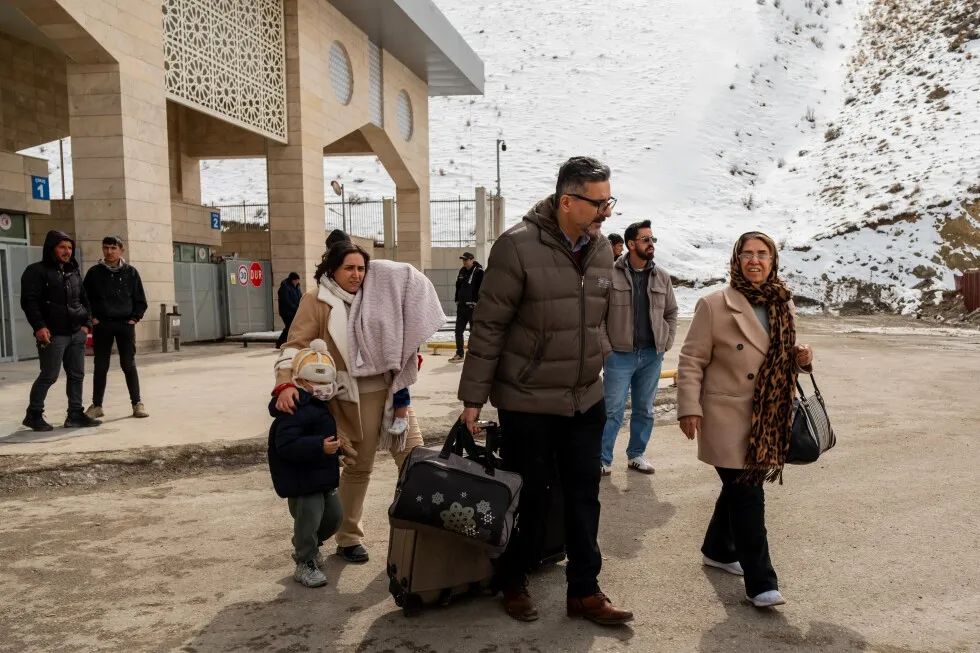
Iranians grapple with whether to flee the country because of the war 1 of 4 | People, mostly Iranians who crossed from Iran at the Kapikoy border crossing, pull luggage in Turkey’s eastern Van-province" class="entity-link entity-location" data-entity-id="41077" data-entity-type="location">Van province, Friday, March 6, 2026. (AP Photo/Murat Kocabas) 2 of 4 | People, mostly Iranians who crossed from Iran at the Kapikoy border crossing, pull luggage in Turkey’s eastern Van-province" class="entity-link entity-location" data-entity-id="41077" data-entity-type="location">Van province, Friday, March 6, 2026. (AP Photo/Murat Kocabas) 3 of 4 | People, mostly Iranians who crossed from Iran through the Kapikoy border crossing, stand with luggage in Turkey’s eastern Van-province" class="entity-link entity-location" data-entity-id="41077" data-entity-type="location">Van province, Friday, March 6, 2026. (AP Photo/Murat Kocabas) 4 of 4 | A man welcomes a woman who crossed from Iran to Turkey at the Kapikoy Border Gate in eastern Van-province" class="entity-link entity-location" data-entity-id="41077" data-entity-type="location">Van province, Turkey, Thursday, March 5, 2026. (AP Photo/Serra Yedikardes) 1 of 4 People, mostly Iranians who crossed from Iran at the Kapikoy border crossing, pull luggage in Turkey’s eastern Van-province" class="entity-link entity-location" data-entity-id="41077" data-entity-type="location">Van province, Friday, March 6, 2026. (AP Photo/Murat Kocabas) Add AP News on Google Add AP News as your preferred source to see more of our stories on Google. 2 of 4 People, mostly Iranians who crossed from Iran at the Kapikoy border crossing, pull luggage in Turkey’s eastern Van-province" class="entity-link entity-location" data-entity-id="41077" data-entity-type="location">Van province, Friday, March 6, 2026. (AP Photo/Murat Kocabas) Add AP News on Google Add AP News as your preferred source to see more of our stories on Google. 3 of 4 People, mostly Iranians who crossed from Iran through the Kapikoy border crossing, stand with luggage in Turkey’s eastern Van-province" class="entity-link entity-location" data-entity-id="41077" data-entity-type="location">Van province, Friday, March 6, 2026. (AP Photo/Murat Kocabas) Add AP News on Google Add AP News as your preferred source to see more of our stories on Google. 4 of 4 A man welcomes a woman who crossed from Iran to Turkey at the Kapikoy Border Gate in eastern Van-province" class="entity-link entity-location" data-entity-id="41077" data-entity-type="location">Van province, Turkey, Thursday, March 5, 2026. (AP Photo/Serra Yedikardes) Add AP News on Google Add AP News as your preferred source to see more of our stories on Google. Updated [hour]:[minute] [AMPM] [timezone], [monthFull] [day], [year] Kapikoy border crossing, Turkey (AP) — After bombs exploded near her home in the eastern Iranian city of Golestan, hairdresser Merve Pourkaz decided to leave.Pourkaz, 32, said she traveled nearly 1,500 kilometers (932 miles) to an alpine border crossing in the hopes of reaching the safety of the nearby Turkish city of Van.“If they let me, I will stay in Van until the war ends,” she told The Associated Press recently while waiting at the crossing. “If the war doesn’t end, maybe I’ll go back and die.”Pourkaz is one of the 3.2 million people in Iran who the U.N. refugee agency estimates have been displaced since the U.S.-Israel war with Iran started. While some are seeking shelter in safer parts of Iran or one of its neighboring countries, others are returning from abroad, heading toward the fighting to protect their families and homes. So far, relatively few people have chosen to leave: The U.N. estimates that only about 1,300 Iranians have fled via Turkey each day since the war started, and on some days, more people return to Iran than depart. But Iran’s neighbors and Europe are growing increasingly concerned about a possible migration crisis should the war drag on and are making contingency plans. As Pourkaz was entering Turkey, Leila Rabetnezhadfard was headed the other way.Rabetnezhadfard, 45, was in Istanbul preparing to marry a German university professor when the fighting started. She postponed the ceremony and left for home in Shiraz, in southern Iran. “How can I feel safe in Istanbul when my family is living in Iran during the war?” said Rabetnezhadfard, explaining that bringing her family to Istanbul wasn’t an option because her apartment is small, her brother needs medical care, and life there is expensive.“I will not leave Iran until the war ends,” she said. Fleeing the fightingThe U.N. has warned that continued fighting will likely push more Iranians to flee their homes.As in the 12-day conflict last year, many Iranians are now sheltering in place, without money to flee or perhaps because of U.S. President Donald Trump’s Feb. 28 warning.“Stay sheltered. Don’t leave your home. It’s very dangerous outside. Bombs will be dropping everywhere,” he said.Although large numbers of Iranians haven’t fled the country yet, people have been leaving major cities for the relative safety of the countryside bordering the Caspian Sea north of the capital, Tehran, according to the International Organization for Migration.“Movement out of Iran appears limited mainly because people are prioritizing staying with their families, as well as the safety of their families and property, and due to security conditions and logistical constraints,” said Salvador Gutierrez, chief of the IOM’s mission in Iran.If Iran’s critical infrastructure is destroyed, that could lead to waves of people trying to cross into one of Iran’s neighbors: Pakistan, Afghanistan, Turkmenistan, Azerbaijan, Armenia, Turkey and Iraq.“If Tehran, a city of 10 million people, doesn’t have water, they’re going to go somewhere,” said Alex Vatanka, a fellow at the Middle East Institute in Washington.Iran is already grappling with one of the world’s largest refugee populations: roughly 2.5 million forcibly displaced people mostly from Afghanistan and Iraq. Neighbors brace for impactIf the crisis deepens, aid groups say the most likely destinations for refugees are Iran’s borders with Iraq and Turkey, which stretch roughly 2,200 kilometers (1,367 miles) through rough alpine terrain that is home to many Kurdish communities and are difficult to police.Turkey had a so-called open-door policy that allowed millions of Syrian refugees to enter the country during their country’s long civil war. But it has abandoned that approach for various reasons.Instead, it has prepared plans to shelter Iranian refugees in “buffer zones” along the border, or in tent cities or temporary housing inside Turkey, the country’s Hurriyet newspaper quoted Turkish Interior Minister Mustafa Ciftci as saying.Iranians who have fled the war will likely not seek refugee status in Turkey because asylum claims might take years to process, if at all, said Sara Karakoyun, an aid worker at the independent Human Resource Development Foundation based near the border. “They don’t want to wait in limbo for years for a refugee status they might not get,” she said.Turkey’s defense ministry said in January that Turkey had hardened its border with Iran by adding 380 kilometers of concrete walls, 203 optical towers and 43 observation posts.Turkey will likely send troops to secure its border and tightly control the flow of people into the country while seeking European Union funds to help deal with refugees, said Riccardo Gasco, an analyst at the IstanPol Institute. Europe taps network to prepare for the worstThe relationship between the EU and Turkey was redefined by the Syrian refugee crisis a decade ago. Nearly two-thirds of the 4.5 million Syrians fleeing the civil war ended up in Turkey. Many then made their way to Europe via small boats.In 2016, Brussels and Ankara forged a migration deal where the EU offered Turkey incentives and up to 6 billion euros ($7.1 billion) in aid for Syrian refugees on its territory to persuade Ankara to stop tens of thousands of migrants from setting out for Greece.Aid groups said that deal created open-air prisons with squalid conditions. But for the EU leadership, the deal saved people, kept many migrants from reaching EU territory, and bettered the lives of refugees in Turkey.Renewal of that deal is up this year, but Turkish citizens have soured on Syrian refugees and anti-immigrant right-wing parties have surged in popularity in parts of Europe.And another refugee crisis is already underway even closer to Europe, with fighting in Lebanon between Israel and Hezbollah displacing more than 800,000 people so far.“We’ve got a situation (in the Middle East) that could have grave humanitarian consequences right at a time where humanitarian funding has been completely slashed,” said Ninette Kelley, chair of the World Refugee & Migration Council, pointing to the Trump administration’s gutting of USAID. “Is the world ready for another humanitarian disaster?”___McNeil reported from Brussels. Associated Press writers Suzan Fraser in Ankara, Turkey, Fay Abuelgasim in Cairo, and Qassim Abdul-Zahra in Baghdad contributed to this report. McNeil covers Europe and beyond with a focus on conflict and the environment.
SRCAssociated Press (AP)
LANGEN
LEANCenter
WORDS1 362
ENT12
SAT · 2026-03-14 · 14:23 GMTBRIEF NSR-2026-0314-24462
NSR-2026-0314-24462News Report·EN·Human Interest
Iranians grapple with whether to flee the country because of the war
Following bombings near her home in Golestan, Iran, Merve Pourkaz, a 32-year-old hairdresser, traveled to the Kapikoy border crossing in Turkey in early March 2026. She hopes to find safety in the Turkish city of Van.
By
SAM McNEIL and SERRA YEDIKARDESAssociated Press (AP)Filed 2026-03-14 · 14:23 GMTLean · CenterRead · 6 min
Associated Press (AP)FIG 01
Reading time
6min
Word count
1 362words
Sources cited
2cited
Entities identified
12entities
Quality score
100%
§ 01
Briefing Summary
AI-generatedNEWSAR · AI
Following bombings near her home in Golestan, Iran, Merve Pourkaz, a 32-year-old hairdresser, traveled to the Kapikoy border crossing in Turkey in early March 2026. She hopes to find safety in the Turkish city of Van. Pourkaz journeyed nearly 1,500 kilometers seeking refuge from the war. She expressed uncertainty about her future, stating she would stay in Van until the war ends, but might return to Iran if it doesn't. The Associated Press reported on Pourkaz's situation as she waited at the border crossing.
Confidence 0.90Sources 2Claims 5Entities 12
§ 02
Article analysis
Model · rule-basedFraming
Human Interest
Conflict
Tone
Mixed Tone
AI-assessed
CalmNeutralAlarmist
Factuality
0.80 / 1.00
Factual
LowHigh
Sources cited
2
Limited
FewMany
§ 03
Key claims
5 extracted01
If they let me, I will stay in Van until the war ends.
quoteMerve Pourkaz
Confidence
1.00
02
The U.N. estimates about 1,300 Iranians have fled via Turkey each day since the war started.
statisticU.N.
Confidence
0.90
03
The U.N. estimates 3.2 million people in Iran have been displaced since the war started.
statisticU.N. refugee agency
Confidence
0.90
04
Merve Pourkaz traveled nearly 1,500 kilometers to the Turkish border.
factualArticle
Confidence
0.90
05
Bombs exploded near Merve Pourkaz's home in Golestan, Iran.
factualArticle
Confidence
0.90
§ 04
Full report
6 min read · 1 362 words§ 05
Entities
12 identifiedKey playerOppositionContextPositiveNeutralNegative
People3
Organizations1
Locations7
Events1
§ 06
Keywords & salience
8 termswar
0.90
iranians
0.80
fleeing
0.70
iran
0.60
border crossing
0.60
turkey
0.60
refugees
0.50
safety
0.40
§ 07
Topic connections
Interactive graph Network visualization showing 51 related topics
View Full Graph Person Organization Location Event|Click node to navigate|Edge numbers = shared articles