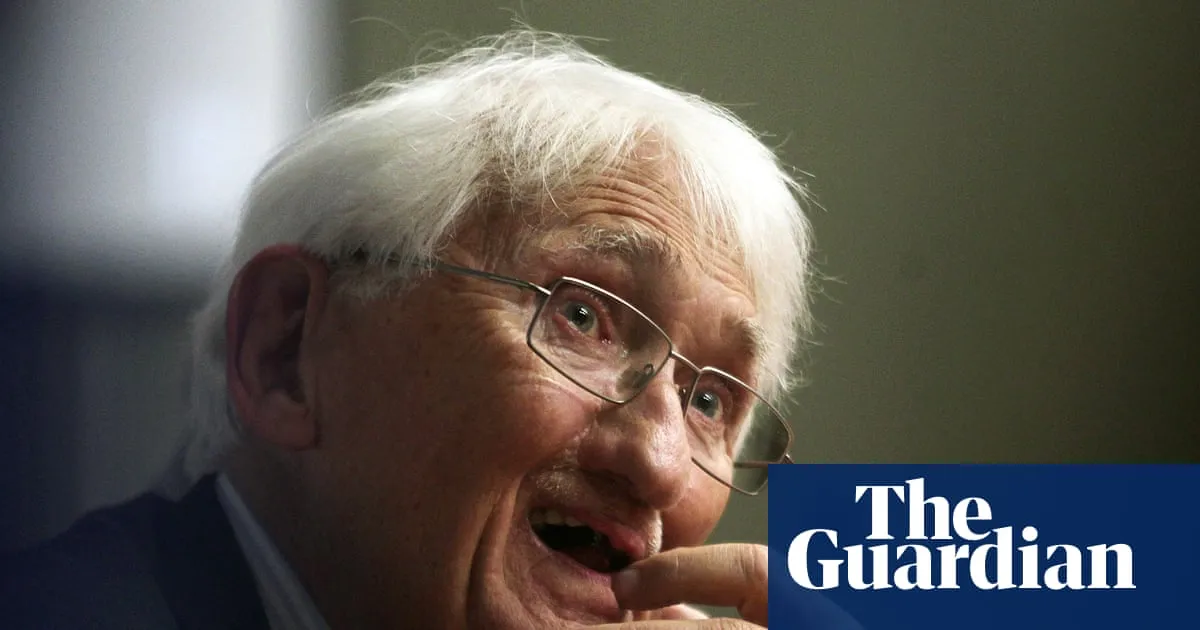
The influential German philosopher and sociologist Jürgen Habermas has died at the age of 96, his publisher has said.Habermas, a towering figure in the intellectual history of postwar Germany, is best known for his theory of political consensus-building. Widely considered one of most influential philosophers of the 20th century, he also helped to shape the discourse around European integration and the formation of the EU.In spite of his background in the neo-Marxist Frankfurt school and his reputation as a court philosopher of the Social Democratic party, his influence cut across party lines. German chancellor, Friedrich Merz, of the conservative Christian Democratic Union, described him as “one of the most significant thinkers of our time”.“His analytical acuity shaped democratic discourse far beyond our country’s borders and served as a beacon in a stormy sea,” Merz said in a statement. “His voice will be missed”.Friedrich Merz called Habermas ‘one of the most significant thinkers of our time’. Photograph: Dpa Picture Alliance Archive/AlamyHabermas’ career, which spanned seven decades, focused on the foundations of social theory, democracy and the rule of law.His belief that the formation of public opinion was vital for democracies to survive explains why Habermas continued to write books and newspaper articles deep into old age. In a 2015 interview with the Guardian, he criticised the then chancellor Angela Merkel for “gambling away” Germany’s postwar reputation with her government’s hardline stance during the Greek debt crisis.More recently, such interventions invited criticism from younger intellectuals. In 2022, he criticised Germany’s then Green party foreign minister, Annalena Baerbock, for her “aggressively self-confident” and “shrill” condemnations of Russia’s war of aggression in Ukraine. His pronouncement that Israel’s war on Gaza following the 7 October Hamas attacks was “justified in principle” was met with disbelief by many philosophers following in the footsteps of the Frankfurt school’s “critical theory”, who published a condemnatory letter.His most recent work, Things Needed to Get Better, was published in December last year. In it, he refuses to “let defeatism have the last word”, arguing it is possible to “confront the crises of the present aggressively and finally overcome them after all”.His publisher, Suhrkamp Verlag, said he died on Saturday in Starnberg, near Munich. He is survived by two of his three children.Born on 18 June 1929 to a bourgeois family in Dusseldorf, Habermas underwent two surgeries after birth and in early childhood for a cleft palate, which resulted in a speech impediment.Jürgen Habermas in 2013. Photograph: Louisa Gouliamaki/AFP/Getty ImagesThis impediment is often cited as having influenced his work on communication. Habermas said he had experienced the importance of spoken language as “a layer of commonality without which we as individuals cannot exist” and recalled struggling to make himself understood.He was raised in a staunchly Protestant household. His father, an economist who headed the local chamber of commerce, joined the Nazi party in 1933 but was no more than a “passive sympathiser“, Habermas said. He himself joined the Hitler Youth at the age of 10, like most German boys at the time. At 15, as the second world war was drawing to a close, he managed to avoid being drafted into the military by hiding from military police.Later, he said he wouldn’t have found his way into philosophy and social theory if he hadn’t experienced confronting the reality of Nazi crimes as a young man. He recalled that “you saw suddenly that it was a politically criminal system in which you had lived”.Educated at the University of Bonn, where he met his wife, Ute, he first rose to prominence as a journalist and an academic in the 1950s. He belonged to the second generation of the Frankfurt school of intellectuals, following in the footsteps of Marxist thinkers like Theodor Adorno and Max Horkheimer.In the 1980s, Habermas was a prominent figure in the historikerstreit, or historians’ dispute, an intellectual debate where conservative historians, most prominently Ernst Nolte, argued that the atrocities of Nazi Germany were not unique and similar crimes had been committed by other governments.Habermas and other opponents of this perspective contended that the conservative historians were trying to lessen the magnitude of Nazi crimes through such comparisons.Defending the uniqueness of Third Reich atrocities, Habermas believed that Vergangenheitsbewältigung, or coming to terms with the past, had to be central to Germany’s identity.His wife, Ute Habermas-Wesselhoeft, died last year. The couple had three children: Tilmann, Judith and Rebekka, who died in 2023.
SRCThe Guardian - World News
LANGEN
LEANCenter-Left
WORDS730
ENT12
SAT · 2026-03-14 · 16:57 GMTBRIEF NSR-2026-0314-24524
NSR-2026-0314-24524News Report·EN·Human Interest
Jürgen Habermas, German philosopher and sociologist, dies aged 96
Jürgen Habermas, the influential German philosopher and sociologist, died on Saturday in Starnberg, near Munich, at the age of 96. Habermas was a prominent figure in postwar German intellectual history, known for his theories on political consensus-building and his contributions to the discourse surrounding European integration.
Donna Ferguson and Philip OltermannThe Guardian - World NewsFiled 2026-03-14 · 16:57 GMTLean · Center-LeftRead · 3 min
The Guardian - World NewsFIG 01
Reading time
3min
Word count
730words
Sources cited
3cited
Entities identified
12entities
Quality score
100%
§ 01
Briefing Summary
AI-generatedNEWSAR · AI
Jürgen Habermas, the influential German philosopher and sociologist, died on Saturday in Starnberg, near Munich, at the age of 96. Habermas was a prominent figure in postwar German intellectual history, known for his theories on political consensus-building and his contributions to the discourse surrounding European integration. His work, spanning seven decades, focused on social theory, democracy, and the rule of law, emphasizing the importance of public opinion in democracies. Despite his neo-Marxist background, his influence extended across party lines, with figures like German Chancellor Friedrich Merz acknowledging his significance. Habermas continued to engage in public discourse through writings and commentary, even in his later years, addressing contemporary issues such as the Greek debt crisis and the war in Ukraine. His most recent work, "Things Needed to Get Better," was published in December 2023.
Confidence 0.90Sources 3Claims 5Entities 12
§ 02
Article analysis
Model · rule-basedFraming
Human Interest
Political Strategy
Tone
Measured
AI-assessed
CalmNeutralAlarmist
Factuality
0.80 / 1.00
Factual
LowHigh
Sources cited
3
Well sourced
FewMany
§ 03
Key claims
5 extracted01
Habermas criticised Annalena Baerbock for her “aggressively self-confident” condemnations of Russia’s war in Ukraine.
quoteHabermas
Confidence
1.00
02
Habermas' most recent work, Things Needed to Get Better, was published in December last year.
factualnull
Confidence
1.00
03
Habermas criticised Angela Merkel for “gambling away” Germany’s postwar reputation during the Greek debt crisis.
quoteHabermas
Confidence
1.00
04
Friedrich Merz described Habermas as “one of the most significant thinkers of our time”.
quoteFriedrich Merz
Confidence
1.00
05
Jürgen Habermas, German philosopher and sociologist, has died at the age of 96.
factualhis publisher
Confidence
1.00
§ 04
Full report
3 min read · 730 words§ 05
Entities
12 identifiedKey playerOppositionContextPositiveNeutralNegative
People4
Organizations3
§ 06
Keywords & salience
10 termsphilosopher
0.90
sociologist
0.80
political consensus-building
0.70
democracy
0.70
frankfurt school
0.60
social theory
0.60
rule of law
0.60
european integration
0.50
public opinion
0.50
critical theory
0.50
§ 07
Topic connections
Interactive graph No topic relationship data available yet. This graph will appear once topic relationships have been computed.