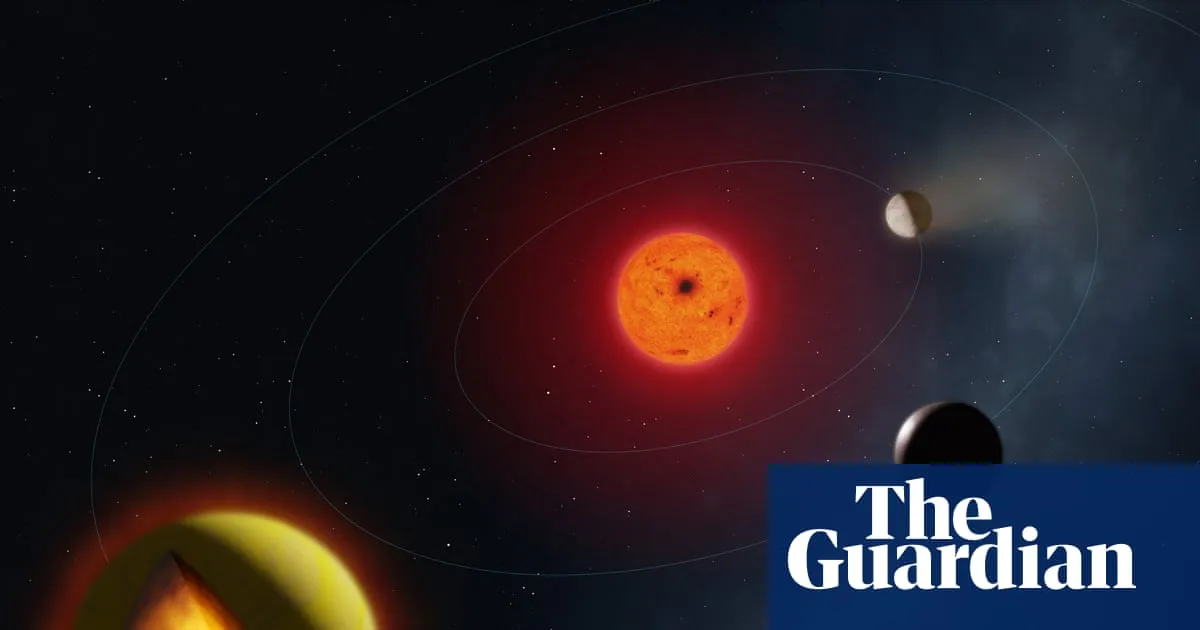
Astronomers have identified a planet composed of molten lava, suggesting the existence of an entirely new category of liquid planet.The distant world, known as L98-59d, is about 1.6 times the size of Earth and orbits a small red star 35 light years away. Astronomers initially thought the planet might harbour a deep ocean of liquid water, but the latest analysis suggests that it could be fundamentally different to anything seen before.“The whole thing really is in a mushy, molten state,” said Dr Harrison Nicholls, an astrophysicist at the University of Oxford. “It’s like molasses. It’s likely that this planet’s core would also be molten.”Surface temperatures would reach a blazing 1,900C (3,500F), large waves are likely to roll over the magma ocean caused by the tidal forces of neighbouring planets, and there would be a pervasive stench of rotten egg thanks to an atmosphere rich in hydrogen sulphide. The overall conditions are not viewed as favourable for hosting life.“If there are aliens out there that could live in lava that would be amazing, but I don’t think it’s likely that it’s habitable,” said Nicholls. “It’s nice to revel in the alienness of the planet itself.”Planets beyond our solar system are too distant to photograph or reach with robotic spacecraft, and until recently astronomers could only make crude estimates of the size, density and temperature of these distant worlds by tracking their silhouettes as they passed in front of their host star. The James Webb Space Telescope, however, is powerful enough to measure starlight filtered through the planet’s atmosphere to give a read-out of which gases are present.Previously, such observations revealed that L98-59d has a sulphur-rich atmosphere that appeared at odds with it being either a rocky or water world – the two conventional categories that a planet of its size would typically fall into. Neither would be capable of maintaining a sulphur atmosphere for the nearly 5bn years the planet has been in existence.Using advanced computer simulations, the latest research reconstructed the planet’s history from shortly after its birth to the present day. This suggested that L98-59d has a global magma ocean extending thousands of kilometres beneath its surface – and possibly a molten core.“You can only really explain this planet if it has this deep magma ocean inside of it,” said Nicholls. “The magma ocean efficiently stores the gases and keeps the gases protected from physical processes that would otherwise remove them.”The findings, which imply that molten planets may be quite common, suggest astronomers may need to be more cautious about designating exoplanets as potentially habitable.“Some planets in the so-called habitable zone might not be very habitable at all, they might be these molten planets,” said Nicholls. “While this molten planet is unlikely to support life, it reflects the wide diversity of the worlds which exist beyond the solar system. We may then ask, what other types of planet are waiting to be uncovered?”Dr Jo Barstow, a planetary scientist at the Open University who was involved in observations of L98-59d with the James Webb telescope, said the latest work provided a plausible explanation.“We talked about it possibly being an exoplanet that resembles Jupiter’s moon Io, with lots of volcanoes caused by tidal heating,” she said. “This work suggests it could be even more extreme.”The findings are published in the journal Nature Astronomy.
SRCThe Guardian - World News
LANGEN
LEANCenter-Left
WORDS552
ENT5
MON · 2026-03-16 · 10:00 GMTBRIEF NSR-2026-0316-24955
NSR-2026-0316-24955News Report·EN·Technology
‘A molten, mushy state’: scientists may have found a new type of liquid planet
Astronomers have identified a potential new type of planet, L98-59d, located 35 light years away, which may be a molten lava world. This planet, about 1.6 times the size of Earth, orbits a red dwarf star and was initially considered a possible water world.
Hannah Devlin Science correspondentThe Guardian - World NewsFiled 2026-03-16 · 10:00 GMTLean · Center-LeftRead · 3 min
The Guardian - World NewsFIG 01
Reading time
3min
Word count
552words
Sources cited
1cited
Entities identified
5entities
Quality score
100%
§ 01
Briefing Summary
AI-generatedNEWSAR · AI
Astronomers have identified a potential new type of planet, L98-59d, located 35 light years away, which may be a molten lava world. This planet, about 1.6 times the size of Earth, orbits a red dwarf star and was initially considered a possible water world. However, new analysis suggests it's primarily molten, with surface temperatures reaching 1,900C and an atmosphere rich in hydrogen sulphide. Researchers used computer simulations and data from the James Webb Space Telescope, which analyzed starlight filtered through the planet's atmosphere, to determine its composition. The presence of a sulphur-rich atmosphere, maintained for billions of years, suggests a deep magma ocean and possibly a molten core, differentiating it from typical rocky or water-based planets.
Confidence 0.90Sources 1Claims 5Entities 5
§ 02
Article analysis
Model · rule-basedFraming
Technology
Human Interest
Tone
Measured
AI-assessed
CalmNeutralAlarmist
Factuality
0.80 / 1.00
Factual
LowHigh
Sources cited
1
Limited
FewMany
§ 03
Key claims
5 extracted01
The planet, L98-59d, is about 1.6 times the size of Earth and orbits a red star 35 light years away.
factual
Confidence
1.00
02
Surface temperatures would reach a blazing 1,900C (3,500F).
factual
Confidence
0.90
03
Astronomers have identified a planet composed of molten lava, suggesting a new category of liquid planet.
factual
Confidence
0.90
04
The magma ocean efficiently stores the gases and keeps the gases protected from physical processes that would otherwise remove them.
quoteNicholls
Confidence
0.80
05
The whole thing really is in a mushy, molten state. It’s like molasses.
quoteDr Harrison Nicholls
Confidence
0.80
§ 04
Full report
3 min read · 552 words§ 05
Entities
5 identifiedKey playerOppositionContextPositiveNeutralNegative
Organizations2
§ 06
Keywords & salience
8 termsliquid planet
1.00
molten lava
0.90
l98-59d
0.80
magma ocean
0.70
exoplanet
0.60
sulphur-rich atmosphere
0.50
planetary science
0.50
james webb space telescope
0.40
§ 07
Topic connections
Interactive graph No topic relationship data available yet. This graph will appear once topic relationships have been computed.