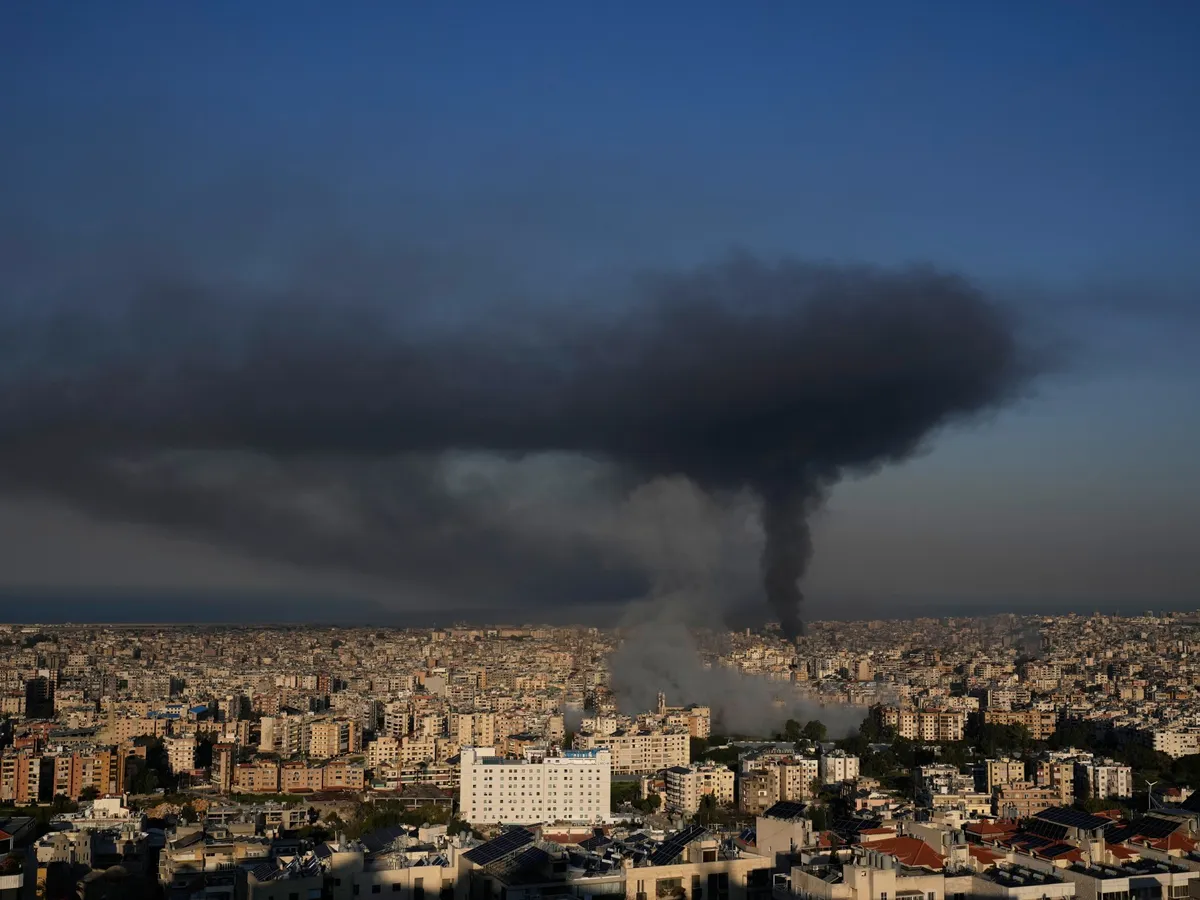
Israel is using military occupation of southern Lebanon and displacement crisis to dictate ceasefire terms, say experts.Smoke rises following Israeli air raids in Dahiyeh, a southern suburb of Beirut, Lebanon, March 3, 2026 [Hussein Malla/AP Photo]Published On 16 Mar 2026Above the smouldering skyline of Beirut’s southern Dahiyeh suburb, new forced evacuation orders from the Israeli military echo through rapidly emptying neighbourhoods.The Israeli warnings, accompanied by bombings of Beirut and other parts of southern Lebanon, contrast starkly with a French proposal for a diplomatic intervention aimed at pausing the latest Israeli war on its northern neighbour.But increasingly, say some analysts, that apparent dissonance between Israel’s actions and the prospect of talks to stop the fighting is in fact a reflection of a new ground reality that Israel is creating: occupying Lebanese territory to give itself greater leverage in any negotiations.Already, the human cost of Israel’s war is staggering. Lebanon has faced a sweeping Israeli offensive since March 2, which has killed about 850 people, including 107 children and 66 women, according to the Ministry of Public Health. More than one million people have been displaced within the country, forced into overcrowded shelters. The escalation followed Hezbollah’s targeting of Israeli military sites in response to a joint US-Israeli attack on Iran in late February, shattering whatever remained of the collapsed November 2024 ceasefire.Amid this humanitarian catastrophe, French President Emmanuel Macron has proposed hosting direct talks between Lebanon and Israel in Paris, warning that “everything must be done to prevent Lebanon [from] descending into chaos”. To support the diplomatic push, Paris announced the delivery of 60 tonnes of humanitarian aid alongside armoured personnel carriers for the Lebanese forces.However, analysts say, the Israeli military, rather than French diplomacy, is setting the agenda for the proposed talks.Geography as a weaponIsrael, according to political analysts, will look to leverage its military presence to impose a radically altered security architecture, using its occupation of southern villages to dictate new facts on the ground.According to Ziad Majed, a political science professor at the Paris" class="entity-link entity-organization" data-entity-id="45096" data-entity-type="organization">American University of Paris, the undeclared conditions of the current diplomatic push involve forcing the Lebanese army to disarm Hezbollah under the strict supervision of the United States and France. By holding Lebanese territory, Israel is forcing Lebanon to negotiate over its sovereignty, with a question mark over whether Israeli troops will eventually withdraw or if currently occupied areas will be permanently transformed into an unpopulated buffer zone.This strategy is currently unfolding on the battlefield. Israel has amassed six military divisions — roughly 100,000 soldiers — along its northern border. Military experts point to the strategic southern Lebanese town of Khiam as the focal point of Israel’s impending ground push.Bahaa Hallal, a retired Lebanese brigadier-general, told Al Jazeera Arabic that Khiam serves as a “geographical key” that oversees the Marjayoun plain and the Hasbani Valley leading to the Litani River. Hallal warned that controlling Khiam would enable Israel to sever communications between southern villages and establish a de facto buffer zone.Imad Salamey, an international relations professor at the Lebanese American University, argued that Israel’s troop deployment pointed to its belief that, as the militarily dominant force, it feels no rush to negotiate.Disarmament and domestic riftsMeanwhile, the crisis in Lebanon is also exposing deep communal rifts within the country.Al Jazeera Arabic’s Mazen Ibrahim has reported that official sources indicate the Lebanese presidency, government, and parliament are urgently consulting to form a six-member delegation of ambassador-level diplomats to negotiate a ceasefire, potentially in Cyprus. However, Ibrahim noted that Nabih Berri, the Lebanese parliament speaker, has refused to include any figures representing the Shia community in the delegation, while maintaining that an Israeli ceasefire must precede any political negotiations.The debate over the disarmament of Hezbollah — a demand not just of Israel but of Western interlocutors — threatens to drag Lebanon into civil strife.Some analysts have argued that the Lebanese military must do more. “The state must force them to hand over their weapons, even if it has to use force,” political analyst Toni Boulos told Al Jazeera.But others, like political researcher Ali Matar, have dismissed that proposition as reckless. He noted that ordering the national army, which includes a significant proportion of Shia soldiers, to fight the Shia-led Hezbollah would fracture the military. He also highlighted the state’s failure to protect its citizens during 16 months of Israeli violations before the ongoing wider war.Negotiating under fireNeither of the warring parties appears ready for immediate concessions. Israeli Foreign Minister Gideon Saar has publicly dismissed the prospect of direct talks, demanding that the Lebanese government first take concrete steps to curb Hezbollah’s military activities.On the other side, Hezbollah Secretary-General Naim Qassem recently declared that diplomatic solutions have failed to stop the killing, warning the Lebanese government against offering “free concessions” and insisting that the battlefield will dictate the final outcome.Some analysts have drawn parallels between the current political climate and the 1983 Israeli invasion of Beirut. Those historical negotiations, conducted under the shadow of Israeli military occupation, culminated in the May 17 Agreement of 1983 — a peace treaty that was ultimately aborted following sectarian divisions within Lebanon.More than four decades later, a new generation of Lebanese families is now huddled in rain-soaked shelters across Beirut. There is chatter of diplomacy, but for now, their homes in the south have been reduced to bargaining chips for Israel’s occupying army.
SRCAl Jazeera
LANGEN
LEANCenter
WORDS890
ENT12
MON · 2026-03-16 · 12:05 GMTBRIEF NSR-2026-0316-24995
NSR-2026-0316-24995News Report·EN·Political Strategy
In Lebanon, Israel is using occupation as negotiating tool, say analysts
Amidst a humanitarian crisis in Lebanon, triggered by an Israeli offensive since March 2, 2026, analysts suggest Israel is using military occupation as a negotiating tactic. The offensive, which followed Hezbollah's targeting of Israeli military sites, has resulted in approximately 850 deaths and displaced over one million people within Lebanon.
Mohammad MansourAl JazeeraFiled 2026-03-16 · 12:05 GMTLean · CenterRead · 4 min
Al JazeeraFIG 01
Reading time
4min
Word count
890words
Sources cited
2cited
Entities identified
12entities
Quality score
100%
§ 01
Briefing Summary
AI-generatedNEWSAR · AI
Amidst a humanitarian crisis in Lebanon, triggered by an Israeli offensive since March 2, 2026, analysts suggest Israel is using military occupation as a negotiating tactic. The offensive, which followed Hezbollah's targeting of Israeli military sites, has resulted in approximately 850 deaths and displaced over one million people within Lebanon. While France proposes diplomatic intervention, including direct talks between Lebanon and Israel, analysts believe Israel is leveraging its occupation of southern Lebanon to dictate ceasefire terms. Experts contend that Israel aims to impose a new security arrangement, potentially forcing the Lebanese army to disarm Hezbollah under international supervision. This strategy uses geography as a weapon to gain leverage in any future negotiations.
Confidence 0.90Sources 2Claims 5Entities 12
§ 02
Article analysis
Model · rule-basedFraming
Political Strategy
Conflict
Tone
Mixed Tone
AI-assessed
CalmNeutralAlarmist
Factuality
0.60 / 1.00
Mixed
LowHigh
Sources cited
2
Limited
FewMany
§ 03
Key claims
5 extracted01
Israel has amassed six military divisions along its northern border.
factualnull
Confidence
0.90
02
More than one million people have been displaced within Lebanon.
statisticnull
Confidence
0.90
03
Lebanon has faced an Israeli offensive since March 2, which has killed about 850 people.
statisticMinistry of Public Health
Confidence
0.90
04
Israel is using military occupation of southern Lebanon and displacement crisis to dictate ceasefire terms.
quoteanalysts
Confidence
0.80
05
The undeclared conditions involve forcing the Lebanese army to disarm Hezbollah.
quoteZiad Majed, political science professor
Confidence
0.70
§ 04
Full report
4 min read · 890 words§ 05
Entities
12 identifiedKey playerOppositionContextPositiveNeutralNegative
Organizations3
§ 06
Keywords & salience
9 termsisraeli occupation
0.90
lebanon
0.80
ceasefire terms
0.70
negotiating tool
0.70
military offensive
0.60
displacement crisis
0.60
humanitarian aid
0.50
diplomatic intervention
0.50
hezbollah
0.40
§ 07
Topic connections
Interactive graph Network visualization showing 51 related topics
View Full Graph Person Organization Location Event|Click node to navigate|Edge numbers = shared articles