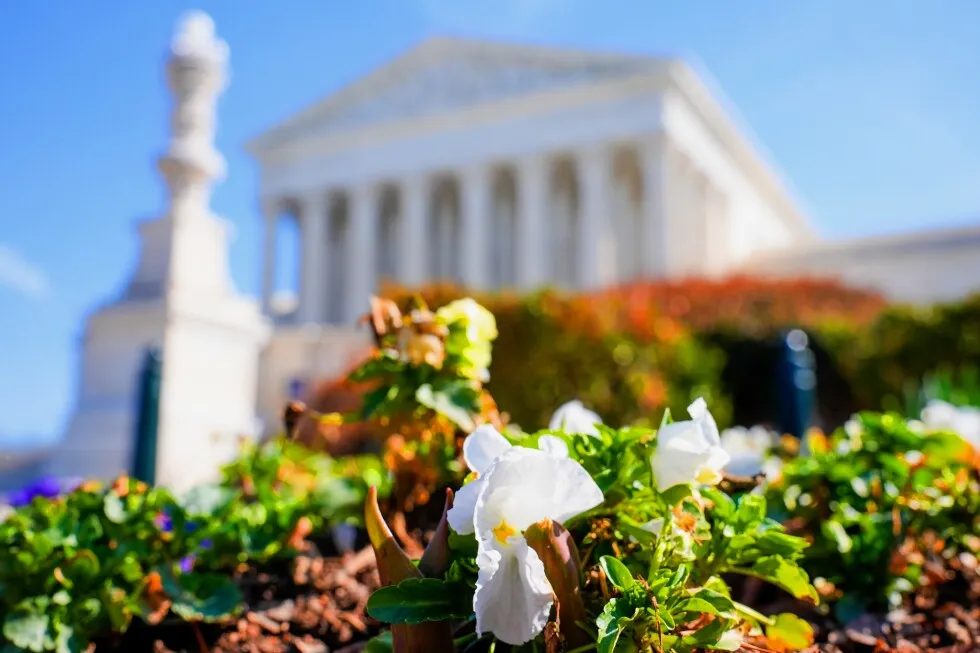
1 of 4 | Flowers blooms in front of the U.S. Supreme Court Tuesday, March 10, 2026, in Washington. (AP Photo/Mariam Zuhaib) 2 of 4 | Cherry trees begin to bloom, near the the Washington-monument" class="entity-link entity-location" data-entity-id="22460" data-entity-type="location">Washington Monument, at the Tidal Basin in Washington, Friday, March 13, 2026. (AP Photo/Rahmat Gul) 3 of 4 | Cherry trees begin to bloom near the Jefferson Memorial, Friday, March 13, 2026, at the Tidal Basin in Washington. (AP Photo/Rahmat Gul) 4 of 4 | Malik Shabazz Pizzaro, left, with the helpf froom urban park ranger June Yoo of the New York City Department of Parks and Recreationm reacts after balancing an egg on a Central Park wall as part of a vernal equinox celebration in New York, Thursday, March 20, 1997. (AP Photo/Mark Lennihan, File) 1 of 4 Flowers blooms in front of the U.S. Supreme Court Tuesday, March 10, 2026, in Washington. (AP Photo/Mariam Zuhaib) Add AP News on Google Add AP News as your preferred source to see more of our stories on Google. 2 of 4 Cherry trees begin to bloom, near the the Washington-monument" class="entity-link entity-location" data-entity-id="22460" data-entity-type="location">Washington Monument, at the Tidal Basin in Washington, Friday, March 13, 2026. (AP Photo/Rahmat Gul) Add AP News on Google Add AP News as your preferred source to see more of our stories on Google. 3 of 4 Cherry trees begin to bloom near the Jefferson Memorial, Friday, March 13, 2026, at the Tidal Basin in Washington. (AP Photo/Rahmat Gul) Add AP News on Google Add AP News as your preferred source to see more of our stories on Google. 4 of 4 Malik Shabazz Pizzaro, left, with the helpf froom urban park ranger June Yoo of the New York City Department of Parks and Recreationm reacts after balancing an egg on a Central Park wall as part of a vernal equinox celebration in New York, Thursday, March 20, 1997. (AP Photo/Mark Lennihan, File) Add AP News on Google Add AP News as your preferred source to see more of our stories on Google. Updated [hour]:[minute] [AMPM] [timezone], [monthFull] [day], [year] It’s far from clear if the weather is planning to cooperate, but spring arrives — technically, at least — Friday. The vernal equinox arrives on Friday, marking the start of the spring season for the Northern Hemisphere and the fall in the Southern Hemisphere. On the equator, the sun will be directly overhead at noon. Equinoxes are the only times when both the North and South poles are lit by sunshine at the same time.Equinoxes have been marked and celebrated around the world for centuries. In Japan, for example, Vernal Equinox Day is a public holiday. At the Mayan site Chichen Itza in Mexico, people gather during the equinox to watch the sun create a shadow pattern that resembles a serpent descending a pyramid called El Castillo.But what is happening in the heavens? Here’s what to know about the Earth’s orbit. What is the equinox?As the Earth travels around the sun, it does so at an angle, making the sun’s warmth and light fall unequally on the northern and southern halves of the planet for most of the year.But during the equinox, the Earth’s tilt is neither toward the sun nor away from the sun, so both the northern and southern hemispheres get an equal amount of sunlight. The sun rises almost exactly due east and it sets almost exactly due west. The word equinox comes from two Latin words meaning equal and night. That’s because on the equinox, day and night last almost the same amount of time — though one may get a few extra minutes, depending on where you are on the planet. The Northern Hemisphere’s fall — or autumnal — equinox can land between Sept. 21 and 24, depending on the year. Its spring — or vernal — equinox can land between March 19 and 21.The exact time of the equinox is the moment the sun is directly overhead at the equator. For 2026, it’s Friday, March 20, at 10:46 a.m. EST. From there, days will get a little longer every day in the Northern Hemisphere — and shorter in the Southern Hemisphere — until the solstice in June. What is the solstice?The solstices mark the times when the Earth’s tilt is tipped most extremely either toward or away from the sun. This means the hemispheres are getting very different amounts of sunlight, and days and nights are at their most unequal.At the Northern Hemisphere’s summer solstice, the Earth’s upper half is leaning toward the sun, creating the longest day and shortest night of the year. The summer solstice falls between June 20 and 22. This year it’s the 21st. The opposite happens at the Northern Hemisphere winter solstice: the Earth’s upper half leans the furthest away from the sun, leading to the shortest day and longest night of the year. The winter solstice falls between Dec. 20 and 23. What’s the difference between meteorological and astronomical seasons? These are just two different ways to carve up the year.While astronomical seasons depend on how the Earth moves around the sun, meteorological seasons are defined by the weather. Meteorologists break down the year into three-month seasons based on annual temperature cycles. By that calendar, spring starts on March 1, summer on June 1, fall on Sept. 1 and winter on Dec. 1. The Associated Press Health and Science Department receives support from the Howard Hughes Medical Institute’s Department of Science Education and the Robert Wood Johnson Foundation. The AP is solely responsible for all content.
SRCAssociated Press (AP)
LANGEN
LEANCenter
WORDS921
ENT12
MON · 2026-03-16 · 14:23 GMTBRIEF NSR-2026-0316-25015
NSR-2026-0316-25015News Report·EN·Environmental
Is spring really — finally — here?
The article discusses the arrival of spring, which technically begins on Friday with the vernal equinox. The vernal equinox marks the start of spring in the Northern Hemisphere and autumn in the Southern Hemisphere.
By
THE ASSOCIATED PRESSAssociated Press (AP)Filed 2026-03-16 · 14:23 GMTLean · CenterRead · 4 min
Associated Press (AP)FIG 01
Reading time
4min
Word count
921words
Sources cited
0cited
Entities identified
12entities
Quality score
100%
§ 01
Briefing Summary
AI-generatedNEWSAR · AI
The article discusses the arrival of spring, which technically begins on Friday with the vernal equinox. The vernal equinox marks the start of spring in the Northern Hemisphere and autumn in the Southern Hemisphere. On this day, the sun is directly overhead at the equator, and both poles are illuminated by sunshine. The equinox has been celebrated for centuries across the globe, including in Japan, where Vernal Equinox Day is a public holiday. The article includes photos of flowers blooming in Washington D.C. and a file photo of a vernal equinox celebration in New York City.
Confidence 0.90Claims 5Entities 12
§ 02
Article analysis
Model · rule-basedFraming
Environmental
Human Interest
Tone
Measured
AI-assessed
CalmNeutralAlarmist
Factuality
0.90 / 1.00
Factual
LowHigh
Sources cited
0
No named sources
FewMany
§ 03
Key claims
5 extracted01
Vernal Equinox Day is a public holiday in Japan.
factual
Confidence
1.00
02
Equinoxes are the only times when both the North and South poles are lit by sunshine at the same time.
factual
Confidence
1.00
03
On the equator, the sun will be directly overhead at noon.
factual
Confidence
1.00
04
The vernal equinox arrives on Friday, marking the start of the spring season for the Northern Hemisphere and the fall in the Southern Hemisphere.
factual
Confidence
1.00
05
Spring arrives — technically, at least — Friday.
factual
Confidence
1.00
§ 04
Full report
4 min read · 921 words§ 05
Entities
12 identifiedKey playerOppositionContextPositiveNeutralNegative
Organizations2
§ 06
Keywords & salience
9 termsspring
1.00
vernal equinox
0.90
equinox
0.70
northern hemisphere
0.60
cherry trees
0.50
southern hemisphere
0.50
flowers bloom
0.50
celebration
0.40
washington
0.40
§ 07
Topic connections
Interactive graph Network visualization showing 51 related topics
View Full Graph Person Organization Location Event|Click node to navigate|Edge numbers = shared articles