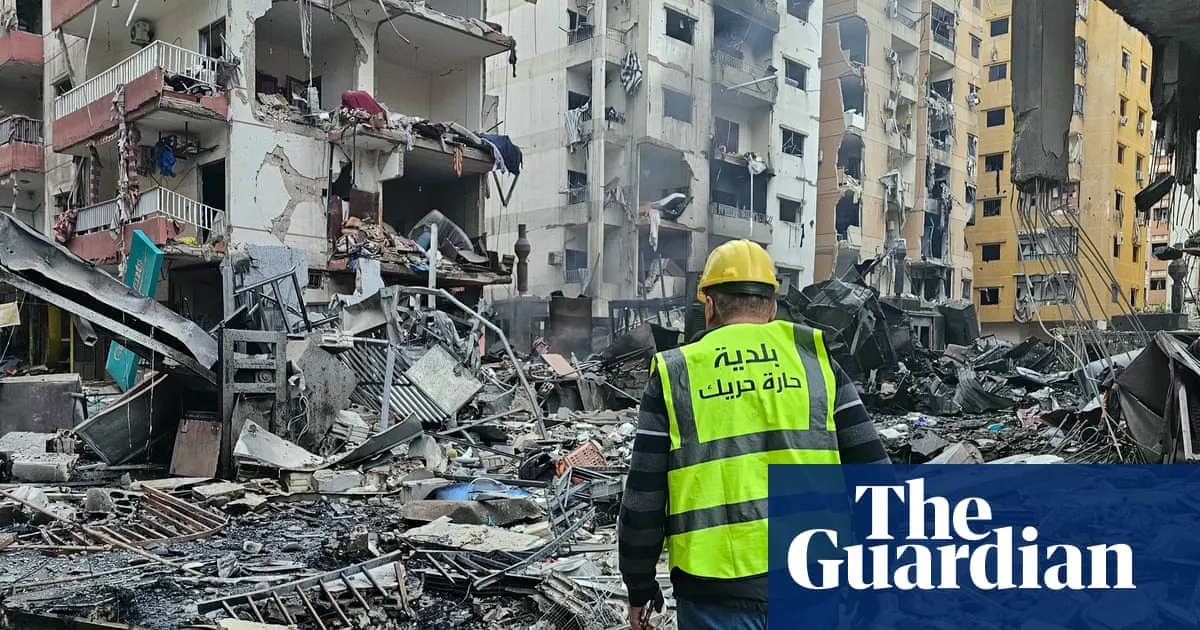
Israel’s announcement on Monday of a ground campaign in new areas of southern Lebanon is fuelling fears of a prolonged occupation among hundreds of thousands of displaced Lebanese.Concerns intensified after Israel’s defence minister, Israel-katz" class="entity-link entity-person" data-entity-id="4249" data-entity-type="person">Israel Katz, drawing comparisons with Gaza, warned displaced Lebanese forced from their homes would not be allowed to return until the safety of Israelis near the border was guaranteed, remarks that appeared to suggest the presence of Israeli troops could become prolonged.“Hundreds of thousands of Shi’ite residents of southern Lebanon who have evacuated or are evacuating their homes in southern Lebanon and Beirut will not return to areas south of the Litani line until the safety of northern residents is ensured,” Katz said in a statement. ‘‘Prime Minister Benjamin Netanyahu and I have instructed the IDF [Israel Defense Forces] to destroy the terror infrastructure in the contact villages near the border in Lebanon,” he added, “just as was done against Hamas in Rafah, Beit Hanoun and the terror tunnels in Gaza”.Under the November 2024 ceasefire agreement, Hezbollah was to pull back from southern Lebanon and the Lebanese military was to take over, in exchange for Israel ceasing its bombardment of the country. Israel said Lebanon never upheld its part of the deal, and the Israelis continued to carry out near-daily airstrikes against what it said were Hezbollah positions and weapons.The new war began when Hezbollah fired rockets at Israel on 2 March, prompting Israel to launch a campaign across Lebanon. Since then, the conflict has escalated sharply and has already pushed beyond the parameters of the 13-month Israel-Hezbollah war of 2023-24. Israel has displaced about 1 million people from wide swathes of the country. Reports indicate more than 800 people have been killed, with some reports citing 826 to more than 850 deaths since the escalation began.Ramzi Kaiss, a Lebanon researcher for Human Rights Watch, said Katz’s statement raised the risk of forced displacement, a war crime.“Preventing civilians from returning to their homes in an area that is nearly 10% of Lebanon’s territory, until some vague ‘safety’ standard is secured, would be unlawful and further raises the risk of forced displacement, which would be a war crime,” said Kaiss.Internally displaced people sit next to tents after fleeing their homes in southern Lebanon. Photograph: Wael Hamzeh/EPATo the hundreds of thousands of displaced residents of villages south of the Litani River, the Israeli defence minister’s statement brought fears of an occupation similar to the one they experienced from 1982 to 2000, when the Israeli military occupied the area.“God forbid we return to the days of the previous border-strip occupation. We’re afraid of that, honestly. It took us years before we were able to return to Naqoura. To return to that would be very difficult,” said Abbas Awadeh, a member of the municipality of Naqoura who has himself been displaced.Virtually everyone has fled Naqoura, a beach resort town on the Lebanese-Israeli border, since the Israeli military issued a displacement order last week. The IDF ordered all residents south of the Litani to “temporarily” move north on 4 March before what it said were strikes on Hezbollah targets, followed by two more sweeping displacement orders in different areas of the country.A prolonged displacement was the worst fear for those residents, many of whom are now sleeping on the street.“People really want to return to their towns, because the situation is very difficult. Sometimes a person can’t even secure food. Displacement is humiliating,” said Awadeh.Far-right figures within Israel’s governing coalition have increasingly called for harsher military action against Hezbollah, with some advocating the creation of a security buffer inside southern Lebanon. The finance minister, Bezalel Smotrich, warned earlier this month that Beirut’s southern suburbs could be reduced to something resembling Khan Younis in Gaza, a reference to the widespread destruction caused during Israel’s war with Hamas.“The ground operation in southern Lebanon is an expression of Israel’s new security doctrine in the aftermath of October 7,” said Prof Yagil Levy, the head of the Open University Institute for the Study of Civil-Military Relations in Israel. “It is unfolding the renewed occupation of parts of southern Lebanon. Yet Israel is not returning to the years 1982–2000, when it occupied part of Lebanon but was dragged into a guerrilla war whose casualties forced it to withdraw. This time, it seizes territory and removes the population, thereby ensuring full freedom of action and reducing the risk of guerrilla operations emerging from villages.”People sit at a school turned into a shelter for displaced families in Beirut. Photograph: Khalil Ashawi/ReutersLevy said that, in this spirit, a perimeter was established in the Gaza Strip, which now covers about half of its territory, and that “now the idea of the perimeter is also being applied in Lebanon”.“Israel regards this new security doctrine as feasible because the world, above all the United States, effectively accepts the principle of Israel’s right to absolute security, and thus implicitly accepts the principle that an Arab civilian population constitutes a form of risk,” he added. “This doctrine is also taking shape in the West Bank, as reflected in the more flexible rules of engagement and the authority given to settler militias to remove Palestinian civilian communities.”According to analysts, Israel’s expanding military operations in southern Lebanon appear increasingly aimed at reshaping the balance of power before any diplomatic settlement. While international efforts to halt the fighting continue, Israel’s advance into Lebanese territory may give it greater leverage in negotiations by establishing new facts on the ground.Despite the blanket displacement order, the Israeli military was not forcing all villages to vacate. Certain border villages, particularly those with large Christian populations, were not being forced to do so. Selective displacement was a parallel to the 1982 occupation, when Israel allowed residents of certain Christian or Sunni villages to remain and even issued work permits for some to work inside Israel proper.Seven villages along the eastern Lebanese-Israeli border, the so-called Arqoub area, decided to remain in their homes after officials received calls from the Israeli military telling them they could stay.“They [the Israeli military] said: ‘Don’t leave your homes, don’t go anywhere, don’t get involved and don’t allow any strangers to come close to you,” said Qassem al-Adiri, the mayor of Kfar Shouba, one of the villages in the Arqoub area.The Israeli military also called municipal officials in Rmeish, a Maronite Christian village on the western Lebanese-Israeli border, telling them they could stay and would not be targeted, as long as they ensured no Hezbollah fighters would enter the village. After the call, all displaced people sheltering in the town were asked to leave.“We will stay in our homes as long as we are peaceful and safe and not involved in armed activity. We are outside of this conflict, we are innocent,” said al-Adiri.
SRCThe Guardian - World News
LANGEN
LEANCenter-Left
WORDS1 125
ENT12
MON · 2026-03-16 · 18:31 GMTBRIEF NSR-2026-0316-25057
NSR-2026-0316-25057News Report·EN·Conflict
Israel’s planned expansion of Lebanon ground campaign fuels fears of prolonged occupation
Israel's planned ground campaign in southern Lebanon is raising concerns about a prolonged occupation and displacement of Lebanese civilians. Israeli Defense Minister Israel Katz stated that displaced Lebanese residents will not be allowed to return to their homes south of the Litani River until the safety of northern Israelis is guaranteed, drawing comparisons to operations in Gaza.
Lorenzo Tondo in Jerusalem and William Christou in BeirutThe Guardian - World NewsFiled 2026-03-16 · 18:31 GMTLean · Center-LeftRead · 5 min
The Guardian - World NewsFIG 01
Reading time
5min
Word count
1 125words
Sources cited
3cited
Entities identified
12entities
Quality score
100%
§ 01
Briefing Summary
AI-generatedNEWSAR · AI
Israel's planned ground campaign in southern Lebanon is raising concerns about a prolonged occupation and displacement of Lebanese civilians. Israeli Defense Minister Israel Katz stated that displaced Lebanese residents will not be allowed to return to their homes south of the Litani River until the safety of northern Israelis is guaranteed, drawing comparisons to operations in Gaza. This announcement follows escalating conflict between Israel and Hezbollah, which began in March after Hezbollah fired rockets at Israel. The conflict has already displaced approximately one million Israelis and resulted in hundreds of deaths. Human Rights Watch has warned that preventing civilians from returning to their homes could constitute forced displacement, a potential war crime.
Confidence 0.90Sources 3Claims 5Entities 12
§ 02
Article analysis
Model · rule-basedFraming
Conflict
Human Rights
Tone
Mixed Tone
AI-assessed
CalmNeutralAlarmist
Factuality
0.70 / 1.00
Factual
LowHigh
Sources cited
3
Well sourced
FewMany
§ 03
Key claims
5 extracted01
Under the November 2024 ceasefire, Hezbollah was to pull back from southern Lebanon.
factualnull
Confidence
1.00
02
Katz warned displaced Lebanese would not return until the safety of Israelis was guaranteed.
quoteIsrael Katz
Confidence
1.00
03
Israel announced a ground campaign in new areas of southern Lebanon.
factualnull
Confidence
1.00
04
Israel has displaced about 1 million people from wide swathes of the country.
factualnull
Confidence
0.90
05
Reports indicate more than 800 people have been killed since the escalation began.
statisticnull
Confidence
0.80
§ 04
Full report
5 min read · 1 125 words§ 05
Entities
12 identifiedKey playerOppositionContextPositiveNeutralNegative
People3
Organizations3
§ 06
Keywords & salience
10 termssouthern lebanon
0.90
prolonged occupation
0.80
ground campaign
0.80
forced displacement
0.70
displaced lebanese
0.70
hezbollah
0.60
war crime
0.60
safety of israelis
0.50
israel defense forces
0.50
escalation
0.40
§ 07
Topic connections
Interactive graph Network visualization showing 51 related topics
View Full Graph Person Organization Location Event|Click node to navigate|Edge numbers = shared articles