BY THE NUMBERSNearly one in five people in Lebanon have been forced from their homes as Israel launches new ‘ground operations’.(Al Jazeera)Published On 17 Mar 2026The Israeli military has launched new waves of air raids across southern Lebanon after announcing “limited and targeted ground operations” on Monday against Hezbollah positions.Israel has intensified its military operations throughout Lebanon, creating a new front in the expanding regional conflict.On March 2, Hezbollah launched a barrage of rockets and drones at Israel for the first time in about a year, in response to the assassination of Iran’s Supreme Leader Ayatollah Ali Khamenei in Tehran. On the other hand, Israel continued near-daily attacks on Lebanon, violating the November 2024 ceasefire.Between March 2 and March 16, Israeli attacks have killed at least 886 people – including 67 women, 111 children, and 38 health workers – and wounded 2,141, according to Lebanon’s Ministry of Public Health.More than a million Lebanese have been displaced from their homes, with Israel-katz" class="entity-link entity-person" data-entity-id="45608" data-entity-type="person">Israeli Defence Minister Israel Katz on Monday saying he would not allow the return of people to the country’s south until the safety of Israelis is guaranteed.Which areas has Israel attacked?Data from the Armed Conflict Location & Event Data (ACLED), an independent monitor, has recorded at least 394 Israeli attacks on Lebanon.The attacks have mostly been concentrated in southern Lebanon and the southern suburbs of Beirut. There have also been Israeli attacks in the Bekaa Valley and Baalbek in eastern Lebanon.In the capital, Beirut, home to roughly half of Lebanon’s 5.9 million population, Israeli attacks have targeted several areas in Dahiyeh, a cluster of neighbourhoods in the southern suburbs that once housed nearly one million people, most of whom have now been forcibly displaced.Israeli warplanes have targeted several parts of the city, including Haret Hreik, the Bashoura neighbourhood in the heart of Beirut, and Ramlet al-Baida along the seaside, where displaced families were seeking respite from relentless bombing.The human toll of Israeli attacks on LebanonSince October 7, 2023, Israeli attacks in Lebanon have killed at least 5,282 people, according to the latest figures from the Lebanese Health Ministry and historical data compiled by ACLED.The cross-border fighting between Israel and Hezbollah began a day after Hamas and other Palestinian armed groups attacked southern Israel on October 7, 2023, and Israel launched its genocidal war on Gaza.Hezbollah, which was established in response to the Israeli invasion of Lebanon in 1982, fired rockets at Israel in solidarity with Palestinians.Yemen’s Houthi group also attacked ships in the Red Sea, disrupting global trade in solidarity with the Palestinians. Houthis and Hezbollah are part of Iran’s “axis of resistance”.Israel’s ongoing genocide in Gaza has killed more than 72,000 Palestinians, and the enclave of 2.3 million people has been turned into rubble. Israel has killed more than 800 Palestinians since the latest ceasefire brokered by the United States in October 2025.Israel and Hezbollah signed a ceasefire deal on November 26, 2024, after nearly two months of fighting and Israeli incursion in southern Lebanon. But Israel refused to pull out its troops and continued attacks in violation of the deal.More than one million displacedOn March 12, the Israeli army expanded its forced displacement orders for residents of southern Lebanon – from the Litani River to north of the Zahrani River, about 40km (25 miles) north of the Israeli border.According to the Norwegian Refugee Council, Israel’s sweeping evacuation orders now cover more than 1,470sq km (568sq miles), or about 14 percent of the country’s territory.The map below shows more than 100 towns and villages across the country that are under forced evacuation orders from the Israeli military.Nearly one in five people in Lebanon, or 18 percent of the population, has been displaced over the past two weeks.According to Lebanon’s Disaster Risk Management Unit, the total number of registered displaced people has now reached 1,049,328, and the number of displaced people residing in collective shelters is 132,742.The pace of displacement has outstripped the country’s shelter capacity. Many families have been unable to secure accommodation and are spending nights in streets, vehicles, or public spaces as collective shelters fill up. For many of them, this is not the first time.Between October 2023 and November 2024, amid cross-border fighting between Hezbollah and Israel, hundreds of thousands of residents of southern Lebanon’s border villages bore the brunt of the violence.At its peak, 899,725 people were forcefully displaced by Israeli forces. Most of them had returned by last October, only to be forced to flee again.Israeli attacks during these 14 months caused widespread destruction to homes and infrastructure. The World Bank estimated damage to residential buildings alone at approximately $2.8bn. About 99,000 homes were damaged or destroyed, leaving many families unable to return even after the ceasefire.
SRCAl Jazeera
LANGEN
LEANCenter
WORDS783
ENT9
TUE · 2026-03-17 · 12:15 GMTBRIEF NSR-2026-0317-25320
NSR-2026-0317-25320News Report·EN·Conflict
Mapping Israeli attacks and the displacement of one million in Lebanon
As of March 17, 2026, Israel has intensified military operations in Lebanon, launching air raids and "limited ground operations" against Hezbollah following a barrage of rockets and drones fired by Hezbollah into Israel on March 2. These actions are a response to the assassination of Iran’s Supreme Leader.
Marium Ali,Mohamed A. HusseinAl JazeeraFiled 2026-03-17 · 12:15 GMTLean · CenterRead · 4 min
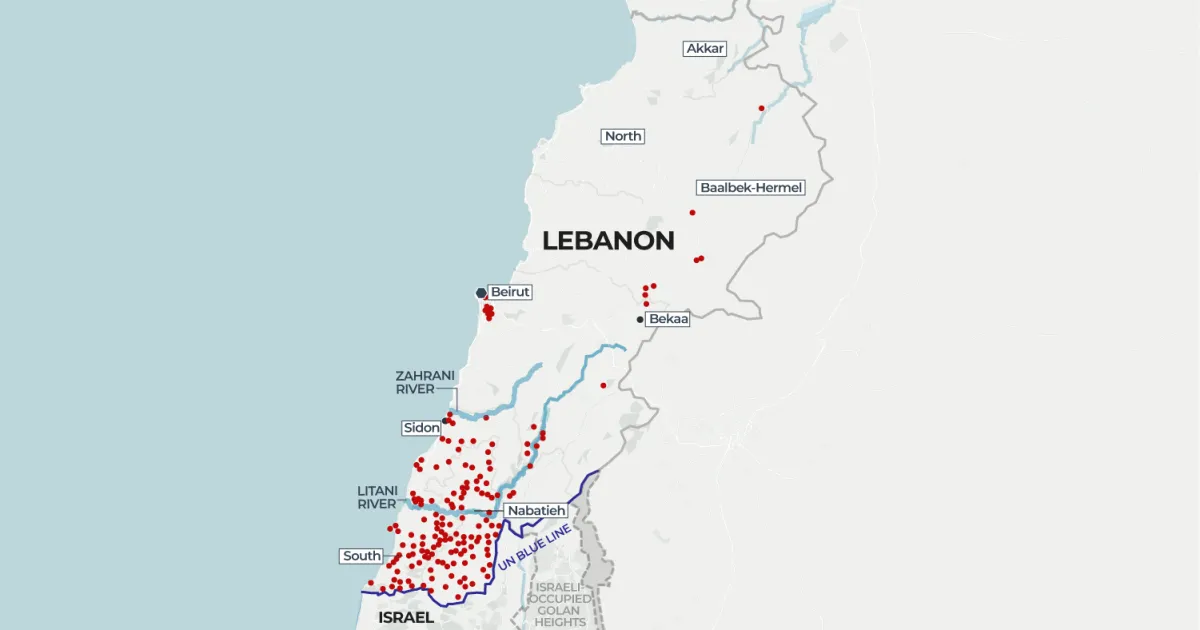
Al JazeeraFIG 01
Reading time
4min
Word count
783words
Sources cited
3cited
Entities identified
9entities
Quality score
100%
§ 01
Briefing Summary
AI-generatedNEWSAR · AI
As of March 17, 2026, Israel has intensified military operations in Lebanon, launching air raids and "limited ground operations" against Hezbollah following a barrage of rockets and drones fired by Hezbollah into Israel on March 2. These actions are a response to the assassination of Iran’s Supreme Leader. Since March 2, Israeli attacks have killed at least 886 people and wounded 2,141, according to Lebanon’s Ministry of Public Health. Over one million Lebanese have been displaced, primarily from southern Lebanon and the southern suburbs of Beirut, which have been the focus of 394 Israeli attacks. The conflict began after the October 7, 2023, attacks on Israel, resulting in at least 5,282 deaths in Lebanon since then.
Confidence 0.90Sources 3Claims 5Entities 9
§ 02
Article analysis
Model · rule-basedFraming
Conflict
Human Rights
Tone
Mixed Tone
AI-assessed
CalmNeutralAlarmist
Factuality
0.70 / 1.00
Factual
LowHigh
Sources cited
3
Well sourced
FewMany
§ 03
Key claims
5 extracted01
Israeli Defence Minister Israel Katz said he would not allow the return of people to the country’s south until the safety of Israelis is guaranteed.
quoteIsrael Katz
Confidence
1.00
02
Data from ACLED has recorded at least 394 Israeli attacks on Lebanon.
statisticACLED
Confidence
0.90
03
More than a million Lebanese have been displaced from their homes.
statisticAl Jazeera
Confidence
0.90
04
Nearly one in five people in Lebanon have been forced from their homes as Israel launches new ‘ground operations’.
statisticAl Jazeera
Confidence
0.90
05
Between March 2 and March 16, Israeli attacks have killed at least 886 people and wounded 2,141.
statisticLebanon’s Ministry of Public Health
Confidence
0.80
§ 04
Full report
4 min read · 783 words§ 05
Entities
9 identifiedKey playerOppositionContextPositiveNeutralNegative
People2
§ 06
Keywords & salience
8 termsisraeli attacks
1.00
lebanon
0.90
displacement
0.80
hezbollah
0.70
military operations
0.60
regional conflict
0.50
air raids
0.50
casualties
0.40
§ 07
Topic connections
Interactive graph Network visualization showing 51 related topics
View Full Graph Person Organization Location Event|Click node to navigate|Edge numbers = shared articles