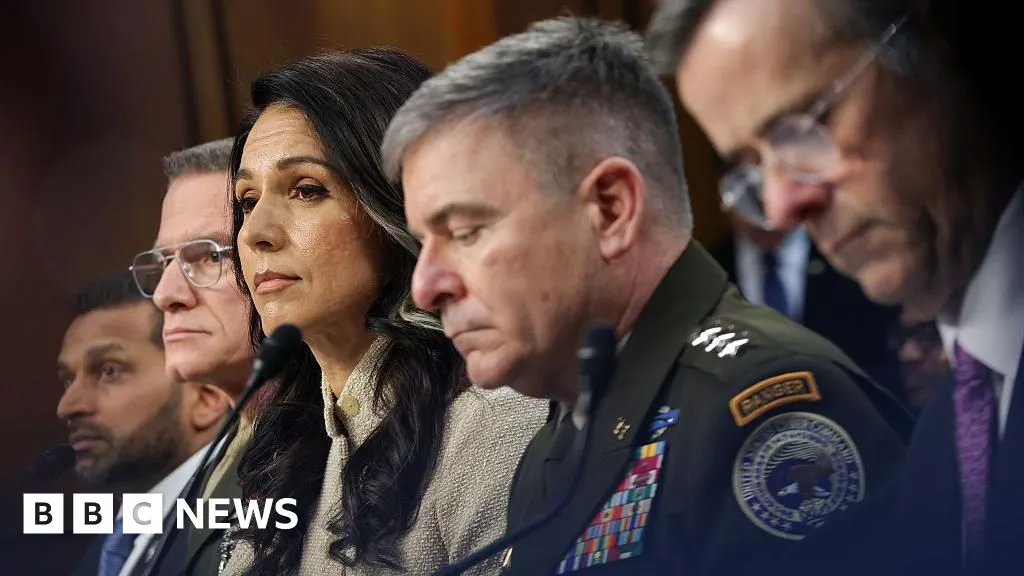
5 hours agoMadeline HalpertandKayla EpsteinGetty ImagesThe top intelligence official in the US said on Wednesday that the Iranian regime was "intact" but "largely degraded".Director of National Intelligence Tulsi Gabbard and other top Trump administration officials testified at a congressional hearing for more than two hours about worldwide threats to the US.It was the first public briefing on intelligence since the war began in late February and came one day after a top counterterrorism leader resigned saying Iran had not posed an imminent threat to the US.Gabbard, who coordinates the country's intelligence operations, also said that the US had anticipated trouble in the Strait of Hormuz, a vital shipping channel."The IC [intelligence community] assesses the regime in Iran appears to be intact, but largely degraded due to attacks on its leadership and military capabilities," she said.Appearing alongside the heads of the CIA, FBI, National Security Agency and Defense Intelligence Agency, Gabbard declined to answer when asked repeatedly by Senator Jon Ossoff, a Democrat, about whether she had viewed Iran as an imminent threat. "The only person who can determine what is and is not an imminent threat is the president," she said.Since the war began, lawmakers and commentators from both parties have questioned why the US struck the Islamic Republic and if the Trump administration was aware of potential problems in the Strait of Hormuz on the southern coast of Iran. President Donald Trump has said the US attacked largely because Iran was developing nuclear weapons, which threatened the US and Israel.On Tuesday, Joe Kent resigned from his role as director of the national counterterrorism center, saying in a publicly posted resignation letter that Iran had posed "no imminent threat" to the US and criticising Trump for the war.CIA Director John Ratcliffe, director of the CIA, testified on Wednesday that he did not agree with Kent."I think Iran has been a constant threat to the United States for an extended period of time, and posed an immediate threat at this time," he said. Gabbard said US and Israeli strikes in the Middle East had "largely destroyed" Iran's military capabilities. She also said the intelligence community had assessed that "Iran was trying to recover from the severe damage to its nuclear infrastructure sustained during the 12-Day War and continued to refuse to comply with its nuclear obligations".In written remarks prepared for the hearing, Gabbard had asserted those attacks "obliterated" Iran's nuclear enrichment programme, and Iran had made "no efforts" to rebuild it. But she did not read that assertion aloud.When Democratic Senator Mark Warner asked Gabbard about the omission, she said she had to trim her public remarks because they were "running long". "So you chose to omit the parts that contradict the president," Warner responded, pointing Trump's contention that military action against Iran was justified because of its nuclear-weapon development. Lawmakers also asked how involved intelligence officials were in Trump's decision to strike Iran. Senator Angus King, an Independent from Maine, asked if they were "in the room" with Trump as he made his "final decision". Ratcliffe estimated he was in "dozens and dozens" of meetings with the president, but did not know if there was a "single time where a decision was made".King also asked if intelligence officials had informed Trump that Iran could potentially attack the Strait of Hormuz during a conflict with the US. Iran has effectively shut down the vital oil shipping channel since the US-Israel war with Iran began."The president gets briefings constantly about intelligence," Ratcliffe said. He added that the Pentagon prepared for Iran to hit "US interests in energy sites across the region" and "took measures for force protection".The intelligence community had a "longstanding assessment" that Iran "would likely hold the Strait of Hormuz," Gabbard noted. She said the US defence department took "pre-emptive planning measures" as a result of that report.
SRCBBC News - World
LANGEN
LEANCenter
WORDS638
ENT12
WED · 2026-03-18 · 22:18 GMTBRIEF NSR-2026-0318-25863
NSR-2026-0318-25863News Report·EN·National Security
US intelligence chief says Iran's regime 'intact' but 'degraded'
During a congressional hearing on worldwide threats, US intelligence chief Tulsi Gabbard stated that while the Iranian regime remains "intact," its leadership and military capabilities have been "largely degraded." The briefing, the first since the start of a recent war, addressed concerns about the US's actions against Iran and potential issues in the Strait of Hormuz. Gabbard declined to comment on whether Iran posed an imminent threat, deferring to the President's authority.
BBC News - WorldFiled 2026-03-18 · 22:18 GMTLean · CenterRead · 3 min
BBC News - WorldFIG 01
Reading time
3min
Word count
638words
Sources cited
7cited
Entities identified
12entities
Quality score
100%
§ 01
Briefing Summary
AI-generatedNEWSAR · AI
During a congressional hearing on worldwide threats, US intelligence chief Tulsi Gabbard stated that while the Iranian regime remains "intact," its leadership and military capabilities have been "largely degraded." The briefing, the first since the start of a recent war, addressed concerns about the US's actions against Iran and potential issues in the Strait of Hormuz. Gabbard declined to comment on whether Iran posed an imminent threat, deferring to the President's authority. The hearing followed the resignation of a counterterrorism leader who claimed Iran posed no such threat, a view disputed by the CIA Director. Gabbard also noted that Iran was attempting to recover from damage to its nuclear infrastructure and continued to defy nuclear obligations.
Confidence 0.90Sources 7Claims 5Entities 12
§ 02
Article analysis
Model · rule-basedFraming
National Security
Political Strategy
Tone
Measured
AI-assessed
CalmNeutralAlarmist
Factuality
0.70 / 1.00
Factual
LowHigh
Sources cited
7
Well sourced
FewMany
§ 03
Key claims
5 extracted01
Iran has been a constant threat to the United States for an extended period of time, and posed an immediate threat at this time.
quoteJohn Ratcliffe
Confidence
1.00
02
Iran had posed 'no imminent threat' to the US.
quoteJoe Kent
Confidence
1.00
03
Iran was trying to recover from the severe damage to its nuclear infrastructure sustained during the 12-Day War.
factualTulsi Gabbard
Confidence
0.90
04
The Iranian regime was 'intact' but 'largely degraded'.
factualTulsi Gabbard
Confidence
0.90
05
US and Israeli strikes in the Middle East had 'largely destroyed' Iran's military capabilities.
factualTulsi Gabbard
Confidence
0.80
§ 04
Full report
3 min read · 638 words§ 05
Entities
12 identifiedKey playerOppositionContextPositiveNeutralNegative
People4
Organizations4
§ 06
Keywords & salience
9 termsiran
1.00
us intelligence
0.90
threat assessment
0.80
degraded military capabilities
0.70
imminent threat
0.70
nuclear weapons
0.60
strait of hormuz
0.60
counterterrorism
0.50
congressional hearing
0.50
§ 07
Topic connections
Interactive graph Network visualization showing 51 related topics
View Full Graph Person Organization Location Event|Click node to navigate|Edge numbers = shared articles