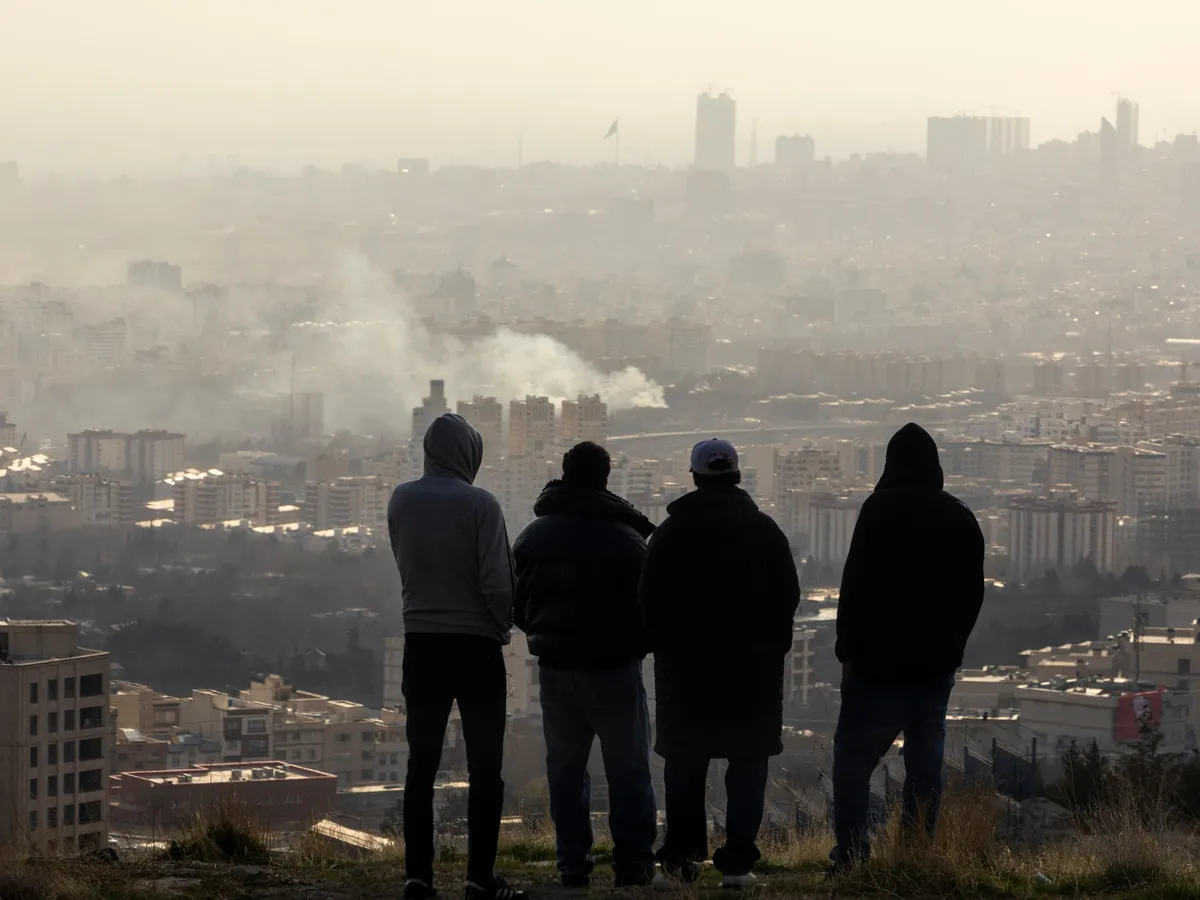
What is being done to Iran today could be done to Africa tomorrow. Africa must reject this illegal war.Al Jazeera columnist.Published On 20 Mar 2026Men watch from a hillside as a plume of smoke rises after an explosion on March 2, 2026 in Tehran, Iran [Majid Saeedi/Getty Images]Israel and America’s war on Iran has killed more than 1,500 people in a matter of weeks, and the toll continues to rise.In Tehran on March 7, mourners gathered around the coffin of Zainab Sahebi, a two-year-old girl killed in an Israeli air strike. A small doll lay beside her coffin as relatives and neighbours crowded the funeral, grappling with the loss of a child taken in an instant.Zainab’s funeral was only one of many.On March 3, thousands gathered in Minab, in Hormozgan province, for a mass funeral after the Shajareh Tayyebeh girls’ primary school was destroyed during the opening day of the bombing campaign. Rows of coffins were carried through the city as families laid to rest at least 175 students and staff, most of them children, killed in one of the deadliest incidents of the conflict.Violence like this has a long and familiar history.From Gaza to Lebanon and now Iran, civilians continue to bear the price of imperialism.This escalation has not been limited to civilians. Israeli strikes also killed Iran’s Supreme Leader Ayatollah Ali Khamenei, along with senior military officials.For Africa, the crisis unfolding thousands of kilometres away is not a distant geopolitical calamity.Instability in the Gulf has historically translated into sharp fuel price increases across the continent, with imported petroleum underpinning transport, electricity generation and food supply chains from Lagos and Nairobi to Johannesburg and Dakar.The result is rising inflation and higher food prices.Still, Africa’s stake in this conflict is not only economic.It is also a legal and political question.The issue confronting African governments is not whether they admire the Islamic Republic of Iran or the United States.The real question is whether the rules governing the use of force between states still apply at all.Article 2(4) of the United Nations Charter prohibits states from using military force against the territorial integrity or political independence of another state, except in self-defence or with UN Security Council authorisation, a principle long understood as central to international order.None of these legal thresholds were met in the case of the strikes on Iran.Instead, both Israeli Defence Minister Israel Katz and US Secretary of War Pete Hegseth have presented the strikes on Iran as acts of “preemptive” self-defence against Iran’s nuclear and missile capabilities.Africans have seen before how quickly Western military campaigns, launched in the name of democracy, human rights or humanitarian protection, can expand far beyond their stated purpose.Libya is a case in point.In March 2011, the United Nations Security Council adopted Resolution 1973, authorising “all necessary measures” to protect civilians during Libya’s uprising against Colonel Muammar Gaddafi.Within months, NATO aircraft were conducting an extensive bombing campaign across Libya, striking military installations and government infrastructure, while also killing civilians.For many Africans, it was no cause for celebration.The moment symbolised something deeper: a Western air war that culminated in the violent overthrow of an African government and the death of its leader.More than a decade later, Libya remains politically fractured, governed by rival administrations in Tripoli and eastern Libya, while armed militias continue to dominate large parts of the country.Libya’s collapse also destabilised the wider Sahel, where looted Libyan weapons and returning fighters helped ignite the 2012 rebellion in Mali, and contributed to coups and insurgencies that continue to shake Mali, Niger and Burkina Faso.Libya, like Iraq and Afghanistan, stands as a warning of what can follow when outside powers remake a state through force.Indeed, the pattern across Iran, Libya and the Democratic Republic of the Congo is clear. In each case, leaders sought to assert national control over strategic resources — oil in Iran and Libya, minerals in the DRC — only to face confrontation with Western dominance.In September 1960, Congo’s independence leader Patrice Lumumba was deposed in a Western-backed coup and executed four months later after attempting to secure sovereignty over the country’s vast mineral wealth.Half a century later, the same fate befell Gaddafi.Today, Iran’s leader has been killed in a military operation justified as a security necessity.Africa and the wider Global South stand at a crossroads.The United Nations and the UN Charter remain among the few barriers standing between the present and a return to an era when powerful Western nations openly reserved the right to pillage Africa and other continents at any cost.At the turn of the 20th century in the Congo Free State, in present-day DRC, the regime of King Leopold II of Belgium presided over a system of forced labour so brutal that historians estimate around 10 million Congolese died from violence, disease and starvation.American troops occupied Cuba after the Spanish–American War of 1898 and forced the island to accept the Platt Amendment, which gave Washington the right to intervene in its affairs. The United States also seized Puerto Rico in the same war and, in April 1914, landed forces in Veracruz, Mexico, during the Mexican Revolution.These actions reflected a time when powerful states acted with impunity and reshaped governments at will.African leaders must respond to the present violations with clarity and resolve.They should demand an immediate cessation of hostilities and unequivocally condemn the leaders responsible for this escalation: Israeli strongman Benjamin Netanyahu and US President Donald Trump.They must defend Iran’s sovereignty and Iranian lives.They must stand up to the many faces of imperial power, including through coordinated action at the African Union and the United Nations General Assembly.When African states founded the Organisation of African Unity in Addis Ababa on May 25, 1963, one of its core principles was respect for sovereignty and territorial integrity, a response to centuries of external intervention on the continent.On that occasion, Ghana’s founding president Kwame Nkrumah warned fellow African leaders that “independence is only the prelude to a new and more involved struggle for the right to conduct our own economic and social affairs unhampered by crushing and humiliating neo-colonialist controls and interference”.More than 60 years later, that warning still stands.It is time to defend the principles of the United Nations Charter.History shows how quickly precedents travel.Today it is Iran.Tomorrow it may be Africa.The views expressed in this article are the author’s own and do not necessarily reflect Al Jazeera’s editorial stance.
SRCAl Jazeera
LANGEN
LEANCenter
WORDS1 060
ENT11
FRI · 2026-03-20 · 11:08 GMTBRIEF NSR-2026-0320-26349
NSR-2026-0320-26349Opinion·EN·Political Strategy
Iran today, Africa tomorrow
In March 2026, an Al Jazeera columnist reported on the ongoing war between Israel and America against Iran, which has resulted in over 1,500 deaths in a matter of weeks. The conflict has targeted civilians, including the killing of children and the destruction of a primary school, as well as the assassination of Iran's Supreme Leader.
Tafi MhakaAl JazeeraFiled 2026-03-20 · 11:08 GMTLean · CenterRead · 5 min
Al JazeeraFIG 01
Reading time
5min
Word count
1 060words
Sources cited
0cited
Entities identified
11entities
Quality score
100%
§ 01
Briefing Summary
AI-generatedNEWSAR · AI
In March 2026, an Al Jazeera columnist reported on the ongoing war between Israel and America against Iran, which has resulted in over 1,500 deaths in a matter of weeks. The conflict has targeted civilians, including the killing of children and the destruction of a primary school, as well as the assassination of Iran's Supreme Leader. The article argues that this situation has implications for Africa, both economically through rising fuel prices and inflation, and politically, as it violates international law prohibiting the use of force against another state without self-defense or UN authorization. The author emphasizes that Africa must reject this illegal war.
Confidence 0.90Claims 5Entities 11
§ 02
Article analysis
Model · rule-basedFraming
Political Strategy
Legal & Judicial
Tone
Mixed Tone
AI-assessed
CalmNeutralAlarmist
Factuality
0.30 / 1.00
Opinion-Heavy
LowHigh
Sources cited
0
No named sources
FewMany
§ 03
Key claims
5 extracted01
The issue confronting African governments is whether the rules governing the use of force between states still apply at all.
factualAl Jazeera columnist
Confidence
0.90
02
Israeli strikes also killed Iran’s Supreme Leader Ayatollah Ali Khamenei, along with senior military officials.
factualAl Jazeera columnist
Confidence
0.90
03
Israel and America’s war on Iran has killed more than 1,500 people in a matter of weeks.
factualAl Jazeera columnist
Confidence
0.80
04
Instability in the Gulf has historically translated into sharp fuel price increases across the continent.
factualAl Jazeera columnist
Confidence
0.70
05
What is being done to Iran today could be done to Africa tomorrow.
predictionAl Jazeera columnist
Confidence
0.60
§ 04
Full report
5 min read · 1 060 words§ 05
Entities
11 identifiedKey playerOppositionContextPositiveNeutralNegative
§ 06
Keywords & salience
10 termsiran
1.00
africa
0.80
illegal war
0.70
israeli strikes
0.70
international law
0.60
united nations charter
0.60
imperialism
0.50
civilians
0.50
fuel price increases
0.50
political independence
0.40
§ 07
Topic connections
Interactive graph Network visualization showing 51 related topics
View Full Graph Person Organization Location Event|Click node to navigate|Edge numbers = shared articles