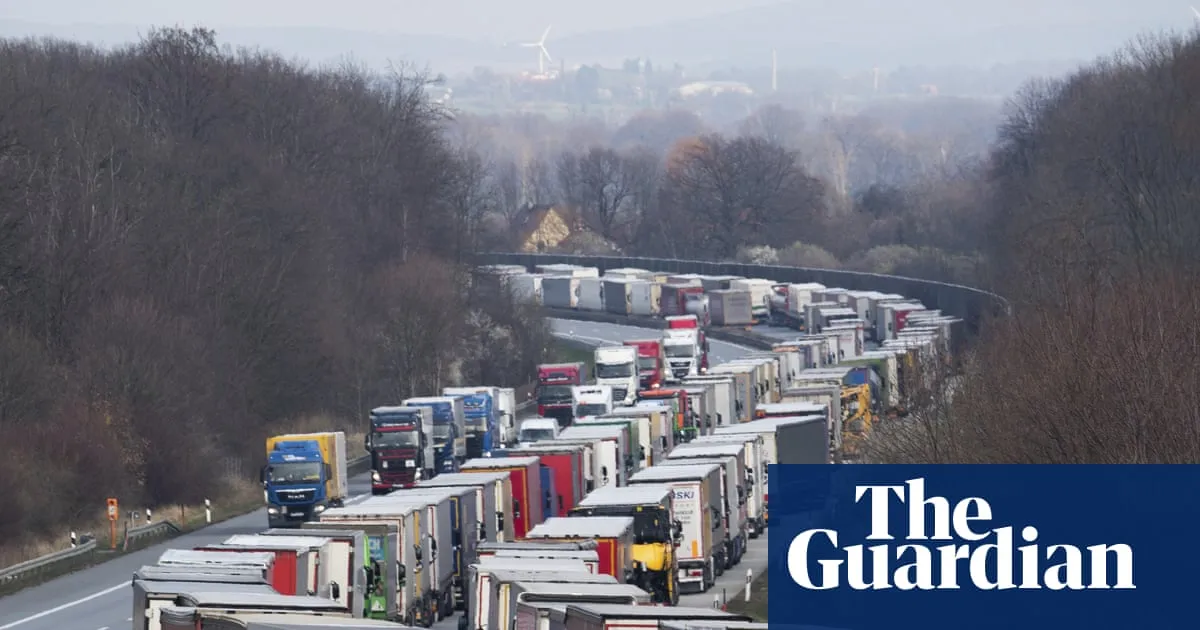
The chances of the European trucking industry hitting zero emissions targets are “dire”, an industry body has warned, as it emerged that only a tiny amount of lorries delivering goods in the EU are electric.Speaking as the European Commission prepares to water down electric car targets, the boss of the association for commercial vehicles called on the commission to commit to an urgent review of the sector, tackling problems including a lack of public charging points, a lack of tax breaks for trucks and high energy costs.“The situation is, in a way, dire,” said Christian Levin, the chair of the commercial vehicles board of the European Automobile Manufacturers’ Association (ACEA) said.About 6m trucks deliver goods across the EU but only 10,000 are electric and are more likely to be operating on short routes, the ACEA said.The commercial sector now wants an audit of the market similar to the commission’s review of the car sector, with expectations it will water down targets for electric cars on Tuesday after a meeting in Strasbourg.Levin said there were also huge financial implications for fleet managers, who faced a price tag of €300,000 (£263,000) for an electric 40-tonne two-axle truck, twice the cost of a diesel alternative.“The main reason why customers are holding back is they just see it’s more expensive to operate with a battery electric vehicle, but they also see less flexibility and higher risk for instance [in] residual value, or [concerns] if they have to change their transport assignment, and suddenly they need to do another route where a charging is not possible,” Levin said.Karin Rådström, the chair of the board of management at Daimler Truck, said trucking companies were willing to go electric but they worked on a 2% to 3% margin and the business case was not there unless reaching zero emissions was made more financially attractive.Under current targets, 43% of Europe’s HGV fleet must be electric by 2030, 65% by 2035 and 90% by 2040, with fines for manufacturers who fail to meet fleet-wide CO2 targets. At the moment, fewer than 2% of new HGV registrations are electrically chargeable trucks.“If the trajectory of uptake continues as is … the industry would pay about €2bn in yearly fines,” Levin said.Rådström said there were only 1,500 public charging points for HGVs across Europe but there needed to be 35,000 to enable the transition to electric, or about 500 installed a month.“I’ve been chief executive of Daimler Truck now for 14 months, and I think in total, during these 14 months, there were less than 500 built. So that just shows you the magnitude of acceleration that we need,” she said.Last year it emerged there was only one public electric charging point for HGVs in the UK.Sigrid de Vries, the director general of the ACEA, called on the commission to instigate an early review of the targets so there “can be a closer alignment between the enabling conditions that are not in place and are not coming online, and the obligations on the sector, including having to pay penalties”.
SRCThe Guardian - World News
LANGEN
LEANCenter-Left
WORDS507
ENT3
MON · 2025-12-15 · 14:02 GMTBRIEF NSR-2025-1215-2733
NSR-2025-1215-2733News Report·EN·Environmental
Chances of EU trucking industry hitting zero emissions targets are dire, says industry body
The European Automobile Manufacturers’ Association (ACEA) warns that the EU trucking industry is unlikely to meet zero emissions targets due to slow adoption of electric trucks. Only a small fraction of the 6 million trucks delivering goods in the EU are electric, with adoption hampered by high costs, lack of charging infrastructure, and insufficient financial incentives.
Lisa O’CarrollThe Guardian - World NewsFiled 2025-12-15 · 14:02 GMTLean · Center-LeftRead · 3 min
The Guardian - World NewsFIG 01
Reading time
3min
Word count
507words
Sources cited
4cited
Entities identified
3entities
Quality score
100%
§ 01
Briefing Summary
AI-generatedNEWSAR · AI
The European Automobile Manufacturers’ Association (ACEA) warns that the EU trucking industry is unlikely to meet zero emissions targets due to slow adoption of electric trucks. Only a small fraction of the 6 million trucks delivering goods in the EU are electric, with adoption hampered by high costs, lack of charging infrastructure, and insufficient financial incentives. The ACEA is calling for an urgent review of the sector, similar to the European Commission's review of electric car targets, which is expected to be watered down. Industry leaders cite the high cost of electric trucks (twice that of diesel), limited charging points (only 1,500 versus the needed 35,000), and operational concerns as major obstacles. Under current targets, a significant portion of the HGV fleet must be electric by 2030, 2035 and 2040, with manufacturers facing fines for non-compliance.
Confidence 0.90Sources 4Claims 5Entities 3
§ 02
Article analysis
Model · rule-basedFraming
Environmental
Economic Impact
Tone
Measured
AI-assessed
CalmNeutralAlarmist
Factuality
0.70 / 1.00
Factual
LowHigh
Sources cited
4
Well sourced
FewMany
§ 03
Key claims
5 extracted01
There are only 1,500 public charging points for HGVs across Europe.
factualKarin Rådström, Daimler Truck
Confidence
1.00
02
Under current targets, 43% of Europe’s HGV fleet must be electric by 2030.
factual
Confidence
1.00
03
Only 10,000 out of 6 million trucks delivering goods across the EU are electric.
statisticACEA
Confidence
1.00
04
An electric 40-tonne two-axle truck costs €300,000, twice the cost of a diesel alternative.
factualChristian Levin, ACEA
Confidence
0.90
05
Chances of the European trucking industry hitting zero emissions targets are “dire”.
quoteChristian Levin, ACEA
Confidence
0.90
§ 04
Full report
3 min read · 507 words§ 05
Entities
3 identifiedKey playerOppositionContextPositiveNeutralNegative
Locations1
§ 06
Keywords & salience
10 termszero emissions targets
1.00
trucking industry
0.90
electric trucks
0.90
charging infrastructure
0.70
european commission
0.60
financial implications
0.60
hgv fleet
0.50
co2 targets
0.50
fleet managers
0.50
acea
0.40
§ 07
Topic connections
Interactive graph Network visualization showing 51 related topics
View Full Graph Person Organization Location Event|Click node to navigate|Edge numbers = shared articles