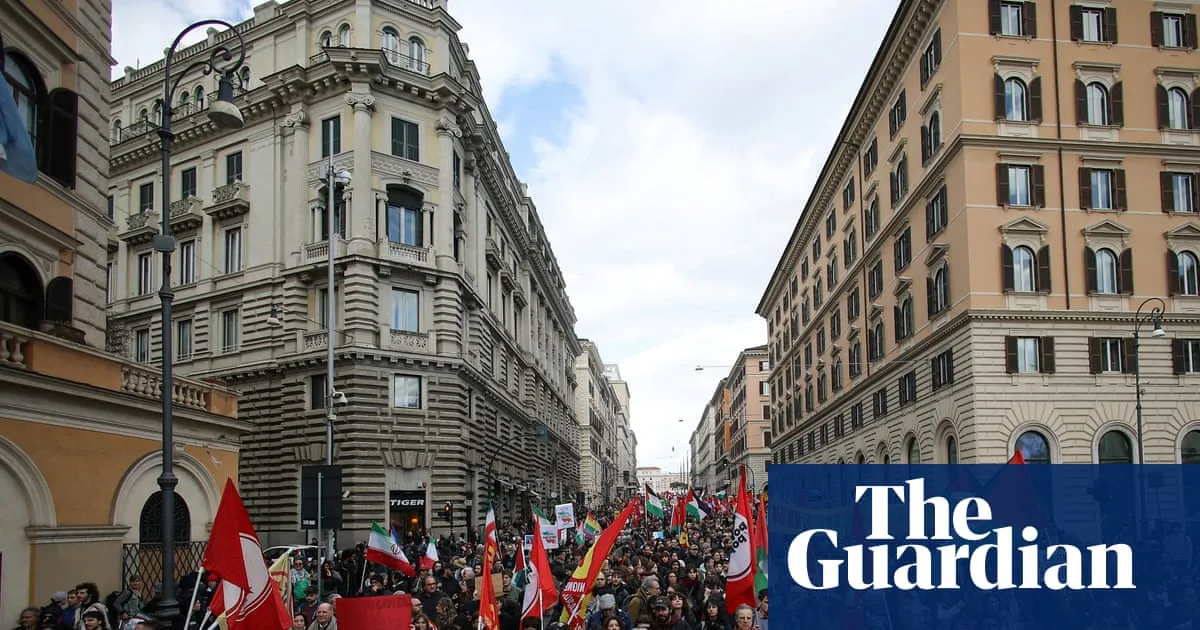
In the run-up to a referendum in Italy on a government quest to overhaul the judiciary, a campaign flyer circulated online quoting Giorgia Meloni, the prime minister, taking aim at judges and feminists. “Judges block the deportations of rapists. Where are the feminists? Vote yes – there will not be another opportunity,” it read.The flyer, posted on the Facebook page of Meloni’s Italy" class="entity-link entity-organization" data-entity-id="40382" data-entity-type="organization">Brothers of Italy, a party with neofascist roots, was subsequently removed. But its tone has defined a campaign dominated by inflammatory rhetoric rather than meaningful debate.At a demonstration against the proposals, Chiara Antonini, from Rome, said: “It is shameful of Meloni to use such threatening language and to intervene on sensitive issues such as the protection of women, especially given the hypocrisy after the government backtracked on a law that would have defined sex without consent as rape. The government just seems to have it in for the judiciary.”After more than three years in power, Meloni is leading one of the most stable governments in the history of the Italian republic and burnishing her image abroad. Now she is putting that hard-won credibility to the test with this high-stakes referendum on Sunday and Monday.Italy’s electorate will vote yes or no to approving amendments to the country’s post-fascism constitution that would shake up the organisation of the justice system. But what is in essence a ballot on a technical and complex change has morphed into a de facto confidence vote on Meloni’s government before a general election in 2027.Mattia Diletti, a politics professor at Sapienza University in Rome, said: “It has become a political referendum and is a power issue for her. It is essentially a choice between Giorgia Meloni or the judges.”Giorgia Meloni says the changes are needed to ensure impartiality, but critics believe they will have the opposite effect. Photograph: Roberto Monaldo/LaPresse/ShutterstockA victory for the yes campaign would usher in changes to how judges and prosecutors are recruited and governed, including separating their career paths, establishing two governing councils selected by lottery and creating a court to handle disciplinary matters.Meloni says the changes are essential for impartiality, in particular to weed out what she calls the leftwing political “factions” ruling the judiciary. Opponents claim they will weaken the power and independence of judges and prosecutors, making them more vulnerable to government control in a manner akin to Viktor Orbán’s Hungary.Opinion polls before the blackout period began pointed to a close race in which the no camp, supported by a significant proportion of the opposition, had gained an edge as the debate intensified.At the end of the campaign, Meloni upped her messaging by accusing judges of undermining her policies to crack down on crime and irregular immigration. She said rejecting the changes would put public safety at risk because it would mean “more immigrants, rapists, paedophiles and drug dealers being freed”. Speaking at a theatre in Milan last week, she said if the ballot failed “we will find ourselves with even more negligent judges and even more surreal sentences”.Carlo Nordio, the justice minister, caused a furore after referring to the judiciary’s supreme council as a “para-mafia system”. His chief of staff, Giusi Bartolozzi, likened the judiciary to a “firing squad” that needed to be eliminated.Justice has long been a thorny issue in Italy, where the spectre of Silvio Berlusconi, the late former prime minister who faced dozens of criminal trials, looms large. Forza Italia, the party founded by Berlusconi, is a partner in Meloni’s ruling coalition. Marina Berlusconi, his daughter, said: “A win for yes wouldn’t just be my father’s [victory].”But Luigi Li Gotti, a criminal lawyer, believes the objective is to come down especially hard on public prosecutors, whom Berlusconi depicted as “the cancer of our democracy”, which could make them more reluctant to investigate high-profile corruption cases and organised crime.Li Gotti, who served as a justice undersecretary in Romano Prodi’s centre-left government, came under fire from Meloni last year for filing a legal complaint against her after Italy released and repatriated a Libyan general wanted for alleged war crimes by the international criminal court.He said the government wanted to change the constitution to “weaken prosecutors and indirectly influence” investigations. Meloni claimed the changes would make Italy’s notoriously sluggish justice system more efficient. “But the goal has nothing to do with improving efficiency,” Li Gotti said.Antonella Attardo, a civil judge in Milan, said that behind the political vitriol was an important vote on significant changes “on which none of us voters have a clue”.“The fear is very much about what will come afterwards,” she said, citing a law change mooted by Antonio Tajani, Italy’s deputy prime minister, that would make police forces more accountable to their relevant government ministries, weakening the power prosecutors have to coordinate an investigation.“This would mean that the executive decides which investigations are going to be done and how,” Attardo said. “The fear is that investigations on corruption or on those close to political or economic power would be silenced.”Micol Parati, a lawyer from Crema in Lombardy who attended a demonstration in Rome in support of the proposals, said: “Nowhere is it written that the judiciary would become slaves of the executive if the referendum wins.”Li Gotti expressed concern that success for Meloni would strengthen her resolve to push forward with other controversial constitutional changes, such as a directly elected prime minister.Meloni appeared on the Italian rapper Fedez’s Pulp podcast this week. Photograph: Vincenzo Nuzzolese/SOPA Images/ShutterstockMeloni is riding high in popularity surveys, which is unusual for Italian leaders this long into an administration. If the referendum goes her way, she will prioritise an electoral law that could give her coalition a comfortable win in the general election, which is due next year.Diletti said: “If she loses, it will be upsetting because it will be much harder for her to prepare for the elections.”In the days before the ballot, Meloni turned to an irreverent podcast hosted by a rapper in an attempt to sway younger voters. “The vote is not about Meloni, it is about justice,” she said.Matteo Bruno, a master’s student in Rome, was unconvinced. “I’m going home to Catania specifically to vote because this is a constitutional reform that might have important consequences for the future of our democracy,” he said.
SRCThe Guardian - World News
LANGEN
LEANCenter-Left
WORDS1 039
ENT7
SUN · 2026-03-22 · 05:00 GMTBRIEF NSR-2026-0322-28330
NSR-2026-0322-28330News Report·EN·Political Strategy
Meloni v the judges: high stakes for Italian PM in vote on judiciary overhaul
Italy is holding a referendum on constitutional amendments that would overhaul the judiciary, a vote seen as a test of Prime Minister Giorgia Meloni's government. The proposed changes affect how judges and prosecutors are recruited, governed, and disciplined.
Angela Giuffrida in RomeThe Guardian - World NewsFiled 2026-03-22 · 05:00 GMTLean · Center-LeftRead · 5 min
The Guardian - World NewsFIG 01
Reading time
5min
Word count
1 039words
Sources cited
2cited
Entities identified
7entities
Quality score
100%
§ 01
Briefing Summary
AI-generatedNEWSAR · AI
Italy is holding a referendum on constitutional amendments that would overhaul the judiciary, a vote seen as a test of Prime Minister Giorgia Meloni's government. The proposed changes affect how judges and prosecutors are recruited, governed, and disciplined. Meloni argues the reforms are needed to ensure impartiality and eliminate political bias within the judiciary. Critics contend the changes would weaken judicial independence and make judges more susceptible to government influence. The campaign has been marked by inflammatory rhetoric, including a controversial flyer linking judges to the deportation of rapists. The outcome of the referendum, taking place on Sunday and Monday, is viewed as a de facto confidence vote on Meloni's government before the 2027 general election.
Confidence 0.90Sources 2Claims 5Entities 7
§ 02
Article analysis
Model · rule-basedFraming
Political Strategy
Legal & Judicial
Tone
Mixed Tone
AI-assessed
CalmNeutralAlarmist
Factuality
0.60 / 1.00
Mixed
LowHigh
Sources cited
2
Limited
FewMany
§ 03
Key claims
5 extracted01
Meloni says the changes are needed to ensure impartiality in the judiciary.
quoteGiorgia Meloni
Confidence
1.00
02
Meloni's government is seeking to overhaul the judiciary.
factual
Confidence
1.00
03
A referendum will be held in Italy on amendments to the constitution regarding the justice system.
factual
Confidence
1.00
04
The vote has become a de facto confidence vote on Meloni’s government.
quoteMattia Diletti
Confidence
0.90
05
Opponents claim the changes will weaken the independence of judges and prosecutors.
factual
Confidence
0.90
§ 04
Full report
5 min read · 1 039 words§ 05
Entities
7 identifiedKey playerOppositionContextPositiveNeutralNegative
§ 06
Keywords & salience
9 termsjudiciary overhaul
0.90
giorgia meloni
0.80
italian referendum
0.80
judges
0.70
political referendum
0.60
impartiality
0.60
government control
0.50
justice system
0.50
feminists
0.40
§ 07
Topic connections
Interactive graph Network visualization showing 34 related topics
View Full Graph Person Organization Location Event|Click node to navigate|Edge numbers = shared articles