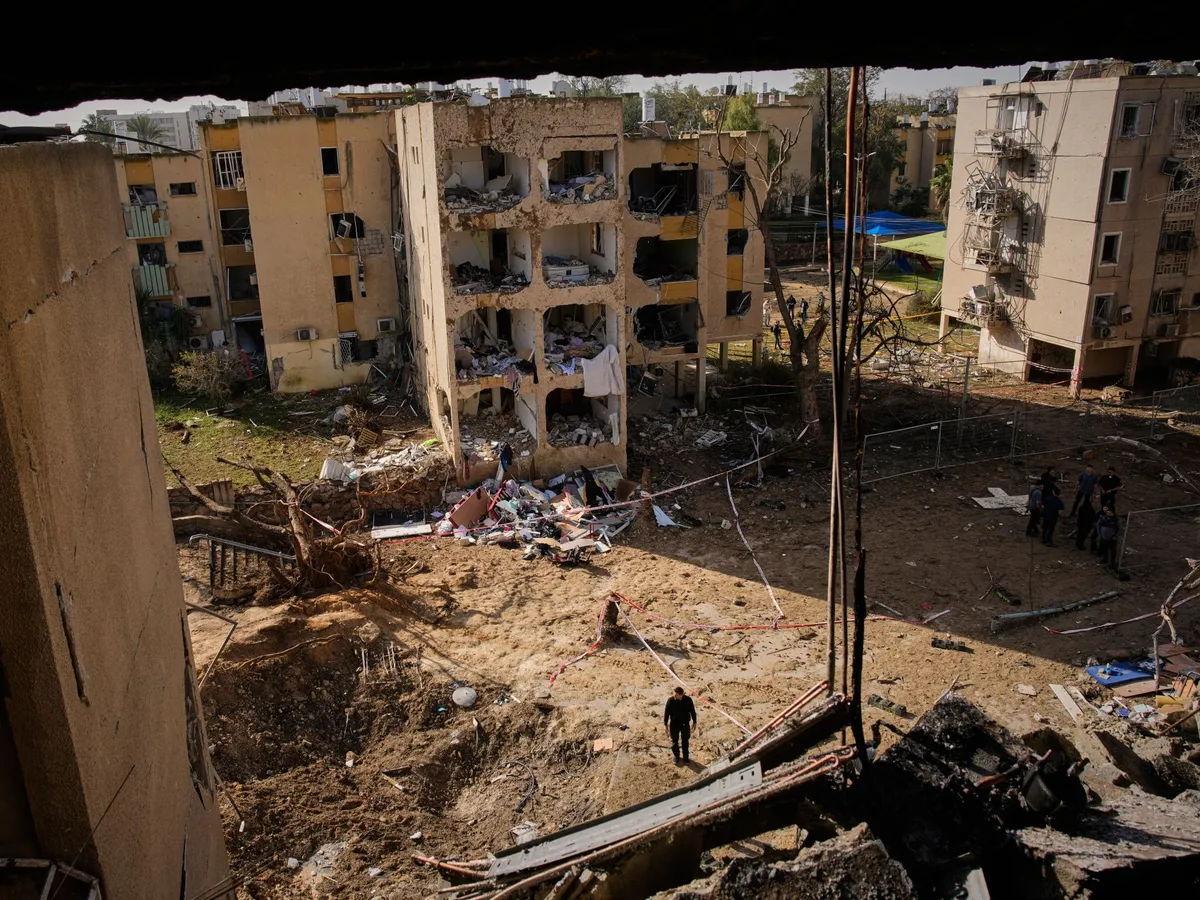
Iranian attacks on Arad and Dimona near Israeli nuclear site raise serious questions about Israel’s defence strategy.People look at residential buildings damaged by an Iranian missile strike in Arad, southern Israel, Sunday, March 22, 2026. [Ohad Zwigenberg/AP]Published On 22 Mar 2026Iranian missiles have struck the towns of Arad and Dimona near an Israeli nuclear research centre in what Iran says was a response to an Israeli attack on its Natanz nuclear facility in Isfahan province.At least 180 people were wounded in Saturday’s attack, and hundreds of people have been evacuated from the strategic towns as the Israeli-United States war on Iran is seemingly entering a new, more lethal phase of fighting.Recommended Stories list of 3 itemslist 1 of 3‘The United States doesn’t even pretend to be within international law’list 2 of 3Photos: Aftermath of Iranian missile strikes near Israel’s nuclear facilitylist 3 of 3Iran war is creating ‘heightened risks of instability across countries in Aend of listIsraeli Prime Minister Benjamin Netanyahu said his country had a “very difficult evening in the battle for our future”. There have been at least 4,564 people wounded in Israel, according to the Ministry of Health, since the start of the war on February 28.Analysts said that while Israel has regularly waged military campaigns on Gaza, the occupied West Bank, Lebanon and elsewhere, it is rare for the Israeli public to feel the effects of war like it has over the past three weeks.In Palestinian territory, including Gaza, Israeli forces have used disproportionate force against armed groups, who use rudimentary rockets to fire at Israel. Israel’s war on Gaza has been called a genocide by scholars and rights groups.With Saturday’s high casualty count, the attacks in Arad and Dimona raise a question: Has Israel underestimated Iranian military capabilities?What weapons is Iran using?Defence analysts described Iran’s missile programme as the Middle East’s largest and most varied. Developed over decades, it contains ballistic and cruise missiles and is designed to give Tehran reach even despite its lack of a modern air force.Iran has short- and medium-range missile systems and longer-range land-attack and antiship cruise missiles.Iran’s short-range ballistic missiles have a range of roughly 150km to 800km (93 to 500 miles) and are built for nearby military targets and rapid regional strikes.Their core systems include the Fateh variants: Zolfaghar, Qiam-1 and older Shahab-1/2 missiles. Their shorter range can be an advantage in a crisis. They can be launched in volleys, compressing warning times and making pre-emption harder.Those medium-range systems include the Shahab-3, Emad, Ghadr-1, the Khorramshahr variants and Sejjil. They also have newer designs like Kheibar Shekan and Haj Qassem.Iran’s land-attack and antiship cruise missiles include the Soumar, Ya-Ali and the Quds variants, Hoveyzeh, Paveh and Ra’ad.The longest reaching ballistic missiles, the Soumar, have a range of 2,000km to 2,500km (1,243 to 1,553 miles). However, it was reported that two Iranian missiles were fired late on Thursday or early on Friday on Diego Garcia, the site of a joint US-United Kingdom military base in the Indian Ocean that is 4,000km (2,485 miles) from Iran. The UK said the attack failed, and an Iranian official denied firing the missile.Former Iranian Supreme Leader Ali Khamenei had previously limited Iranian missile ranges to 2,200km (1,367 miles) but removed that limit after Israel’s 12-day war on Iran in June. The US joined Israel in that war as well, carrying out one day of attacks on Iran’s three main nuclear facilities.“Iran has also used cluster munitions in its attacks on Israel. Each kind of warhead the Iranians have also uses a cluster warhead,” Uzi Rubin, founding director of Israel’s missile defence programme and a senior fellow at the Jerusalem Institute for Strategy and Security, told the US news agency Media Line.What is a cluster munition or warhead?Instead of a single explosive payload, a cluster warhead disperses multiple bomblets.“The tip of the missile, instead of containing a big barrel of explosives, contains a mechanism which holds on to a lot of small bombs. And when the missile approaches the target, it opens its skin, it peels off and it spins around and the bomblets are released and released into space and fall on the ground,” Rubin told Media Line.He added that Iranian cluster warheads may contain 20 to 30 bomblets or 70 to 80, depending on the missile.These munitions are not new for Iran either. Iran reportedly also used cluster munitions in the 12-day war.Amnesty International called Iran’s use of cluster munitions during that war a flagrant violation of international humanitarian law while Israel has also been accused of using cluster bombs in Lebanon.Cluster munitions were banned in 2008 when the Convention on Cluster Munitions was adopted. Neither Iran nor Israel are signatories to the convention.Why are they making an impact now?An Israeli military spokesman said Israel’s air defence systems failed to intercept some of the Iranian missiles that hit Arad and Dimona despite being activated. He said Iran’s weaponry was not “special or unfamiliar” and an investigation was under way.So why are these cluster munitions now making an impact? There are a few reasons.For a ballistic missile equipped with cluster bomblets to be intercepted, it must happen before the payload opens and releases the submunitions. After the payload opens, the missile goes from a single point of attack to multiple points, making it difficult to stop.On Thursday, The Times of Israel reported that the Israeli air force will start conserving interceptors. Military officials reportedly said at the time that Iranian cluster bombs are unlikely to cause significant harm if people have taken shelter and, therefore, may avoid shooting down some of them.What is next?In the next stage of the war, Iran, the US and Israel may continue to target important infrastructure.The US and Israel struck Iran’s Natanz nuclear facility on Saturday, according to the Iranian Atomic Energy Organisation. This facility in central Iran is one of the country’s most important uranium enrichment sites, about 220km (135 miles) southeast of Tehran.In response, Iran launched the attacks on Arad and Dimona, home to Israel’s main nuclear facility.Israel previously struck fuel storage facilities in Tehran, leading to vast, toxic smoke over the Iranian capital. For its part, the US previously hit Kharg Island, Iran’s oil export hub, and threatened to do it again.Iran has essentially closed the Strait of Hormuz, a vital chokepoint for global shipping and oil transport, and has targeted military bases and crucial energy infrastructure across Arab Gulf countries.US President Donald Trump demanded the reopening of the strait and threatened to begin hitting energy infrastructure should Iran not comply.“If Iran doesn’t FULLY OPEN, WITHOUT THREAT, the Strait of Hormuz, within 48 HOURS from this exact point in time, the United States of America will hit and obliterate their various POWER PLANTS, STARTING WITH THE BIGGEST ONE FIRST,” Trump wrote on Truth Social at 23:44 GMT on Saturday.
SRCAl Jazeera
LANGEN
LEANCenter
WORDS1 134
ENT11
SUN · 2026-03-22 · 16:14 GMTBRIEF NSR-2026-0322-29237
NSR-2026-0322-29237News Report·EN·National Security
Did Israel miscalculate Iranian military capabilities?
In March 2026, Iranian missiles struck the Israeli towns of Arad and Dimona, near a nuclear research center, wounding at least 180 people. Iran stated the attack was retaliation for an Israeli strike on its Natanz nuclear facility.
Al Jazeera StaffAl JazeeraFiled 2026-03-22 · 16:14 GMTLean · CenterRead · 5 min
Al JazeeraFIG 01
Reading time
5min
Word count
1 134words
Sources cited
2cited
Entities identified
11entities
Quality score
100%
§ 01
Briefing Summary
AI-generatedNEWSAR · AI
In March 2026, Iranian missiles struck the Israeli towns of Arad and Dimona, near a nuclear research center, wounding at least 180 people. Iran stated the attack was retaliation for an Israeli strike on its Natanz nuclear facility. The incident marks a potentially more lethal phase in the ongoing Israeli-United States war on Iran, which began on February 28 and has already injured thousands in Israel. Analysts suggest the attack raises questions about whether Israel has underestimated Iran's military capabilities, particularly its extensive and varied missile program. Iran's missile arsenal includes short, medium, and long-range ballistic and cruise missiles.
Confidence 0.90Sources 2Claims 5Entities 11
§ 02
Article analysis
Model · rule-basedFraming
National Security
Conflict
Tone
Mixed Tone
AI-assessed
CalmNeutralAlarmist
Factuality
0.70 / 1.00
Factual
LowHigh
Sources cited
2
Limited
FewMany
§ 03
Key claims
5 extracted01
There have been at least 4,564 people wounded in Israel since the start of the war on February 28.
statisticMinistry of Health
Confidence
1.00
02
At least 180 people were wounded in Saturday’s attack.
statistic
Confidence
1.00
03
Iranian missiles have struck the towns of Arad and Dimona near an Israeli nuclear research centre.
factual
Confidence
1.00
04
Iran’s missile programme as the Middle East’s largest and most varied.
factualDefence analysts
Confidence
0.90
05
Israel’s war on Gaza has been called a genocide by scholars and rights groups.
factual
Confidence
0.80
§ 04
Full report
5 min read · 1 134 words§ 05
Entities
11 identifiedKey playerOppositionContextPositiveNeutralNegative
§ 06
Keywords & salience
9 termsiranian military capabilities
0.90
israeli defence strategy
0.80
missile strikes
0.80
iran
0.70
israel
0.70
nuclear facility
0.60
ballistic missiles
0.60
war
0.50
middle east
0.50
§ 07
Topic connections
Interactive graph Network visualization showing 51 related topics
View Full Graph Person Organization Location Event|Click node to navigate|Edge numbers = shared articles