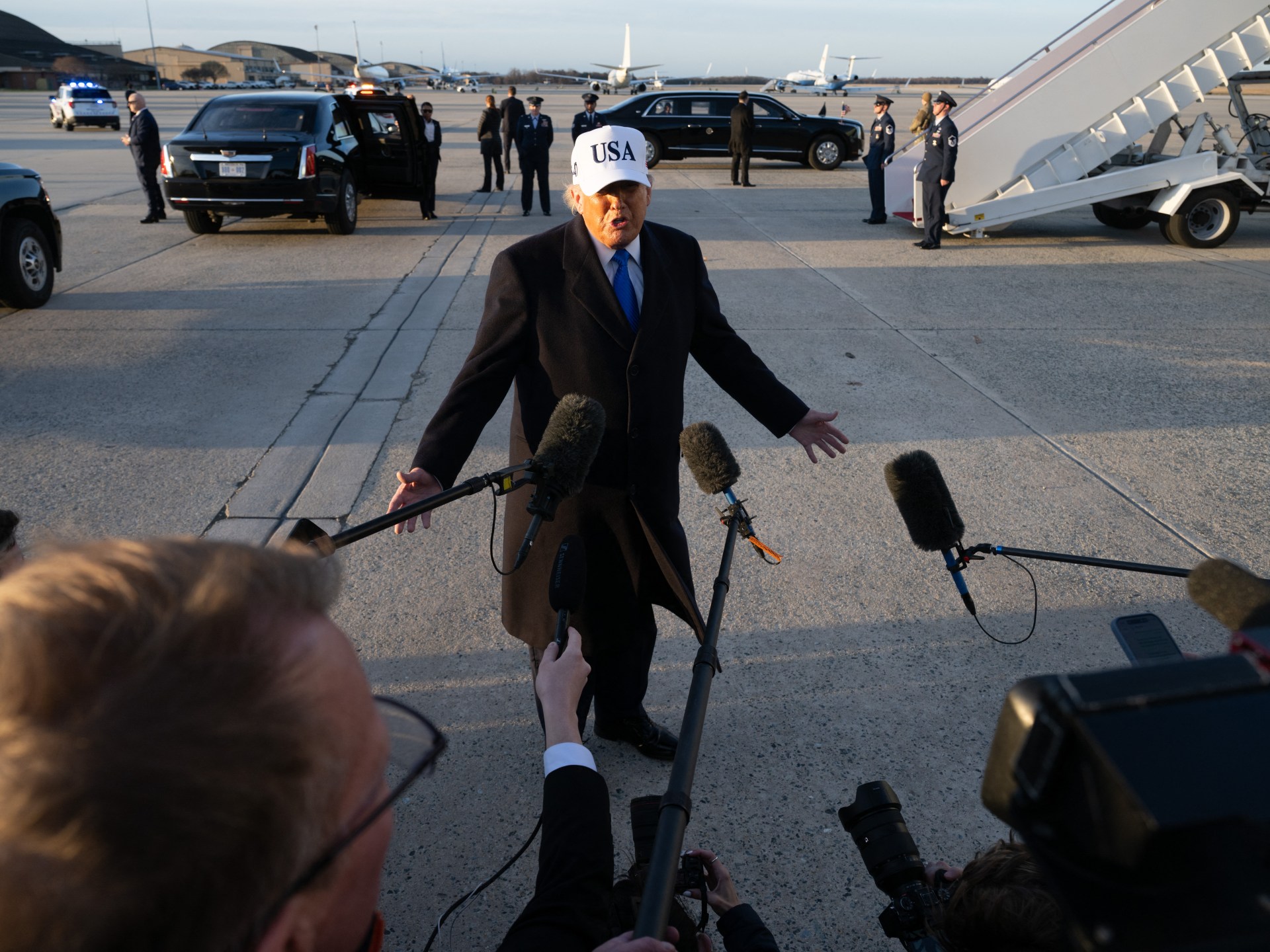
Threat to punish broadcasters for coverage not in ‘public interest’ comes amid wider roll-backs, analysts say.US President Donald Trump speaks to reporters before boarding Air Force One as he departs Joint Base Andrews in Maryland [AFP]Published On 23 Mar 2026Washington, DC – United States President Donald Trump has led a political career defined by claims of biased and unfair media coverage against him. He has also levelled charges that so-called “woke” ideology and “cancel culture” have stifled conservative voices, and accused academic institutions of driving bias towards progressive viewpoints.In fact, one of Trump’s earliest actions in office was signing executive orders “restoring freedom of speech and ending federal censorship”, focusing primarily on former President Joe Biden’s administration’s efforts to curb “disinformation” and “misinformation”.Recommended Stories list of 3 itemslist 1 of 3Paramount’s Warner Bros Discovery bid faces conflict of interest concernslist 2 of 3Stephen Colbert says CBS pulled interview with Texas Democratic candidatelist 3 of 3FCC reject claims of censorship, announces probe into US show The Viewend of listBut free speech advocates say the Trump administration has reached new heights in its sweeping efforts to transform constitutionally protected speech rights, wielding the weight of ostensibly independent regulators and immigration law to do so.The most recent example came in the form of threats by Federal Communications Commission (FCC) Chairman Brendan Carr, who, referring to the US and Israel’s war on Iran, said he would revoke the licences of broadcasters that are “running hoaxes and news distortions” and that do not “operate in the public interest”.The statement, which was a response to Trump’s criticism of US news coverage of the war, was cheered by the president, who said he was “thrilled” to see Carr investigating “Corrupt and Highly Unpatriotic ‘News’ Organizations”.‘Most extreme example’To be sure, US presidents have long criticised media coverage critical of their actions and have historically launched policies that rights groups say raise free speech concerns.Those range from actions taken by former President George W Bush during the so-called “war on terror”, including the increased surveillance of US citizens and non-citizens alike under the Patriot Act.More recently, the Biden administration in 2022 created and quickly paused a so-called Disinformation Governance Board at the Department of Homeland Security, which several free speech groups had criticised for opening the door to subjective government interference on the issue of disinformation.Nevertheless, several free speech observers told Al Jazeera that Trump’s actions have been singularly robust, with his years-long rhetorical threats against the media, which have turned more towards action in his second term.“The second Trump administration has really been characterised by concrete actions to threaten or intimidate or control or weaken the media,” Clayton Weimers, the executive director of Reporters Without Borders (RSF) USA, told Al Jazeera.Weimers said Carr’s threat related to coverage of the Iran war was “one of the most extreme examples” of that approach.Several rights observers agreed that any effort by Carr to revoke broadcast licences for coverage of the Iran war would face an uphill legal battle.But they also argued that it is likely besides the point.“In practice, the FCC can’t take someone’s licence away just like that,” said Weimers. “It’s a really, really long process… and the FCC would likely not get away with it”.“They’re meant as threats, and the threats sometimes work,” he said, noting that local broadcasters rarely have the legal resources or know how to respond to such threats.He pointed to the KCBS-AM radio station in California’s Bay Area, which came under fire from Carr for its reporting on immigration raids in the area.As Carr announced an investigation, the station demoted an anchor and appeared to dial back any coverage considered political.“The threat worked,” Weimers said. “It doesn’t have to be backed up by anything.”‘Completely unprecedented’ approach to FCCThe FCC, established by Congress in 1934, has historically been an independent regulatory agency that, according to its mission statement, “regulates interstate and international communications by radio, television, wire, satellite and cable”.It is also tasked, in part, with “ensuring an appropriate competitive framework” for the US media landscape, including reviewing potential mergers between major telecommunication and media organisations.Victor Pickard, a professor of media policy and political economy at the University of Pennsylvania, said Trump and Carr appear to be approaching the commission in a way unlike any other administration in recent decades.“What is completely unprecedented is the way they have weaponised the Federal Communications Commission,” Pickard told Al Jazeera.“This purportedly independent regulatory agency is just so clearly carrying water for the Trump administration,” he said.Carr himself has indicated little separation from Trump, telling a Senate committee in December of last year that it “is not an independent agency, formally speaking”.Former FCC lawyers have refuted the position, arguing that Congress had envisioned the panel as autonomous from the White House; nevertheless, the word “independent” was scrubbed from the agency’s website following Carr’s testimony.Throughout the first months of Trump’s second term, Carr has taken a confrontational approach to broadcasters.Shortly after Trump took office, Carr reinstated a series of complaints against ABC, CBS and NBC, related to their 2024 election coverage. He launched investigations into the public media companies PBS and NPR, amid a wider Republican effort to cut funding for the organisations over alleged liberal bias.In September, US talk show host Jimmy Kimmel was briefly pulled off his late-night show by ABC managers. This came amid reported pressure from Carr over comments Kimmel had made about the killing of conservative activist Charlie Kirk.Carr has also threatened investigations over the so-called “equal time rule”, which says broadcasters must provide equal access on the airwaves to political opponents. This has affected the daytime talk show The View and CBS late-night host Stephen Colbert.Critics have called the requirements antiquated and logistically impossible.Pickard explained that Carr’s threats have come amid a broader shift in the US media landscape, where beleaguered companies are increasingly eyeing new business deals and mergers.This included the August 2025 acquisition of Paramount, and by proxy, CBS News, by Skydance Media, owned by David Ellison, the son of Trump ally Larry Ellison.Paramount-Skydance recently agreed to acquire Warner Bros Discovery, which owns CNN.“It’s the media owners who are trying to make these deals, and so they, in turn, are going to exert pressure on people below them to make sure that they’re not overly adversarial towards the Trump administration,” Pickard explained.“So this all goes towards this broader aim of trying to rein in the press; trying to push them to amplify Trump’s preferred narratives and talking points,” he said.Trump himself recently posted a graphic on his Truth Social account claiming he was “reshaping the media”, pointing to “new ownership” at CNN, while hailing the appointment of a so-called “news bias ombudsman” at CBS who had formerly headed the conservative Hudson Institute.Multipronged approachStill, the FCC is only one prong of how the Trump administration has approached rights protected by the US Constitution.Other initiatives have seen the administration use immigration law to target individuals for their speech, notably pro-Palestine student protesters; it has used public funding to pressure private universities to change their policies on free speech, protest and diversity programmes on campus; and it has pursued a largely-defunct effort to punish law firms that employed Trump’s perceived political enemies.
SRCAl Jazeera
LANGEN
LEANCenter
WORDS1 196
ENT9
MON · 2026-03-23 · 11:10 GMTBRIEF NSR-2026-0323-30598
NSR-2026-0323-30598News Report·EN·Political Strategy
Threats over Iran war bare Trump efforts to transform free speech: Experts
In 2026, President Trump's administration is facing criticism for its efforts to reshape free speech rights in the US. The administration has accused media outlets of bias and stifling conservative voices, while also claiming to protect free speech by ending federal censorship.
Joseph StepanskyAl JazeeraFiled 2026-03-23 · 11:10 GMTLean · CenterRead · 5 min
Al JazeeraFIG 01
Reading time
5min
Word count
1 196words
Sources cited
3cited
Entities identified
9entities
Quality score
100%
§ 01
Briefing Summary
AI-generatedNEWSAR · AI
In 2026, President Trump's administration is facing criticism for its efforts to reshape free speech rights in the US. The administration has accused media outlets of bias and stifling conservative voices, while also claiming to protect free speech by ending federal censorship. However, free speech advocates argue that the administration is using regulatory bodies and immigration law to suppress constitutionally protected speech. Recently, FCC Chairman Brendan Carr threatened to revoke the licenses of broadcasters deemed to be spreading "hoaxes and news distortions" regarding the US and Israel's war on Iran, a statement praised by Trump. Critics argue that these actions represent an extreme example of presidential interference with media freedom, following a historical pattern of presidents attempting to control media narratives.
Confidence 0.90Sources 3Claims 5Entities 9
§ 02
Article analysis
Model · rule-basedFraming
Political Strategy
Human Rights
Tone
Mixed Tone
AI-assessed
CalmNeutralAlarmist
Factuality
0.60 / 1.00
Mixed
LowHigh
Sources cited
3
Well sourced
FewMany
§ 03
Key claims
5 extracted01
Biden administration created and paused a Disinformation Governance Board in 2022.
factualArticle
Confidence
1.00
02
Trump signed executive orders "restoring freedom of speech and ending federal censorship".
factualArticle
Confidence
1.00
03
FCC Chairman Carr threatened to revoke licenses of broadcasters running "hoaxes and news distortions".
quoteArticle (reporting Carr's statement)
Confidence
0.90
04
Trump has claimed biased media coverage and stifling of conservative voices.
quoteArticle (reporting Trump's claims)
Confidence
0.90
05
Free speech observers told Al Jazeera that Trump's actions have been singularly robust.
quoteFree speech observers
Confidence
0.70
§ 04
Full report
5 min read · 1 196 words§ 05
Entities
9 identifiedKey playerOppositionContextPositiveNeutralNegative
People4
Organizations2
§ 06
Keywords & salience
9 termsfree speech
1.00
donald trump
0.80
media coverage
0.80
censorship
0.70
federal communications commission
0.60
public interest
0.60
disinformation
0.50
iran war
0.50
political bias
0.40
§ 07
Topic connections
Interactive graph Network visualization showing 51 related topics
View Full Graph Person Organization Location Event|Click node to navigate|Edge numbers = shared articles