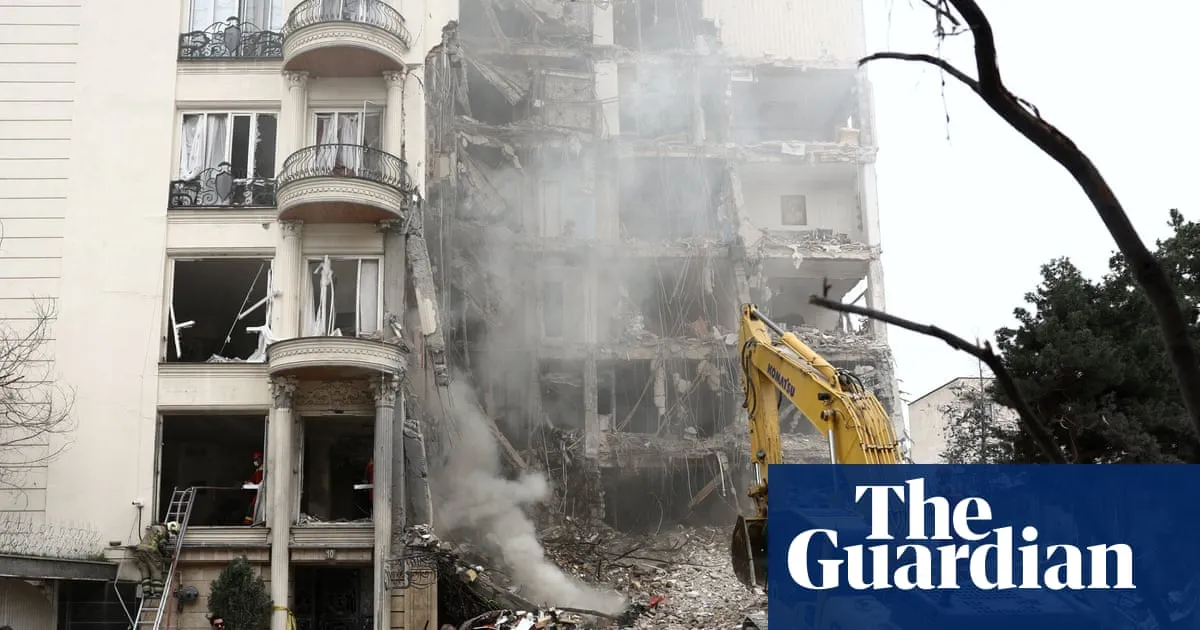
The Israeli military said it had launched a new wave of strikes on Tehran, after Donald Trump signalled a pause in US attacks against energy infrastructure after what he said were productive talks with Iran.The Israeli Defense Forces (IDF) said it would continue operations in line with Israeli government directives until told otherwise.About 40 minutes after Trump said he had extended by five days his deadline to strike Iran’s power plants, describing talks with Tehran as “productive”, the IDF said on X it had “just begun another wave of strikes targeting infrastructure of the Iranian terror regime across Tehran”.The IDF told the Guardian that energy infrastructure would be spared, suggesting Israel may follow Washington in suspending any targeting of Iranian power plants and related sites.An IDF official told the Times of Israel that the military could not comment on the US president’s announcement of negotiations with Iran, saying it was a “political echelon matter”, and stating the IDF was ‘‘operating in accordance with the directives of Israel’s political leadership and will continue to strike in Iran according to its plans until instructed otherwise”.Al Jazeera Arabic’s correspondent in Tehran reported that the size and volume of the explosions in the Iranian capital were “unprecedented”.Israel has not recently threatened to strike such facilities, but the defence minister, Israel-katz" class="entity-link entity-person" data-entity-id="4249" data-entity-type="person">Israel Katz, said on Sunday that attacks on Iran and on “the infrastructure it relies on” would significantly escalate.Iran’s Revolutionary Guards on Monday said they launched a new attack on targets in Israel.Before Israel launched its latest strikes on Iran, Trump wrote on social media that Washington and Tehran “have had, over the last two days, very good and productive conversations”.He added that he had “instructed the Department of War to postpone any and all military strikes against Iranian power plants and energy infrastructure for a five-day period, subject to the success of the ongoing meetings and discussions”.Trump flip-flops on Iran deadline | The LatestThe Israeli prime minister’s office did not immediately respond to requests for comment on the US-Iran talks or Washington’s decision to refrain from targeting certain Iranian sites.On Monday, in a statement on Telegram, the Israeli military said it had struck a series of military bases and weapons sites in a fresh round of attacks on Iran, including an Islamic Revolutionary Guards Corps air defence and ground forces headquarters, a Quds Force base and intelligence site, and a defence ministry missile production facility, as well as other research and manufacturing centres.The Guardian could not independently verify the claims.The US-based Human Rights Activists News Agency (HRANA) said in the previous 24 hours it had recorded at least 206 attacks across 15 provinces in Iran, resulting in at least four casualties (killed and injured, both civilian and military).With the killing of a child on Monday, it is estimated at least 15% of the total human casualties in Iran so far have been under the age of 18.At least six people were killed in strikes on homes in Tabriz city, according to Fars.Since US-Israeli bombs started falling on Iran, estimates of total fatalities (military and civilian) in the country have surpassed 1,500, with some rights groups reporting figures as high as 3,230 as of 21 March.Earlier, the IDF said it had destroyed or rendered inoperable about 330 of Iran’s estimated 470 ballistic missile launchers since the beginning of the war, with more than half hit in airstrikes and others disabled after entrances to underground storage sites were targeted.The military said the air force was continuing to pursue the remaining launchers, as missile fire on Israel has fallen to about 10 a day in recent days, down from roughly 90 at the start of the conflict.Meanwhile, Israel has continued its military campaign in Lebanon. Israeli strikes hit Beirut’s southern suburbs on Monday, the first attack on the Hezbollah stronghold in days, as its military said it had captured two members of the Iran-backed group in southern Lebanon. Lebanon’s health ministry reported that one person was killed.The Israeli military also announced it was “striking Hezbollah infrastructure in Beirut” after having called on residents to leave the southern suburbs beforehand.The state news agency also said Israeli forces had positioned themselves inside the southern village of Aita al-Chaab, deploying a large crane equipped with surveillance cameras facing nearby Ramiyah.On Monday, Bezalel Smotrich, Israel’s far-right finance minister, called for the annexation of areas in southern Lebanon, saying Israel should “apply sovereignty” over areas under its control, signalling an expansionist vision that has alarmed critics at home and abroad.On an Israeli radio programme, Smotrich said the military campaign in Lebanon “needs to end with a different reality entirely, both with the Hezbollah decision but also with the change of Israel’s borders”.“I say here definitively … in every room and in every discussion, too: the new Israeli border must be the Litani [river],” he added.
SRCThe Guardian - World News
LANGEN
LEANCenter-Left
WORDS803
ENT10
MON · 2026-03-23 · 17:30 GMTBRIEF NSR-2026-0323-31179
NSR-2026-0323-31179News Report·EN·Conflict
Israel launches new strikes on Tehran as Trump pauses Iran energy attacks
Following what Donald Trump described as productive talks with Iran, Israel launched a new wave of strikes on Tehran, targeting infrastructure of the "Iranian terror regime." This occurred shortly after Trump announced a five-day postponement of US military strikes against Iranian power plants and energy infrastructure. The Israeli military stated it would continue operations as directed by the Israeli government, regardless of the US announcement.
Lorenzo Tondo in JerusalemThe Guardian - World NewsFiled 2026-03-23 · 17:30 GMTLean · Center-LeftRead · 4 min
The Guardian - World NewsFIG 01
Reading time
4min
Word count
803words
Sources cited
7cited
Entities identified
10entities
Quality score
100%
§ 01
Briefing Summary
AI-generatedNEWSAR · AI
Following what Donald Trump described as productive talks with Iran, Israel launched a new wave of strikes on Tehran, targeting infrastructure of the "Iranian terror regime." This occurred shortly after Trump announced a five-day postponement of US military strikes against Iranian power plants and energy infrastructure. The Israeli military stated it would continue operations as directed by the Israeli government, regardless of the US announcement. While the IDF indicated energy infrastructure would be spared, it declined to comment on the US-Iran negotiations. Iran's Revolutionary Guards also claimed to have launched a new attack on targets in Israel. The strikes in Tehran were reported as being unprecedented in size and volume.
Confidence 0.90Sources 7Claims 5Entities 10
§ 02
Article analysis
Model · rule-basedFraming
Conflict
Political Strategy
Tone
Mixed Tone
AI-assessed
CalmNeutralAlarmist
Factuality
0.70 / 1.00
Factual
LowHigh
Sources cited
7
Well sourced
FewMany
§ 03
Key claims
5 extracted01
HRANA recorded at least 206 attacks across 15 provinces in Iran in the previous 24 hours.
statisticHuman Rights Activists News Agency (HRANA)
Confidence
1.00
02
Iran's Revolutionary Guards launched a new attack on targets in Israel.
factualIran’s Revolutionary Guards
Confidence
1.00
03
IDF said energy infrastructure would be spared.
factualIDF
Confidence
1.00
04
Trump paused US attacks against energy infrastructure after productive talks with Iran.
factualDonald Trump
Confidence
1.00
05
Israeli military launched a new wave of strikes on Tehran.
factualIsraeli Defense Forces (IDF)
Confidence
1.00
§ 04
Full report
4 min read · 803 words§ 05
Entities
10 identifiedKey playerOppositionContextPositiveNeutralNegative
Organizations3
§ 06
Keywords & salience
10 termsisraeli strikes
0.90
iran
0.90
israel
0.90
tehran
0.80
military strikes
0.70
idf
0.70
energy infrastructure
0.70
negotiations
0.60
political leadership
0.50
iranian terror regime
0.40
§ 07
Topic connections
Interactive graph Network visualization showing 51 related topics
View Full Graph Person Organization Location Event|Click node to navigate|Edge numbers = shared articles