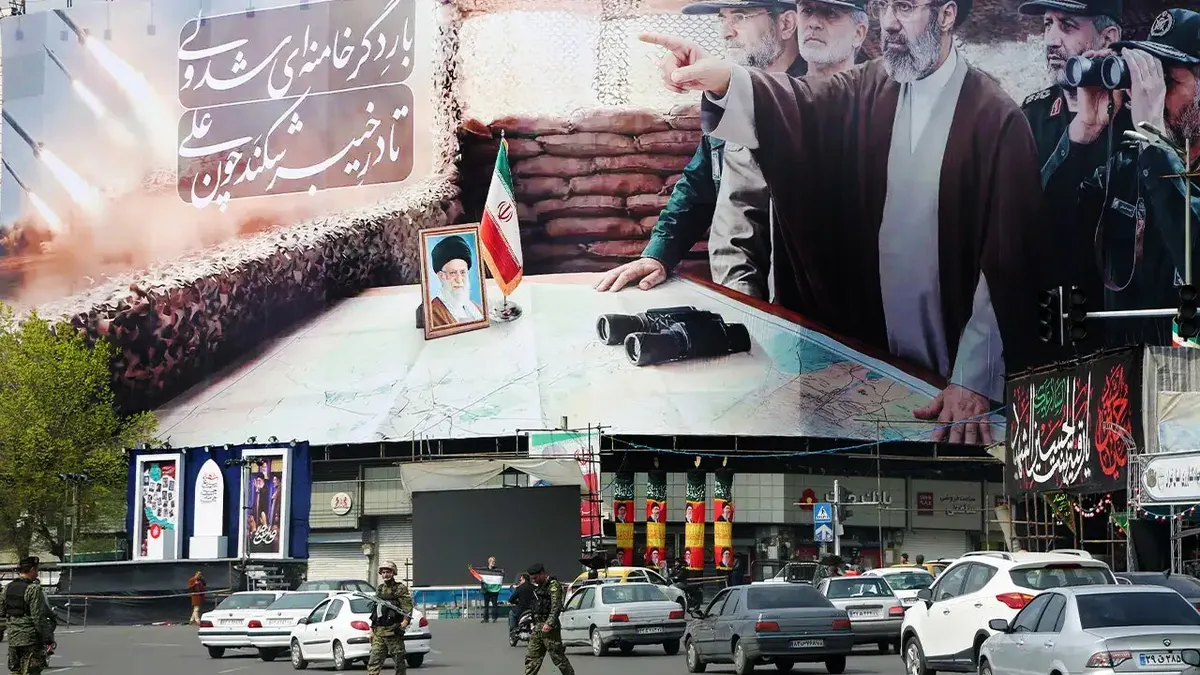
"Nobody knows who to talk to," President Donald Trump said Tuesday at the White House, describing what he portrayed as both chaos and opportunity inside Iran’s leadership. "But we're actually talking to the right people, and they want to make a deal so badly." His remarks come as the U.S. claims it is engaged in talks with a "top" Iranian figure, even as Tehran publicly denies negotiations are taking place. The question now is not just whether talks are happening, but whether anyone in Tehran has the authority to deliver. With U.S.-Israel strikes on senior Iranian leadership and growing internal fractures, Iran appears to be operating less like a centralized theocracy and more like a wartime system run by overlapping power centers, with the Islamic Revolutionary Guard Corps (IRGC) at its core. Here’s who matters now. TRUMP’S MIDDLE EAST ENVOY REVEALS WHAT LED TO BREAKDOWN IN Iran TALKS BEFORE OPERATION EPIC FURY Across intelligence assessments and recent reporting, one conclusion is consistent: the Islamic Revolutionary Guard Corps has emerged as the dominant force in Iran’s political system . Behnam Ben Taleblu, senior fellow at the Foundation for Defense of Democracies Washington, D.C., think tank, said the current moment is accelerating a long-standing trend. "No doubt both the 12-Day war and this current conflict have trimmed the commanding heights of the Islamic Republic's political and military leadership," he said. "But it has also expedited the trend lines inherent in Iranian politics, which is the dominance of the security forces and the ascendance of the IRGC." "Yes, there is more IRGC control over the state than ever before, but the state is weaker than ever before and more of a national security rump state than ever before," he said. "It shouldn't particularly preoccupy Washington, who is and isn't offering negotiations," Ben Taleblu added. "The preeminent preoccupation of Washington has to be working toward a military win at a political win, and that does not come by working with the IRGC, but actually beating them on the battlefield and supporting the forces most arrayed against them in Iran, which are the Iranian people." If the Islamic Revolutionary Guard Corps is the power in Iran, the Supreme National Security Council appears to be the mechanism through which that power is exercised. The Supreme National Security Council is Iran’s top forum for coordinating military and foreign policy, bringing together senior Islamic Revolutionary Guard Corps commanders and government officials under the authority of the supreme leader. It was established after the 1979 revolution and has played a central role in managing major crises, from nuclear negotiations to wartime operations. Iran appointed Mohammad Bagher Zolghadr, a former Islamic Revolutionary Guard Corps commander, as secretary of the council, reinforcing its central role in coordinating military and political decisions, Reuters reported Tuesday. A Middle Eastern official source with knowledge of the system described the structure. "Right now, the power is in the hands of the IRGC," the source said. "The Supreme National Security Council makes the decisions, of course, with the backing of the majority of IRGC commanders." Formally, Iran’s system centers on Supreme Leader Mojtaba Khamenei . But his actual grip on power remains uncertain. Khamenei inherited the position’s sweeping authority following his father’s death, but "lacks the automatic authority enjoyed by his father," the Middle Eastern official said. Moreover, he has not appeared publicly since taking power and only has issued written statements, raising questions about both his health and his ability to govern, after reportedly being injured in the initial Feb. 28 U.S.–Israeli strikes that killed his father and other senior Iranian leaders. Brig. Gen. (res.) Yossi Kuperwasser, head of the Jerusalem Institute for Strategy and Security, suggested his role may currently be limited: "For the time being, since Mojtaba has been injured , it seems he's a hologram and not holding power. However, if Mojtaba recovers, he will be involved in ruling Iran. He is not just a figurehead. But anyhow, for the time being, the control of Iran is in the hands of the revolutionary guards." WITH DOGS, DANCE AND UNCOVERED HAIR, IRANIANS DEFY 'UNHOLY ALLIANCE' OF SOCIALISTS, RADICALS: ‘HYPOCRITES!’ Trump’s statement that he is speaking to a "top person" has focused attention on one name in particular: Mohammad Bagher Ghalibaf. The White House is quietly exploring Ghalibaf as a potential interlocutor and even a possible future leader, Axios reported. A former Islamic Revolutionary Guard Corps commander and current parliament speaker, Ghalibaf represents a hybrid figure inside the system, bridging military credentials and political authority. He was one of the key security figures involved in the crackdown on student protests in July 1999 and has run for president four times since 2005. Iran WAR, 11 DAYS IN: US CONTROLS SKIES, OIL SURGES AND THE REGION BRACES FOR WHAT’S NEXT Ghalibaf is expected to meet U.S. special envoys Steve Witkoff and Jared Kushner in the capital of Pakistan as early as the end of the week. Ben Taleblu said: "Those who see the ascendants of someone like Ghalibaf, who is an IRGC veteran, having extended power outside his traditional civilian rule, have missed the decades of how personality, not profession, has been the driving force in Iranian politics for the past few decades. I would also say those who worry about the IRGC background of the Supreme National Security Council are all that in Iran today, may have missed the fact that the past few Supreme National Security Council Secretaries, Shamkhani, Larijani, Ahmadian, all also had IRGC backgrounds." At the same time, Ghalibaf has publicly denied engaging in talks with the United States, and no direct confirmation of negotiations has been provided by either side. Foreign Minister Abbas Araghchi remains one of the most visible figures internationally. If talks were to take place , Araghchi likely would be part of the Iranian delegation alongside Ghalibaf, Reuters reported. But analysts caution that his role is limited. He may act as a channel for communication, but does not set policy independently. Strategic decisions, particularly on war and negotiations, are still shaped by the Islamic Revolutionary Guard Corps and the broader security establishment. Beyond the headline figures, a broader group of officials who continue to shape Iran’s direction can be identified. These include Islamic Revolutionary Guard Corps chief Ahmad Vahidi, Quds Force commander Esmail Qaani, naval commander Alireza Tangsiri, Judiciary Chief Gholamhossein Mohseni-Ejei, President Masoud Pezeshkian and senior clerical and political figures such as Saeed Jalili and Ayatollah Alireza Arafi . Each represents a different pillar of the system: military power, regional proxy operations, control of strategic waterways, internal repression and religious legitimacy. Together, they form what analysts describe as a fragmented but resilient governing network. Despite internal divisions, Iran’s leadership remains united on one core objective: survival of the regime. Kuperwasser described the split: "There are the more pragmatic elites, like Araghchi, Rouhani, and Zarif. There are also the hardliners who have usually held the upper hand … But they are united in one issue — that the regime should survive and stay in power." Iran’s U.N. mission did not respond to a request for comment in time for publication.
SRCFox News - World
LANGEN
LEANCenter-Right
WORDS1 183
ENT10
TUE · 2026-03-24 · 19:08 GMTBRIEF NSR-2026-0324-33525
NSR-2026-0324-33525News Report·EN·National Security
Who actually runs Iran right now? The key power players as Trump claims talks to 'top' official
Amidst claims of ongoing talks between the U.S. and Iran, the article examines the power dynamics within the Iranian government.
Efrat LachterFox News - WorldFiled 2026-03-24 · 19:08 GMTLean · Center-RightRead · 5 min
Fox News - WorldFIG 01
Reading time
5min
Word count
1 183words
Sources cited
3cited
Entities identified
10entities
Quality score
100%
§ 01
Briefing Summary
AI-generatedNEWSAR · AI
Amidst claims of ongoing talks between the U.S. and Iran, the article examines the power dynamics within the Iranian government. President Trump asserts that the U.S. is in contact with key Iranian figures seeking a deal, while Tehran denies negotiations. The article suggests that the Islamic Revolutionary Guard Corps (IRGC) has become the dominant force in Iran's political system, particularly after recent conflicts. The Supreme National Security Council serves as the main forum for coordinating military and foreign policy under the IRGC's influence. An expert suggests that the U.S. should focus on weakening the IRGC rather than negotiating with them, and support the Iranian people. The article highlights the shift towards a wartime system with overlapping power centers in Iran.
Confidence 0.90Sources 3Claims 5Entities 10
§ 02
Article analysis
Model · rule-basedFraming
National Security
Political Strategy
Tone
Measured
AI-assessed
CalmNeutralAlarmist
Factuality
0.70 / 1.00
Factual
LowHigh
Sources cited
3
Well sourced
FewMany
§ 03
Key claims
5 extracted01
There is more IRGC control over the state than ever before, but the state is weaker than ever before.
quoteBehnam Ben Taleblu
Confidence
0.90
02
The Supreme National Security Council is Iran’s top forum for coordinating military and foreign policy.
factualArticle
Confidence
0.90
03
Tehran publicly denies negotiations are taking place.
factualArticle
Confidence
0.90
04
The U.S. claims it is engaged in talks with a "top" Iranian figure.
factualArticle
Confidence
0.90
05
The Islamic Revolutionary Guard Corps has emerged as the dominant force in Iran’s political system.
factualIntelligence assessments and recent reporting
Confidence
0.80
§ 04
Full report
5 min read · 1 183 words§ 05
Entities
10 identifiedKey playerOppositionContextPositiveNeutralNegative
Organizations3
§ 06
Keywords & salience
9 termsiran
1.00
islamic revolutionary guard corps
0.90
negotiations
0.80
power players
0.70
u.s.
0.60
political system
0.60
military
0.50
supreme national security council
0.50
foreign policy
0.40
§ 07
Topic connections
Interactive graph Network visualization showing 51 related topics
View Full Graph Person Organization Location Event|Click node to navigate|Edge numbers = shared articles