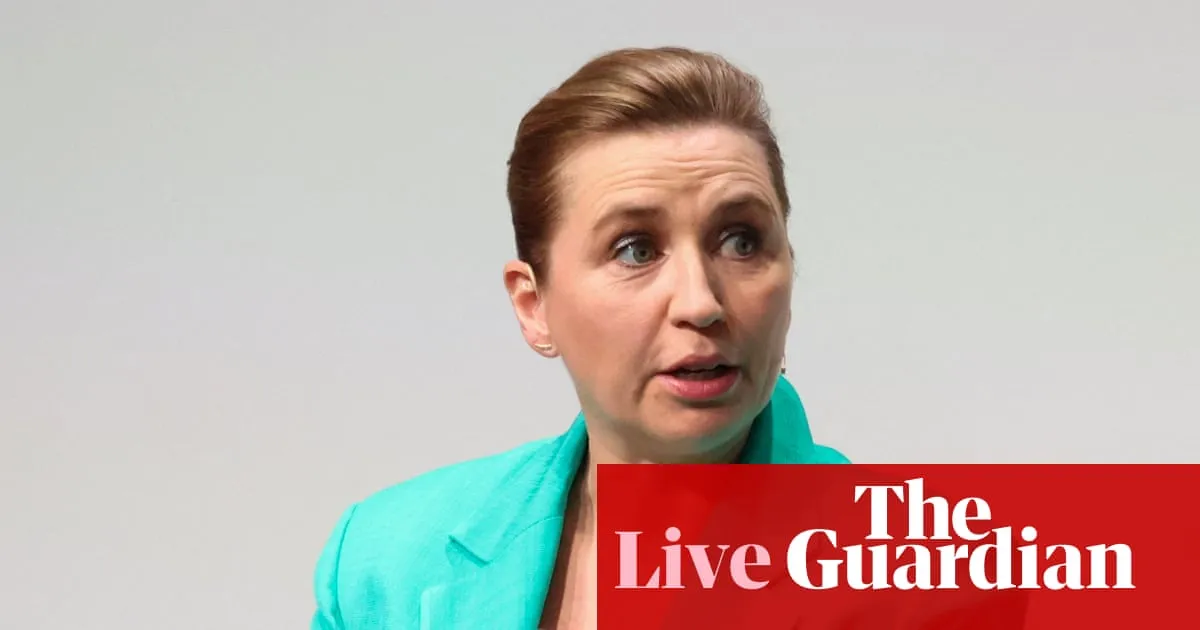
From 5h agoFrederiksen resigns after meeting with king to set government formation process in motionAnd we are just getting a word from the Danish Royal Palace that following last night’s results, Mette Frederiksen has handed in her resignation from the post during her meeting with King Frederik.Denmark’s prime minister, Mette Frederiksen, speaks during an election event for the general election at the Danish Parliament in Copenhagen, Denmark. Photograph: Kristian Tuxen Ladegaard Berg/NurPhoto/ShutterstockNow, this sounds a bit dramatic, but is not really: it is pretty customary as it sets in motion the new government formation process, particularly as the outgoing three-party government clearly does not have a majority required to continue in office (with 70 seats, well short of 90 required for a majority).But Frederiksen will be expected to remain in post as a caretaker until a new administration is formed – and still remains one of the favourites to get the top job.A meeting of political parties at which they will explore a potential way forward – and who could be appointed the “royal investigator” to work on forming the new majority - has been called for 1pm local time (midday UK).Key events1h ago'Royal round' over as 12 party leaders propose their picks for leading government talks1h agoGermany pressing for end to war in Iran, Merz says2h agoPoland's Tusk calls Hungarian minister's calls with Russia 'a disgrace'2h agoHungary's Szijjártó says he often discusses EU issues with Russia, other partners3h agoDenmark braces for lengthy and challenging coalition talks — analysis3h agoDrones reported in Estonia and Latvia suspected to be stray Ukrainian UAVs, authorities say4h ago'It's not me who blew up this government,' Poulsen hits out at Frederiksen4h agoNext government needs to be ready to tackle major crises, Frederiksen says5h agoNext steps in Danish government formation process5h ago'World is not waiting for us,' Frederiksen says as she underlines urgency to form new government5h agoParty leaders set to speak at post-election debate at Dansk Industri5h agoFrederiksen resigns after meeting with king to set government formation process in motion6h agoFrederiksen arrives at Amalienborg to inform King about election results6h agoHungary to stop gas flows to Ukraine amid escalating row over Druzhba pipeline6h agoLatvia and Estonia report drone incursions overnight6h agoPM Frederiksen to meet King Frederik to brief him on election results7h agoMorning opening: Now for the tough bitShow key events onlyPlease turn on JavaScript to use this featureDanish election expert Rune Stubager believes Mette Frederiksen could still stay on as the Danish prime minister.“Whether it will be in a new centrist coalition or a government based mostly on votes from the red bloc, that is up to the negotiations,” Stubager, who co-heads the Danish National Election Study, told AP.Stubager said the leaders should be able to force concessions from each party’s campaign promises to reach their goal of a centrist government.“As far as I can see it, it’s not possible to form a government if all these tripwires are intact,” Stubager said. “So somebody will have to go back on a promise in order for there to be a government.”He added that Moderates leader Lars Løkke Rasmussen, who is now in a position to decide the next government, benefited from leading Denmark’s response to US president Donald Trump’s interest in Greenland.“Donald Trump put up a stage on which Lars Løkke could perform, and he performed well in the eyes of most Danes,” Stubager said.Lars Løkke Rasmussen, Denmark’s Foreign Minister and Chairman of the Moderates arrives at his election party celebration in Copenhagen, Denmark. Photograph: Rasmus Flindt Pedersen/Ritzau Scanpix/AFP/Getty Images'Royal round' over as 12 party leaders propose their picks for leading government talksBack in Denmark, all 12 party leaders have now visited King Frederik in what is known as “the royal round” process to discuss who they think should lead the government formation process.Social Democrats' Peter Hummelgaard and Nikolai Wammen, party leaders in connection with the royal round during which a royal investigator is to be appointed, at Amalienborg Palace in Copenhagen, Denmark. Photograph: Mads Claus Rasmussen/ReutersChairwoman of the Socialist People's Party Pia Olsen Dyhr attends royal consultations, during which a royal investigator is to be appointed, at Amalienborg Palace in Copenhagen, Denmark. Photograph: Mads Claus Rasmussen/EPAChairman of the Liberal Venstre Party Troels Lund Poulsen attends the royal round where a royal investigator is to be appointed at Amalienborg Palace in Copenhagen, Denmark. Photograph: Mads Claus Rasmussen/Ritzau Scanpix/AFP/Getty ImagesWe will see what comes out of this meetings: the name of the “royal investigator” could come as soon as later today.Germany pressing for end to war in Iran, Merz saysMeanwhile, Germany’s chancellor Friedrich Merz said on Wednesday Germany was making every effort to persuade the United States and Israel to find an end to the war with Iran, Reuters reported.German chancellor Friedrich Merz answers questions from lawmakers during a plenum session of the lower house of parliament, the Bundestag, in Berlin, Germany. Photograph: Liesa Johannssen/ReutersAnswering questions in parliament, he said Germany would be ready to join international efforts to stabilise the region after hostilities end but added that any operation would require a mandate from the United Nations.Poland's Tusk calls Hungarian minister's calls with Russia 'a disgrace'Following the reports on his phone calls with Russian and other third-country leaders, Poland’s prime minister Donald Tusk criticised Szijjártó on social media and calling his behaviour “a disgrace.”He said: “Orban’s Foreign Minister has confirmed that he systematically informed Moscow what EU leaders talked about behind closed doors. What a disgrace.” In response, Szijjártó – who regularly clashes with Tusk and other senior Polish officials on social media – said: “This is another lie, why do you still believe fake news??” Hungary's Szijjártó says he often discusses EU issues with Russia, other partnersJennifer Rankinin BrusselsMeanwhile, the Hungarian foreign minister Péter Szijjártó has admitted that he routinely calls his Russian counterpart “before and after” EU meetings, amid ongoing questions about Hungary’s contacts with the Kremlin.Hungarian foreign minister Péter Szijjártó speaks with his Russian counterpart Sergei Lavrov on the margins of a meeting between Russian president Vladimir Putin and Hungarian prime minister Viktor Orbán in Moscow, Russia in November last year. Photograph: Alexander Nemenov/ReutersAs our friends at Euronews reported Szijjártó confirmed the calls at a campaign event in Keszthely in western Hungary on Monday, but suggested he was just doing his job because EU decisions affect Hungary’s “partners” outside the bloc: “These issues must be discussed with our partners outside the European Union. I talk not only to the Russian Foreign Minister, but also to our American, Turkish, Israeli, Serbian and others before and after European Union Council meetings… What I say may sound harsh, but diplomacy is about talking to the leaders of other countries.” After the Washington Post reported that Szijjártó had routine conversations with the Russian foreign minister Sergei Lavrov during EU council meetings, Szijjártó dismissed the allegations as fake news. He maintains that he has not breached any security protocols. It seems highly unlikely that this explanation will satisfy Hungary’s EU partners. Several have strongly criticised his contacts with Russia, which is heavily sanctioned and routinely condemned by the EU for its relentless aggression against Ukraine. A council official on Wednesday described reports of the alleged disclosure of closed-door ministerial discussions to a foreign power as “greatly concerning”. Under the council’s internal rules, discussions are covered by an obligation of professional secrecy, except when decided otherwise, for instance the publication of documents or live-streaming of council discussions. The council official said this obligation of professional secrecy “is an expression of the principle of sincere cooperation and of the principle of mutual trust that are binding on all member states and are fundamental to the work of the European Union and of its institutions”.Denmark braces for lengthy and challenging coalition talks — analysisMiranda Bryantin CopenhagenDenmark is braced for lengthy and challenging coalition talks after neither Mette Frederiksen’s leftwing bloc nor the rightwing parties managed to get a majority in Tuesday’s election.Mette Frederiksen, Denmark's prime minister and Social Democrats party leader, and Lars Løkke Rasmussen, Denmark's foreign minister and Moderates party leader, attend the party leaders' debate after parliamentary elections, in Copenhagen, Denmark. Photograph: Leonhard Föger/ReutersAfter a bruising night for her Social Democrat party, which despite remaining the biggest party in the Danish Parliament had its worst general election since 1903, the prime minister went to Amalienborg palace on Wednesday morning to submit her government’s resignation to the king.Later in the day, parties will start arriving at the palace in order of size, starting with the largest, the Social Democrats, to tell the king who they think should have the role of “royal investigator” – whose task it will be to try to form a government.The failure of the left-leaning “red bloc” and right-leaning “blue bloc”, which won 84 seats and 77 seats respectively, to get a majority in the 179-seat parliament left the Moderates, with 14 seats, in a potentially powerful position to play a key role in forming a new coalition, putting committed centrist Lars Løkke Rasmussen in the position of kingmaker.Drones reported in Estonia and Latvia suspected to be stray Ukrainian UAVs, authorities sayElsewhere, we now know a bit more about the drones reported in Estonia and Latvia (10:12), with authorities suspecting them to be stray Ukrainian military drones, Reuters reported.The UAVs that hit the Nato member nations were believed to be part of a wider Ukrainian attack on Russia, Latvian and Estonian authorities said. They follow another stray Ukrainian drone that Lithuania said on Monday had crashed into a lake.The drones landed in Estonia and Latvia at around the time that Russian officials said a Ukrainian drone attack set fire to oil facilities at Russia’s Baltic Sea ports of Primorsk and Ust-Luga, major export hubs located near Estonia and Finland.A third drone briefly entered Latvian airspace via Belarus before flying into Russia, Latvian authorities said.“The drone was not directed at Estonia. This is a concrete consequence of Russia’s full-scale war of aggression,” Estonia’s foreign minister Margus Tsahkna said in a post on X.“The war, provoked by the aggressor Russia, has got us to this point, with drones falling on the territories of all three Baltic states within 48 hours,” Lithuania’s defence minister Robertas Kaunas said in a statement.There is 12 parties, so 12 audiences with the King, meaning the process will take into late afternoon.DR has the schedule, with 10 minutes slots, from 1pm to 2.50pm (local time).Mette Frederiksen is up first at the top of the hour.The post-election debate is now over, but the government forming process very much is only starting.Party leaders' debate following Danish parliamentary election, in Copenhagen, Denmark. Photograph: Leonhard Föger/ReutersThe party leaders are expected to see the King this afternoon to propose the names for who should be the “royal investigator” tasked with exploring what majorities could be formed (11:25).Let’s see what comes out from that.'It's not me who blew up this government,' Poulsen hits out at FrederiksenMiranda Bryantin CopenhagenAnd there are signs of nervousness and tensions among the other leaders too.Outgoing deputy prime minister Troels Lund Poulsen has hit out at Mette Frederiksen mid-debate, for calling an early election.“It’s not me who blew up this government. It’s not me who called the election,” he said.Chair of the Conservative People's Party Mona Juul, left, chair of the Liberal Party Troels Lund Poulsen, centre, and political leader of the Liberal Alliance Alex Vanopslagh take part in a party leaders debate the day after the parliamentary election at the Confederation of Danish Industry's building in Copenhagen, Denmark. Photograph: Liselotte Sabroe/APThere’s still a lot of laughter in the room, especially after Lars Løkke Rasmussen speaks, despite the enormity of the task ahead.But Rasmussen refuses to respond to Morten Messerschmidt, leader of the far-right Danish People’s Party, when he suggests the pair “pack our egos together and let Troels [Lund Poulsen] form a government.”Next government needs to be ready to tackle major crises, Frederiksen saysIn her comments at the leaders’ debate, Frederiksen also sets out the scale of challenges that the next government will probably have to face, starting from the consequences of the Iran war.Chair of the Socialist People's Party Pia Olsen Dyhr, chair of the Social Democrats Mette Frederiksen, and political leader of the Social Liberal Party Martin Lidegaard look on, during a party leader debate the day after the parliamentary election at the Confederation of Danish Industry, in Copenhagen. Photograph: Liselotte Sabroe/APShe says the closure of the Hormuz Strait and the impact on petrol, oil, diesel prices could put “Denmark’s overall competitiveness under threat.”She says that with the ongoing war in Ukraine, increasingly aggressive Russia and “no one knowing what’s going to happen with the Americans,” the leaders should stop “playing word games as if the old world still existed.”“It does not,” she warns, as she says the next government will have to be ready to take on really tough challenges.She also takes a swipe at the far-right Danish People’s Party’s leader Morten Messerschmidt for being congratulated on his result by Hungary’s Viktor Orbán.“When Viktor Orbán congratulates someone on the election, it’s because he sees an opportunity to undermine Europe, to divide us from each other,” she says.Next steps in Danish government formation processEssentially, what is expected to happen now is that when the parties meet later today, they will be expected to produce a piece of paper with the name of who they think should be appointed as the “royal investigator” and lead the government formation talks.12 parties, 12 pieces of paper, 12 names. It is an early indication of who they think they could do business with.It’s probably worth noting that person does not necessarily have to go on to be the next prime minister, but it tends to happen that’s what happened in 2022 when Mette Frederiksen led the process.There are several possible investigators: from Frederiksen on the “red” side, Troels Lund Poulsen on the “blue” side, and Lars Løkke Rasmussen in the centre, as his party, the Moderates, is most likely to decide the next government.For what it’s worth, the latter openly said he did not want to be the next prime minister.But that was before the election…
SRCThe Guardian - World News
LANGEN
LeanCenter-Left
WORDS2,340
ENT12
WED · 2026-03-25 · 10:54 GMTBRIEF NSR-2026-0325-34415
NSR-2026-0325-34415News Report·EN·Political Strategy
Denmark’s Frederiksen resigns as search for new majority begins after close elections – Europe live
Following a close election in Denmark, Prime Minister Mette Frederiksen has resigned after meeting with King Frederik, initiating the process of forming a new government. Frederiksen's outgoing three-party government did not secure the 90 seats needed for a majority.
Jakub KrupaThe Guardian - World NewsFiled 2026-03-25 · 10:54 GMTLean · Center-LeftRead · 10 min
The Guardian - World NewsFIG 01
Reading time
10min
Word count
2,340words
Sources cited
1cited
Entities identified
12entities
NEWSAR · AI
Following a close election in Denmark, Prime Minister Mette Frederiksen has resigned after meeting with King Frederik, initiating the process of forming a new government. Frederiksen's outgoing three-party government did not secure the 90 seats needed for a majority. While she will remain as caretaker, political parties are meeting to explore potential paths forward and appoint a "royal investigator" to lead government formation talks. The election results have triggered coalition talks, expected to be lengthy and challenging. Frederiksen has emphasized the urgency of forming a new government to address major crises.
Confidence 0.90Sources 1Claims 5Entities 12
Framing
Political Strategy
Diplomatic
Tone
Measured
AI-assessed
CalmNeutralAlarmist
Factuality
0.70 / 1.00
Factual
LowHigh
Sources cited
1
Limited
FewMany
01
A meeting of political parties has been called for 1pm local time.
factualnull
Confidence
1.00
02
The outgoing three-party government clearly does not have a majority required to continue in office (with 70 seats, well short of 90 required).
factualnull
Confidence
1.00
03
Mette Frederiksen has handed in her resignation from the post.
factualDanish Royal Palace
Confidence
1.00
04
Frederiksen will be expected to remain in post as a caretaker until a new administration is formed.
factualnull
Confidence
0.90
05
Mette Frederiksen could still stay on as the Danish prime minister.
quoteRune Stubager
Confidence
0.80
§ 04
Full report
10 min read · 2,340 wordsKey playerOppositionContextPositiveNeutralNegative
government formation
0.90
mette frederiksen
0.80
denmark
0.80
resignation
0.70
election
0.70
coalition talks
0.60
king frederik
0.60
new majority
0.50
political parties
0.50
§ 07
Connections
Who appears together in the newsIn this articleWider coverageLine weight = articles in common
Laying out network…
Strongest ties articles in common
- 3,926
- 443
- 429
- 294
- 281
- 202
Recurring context not named in this article
- PDonald Trumplinks 10
- LUnited Stateslinks 10
- PVolodymyr Zelenskyylinks 9
- OEuropean Unionlinks 9
- PVladimir Putinlinks 9
- ONATOlinks 9
- LChinalinks 9
- LIranlinks 9