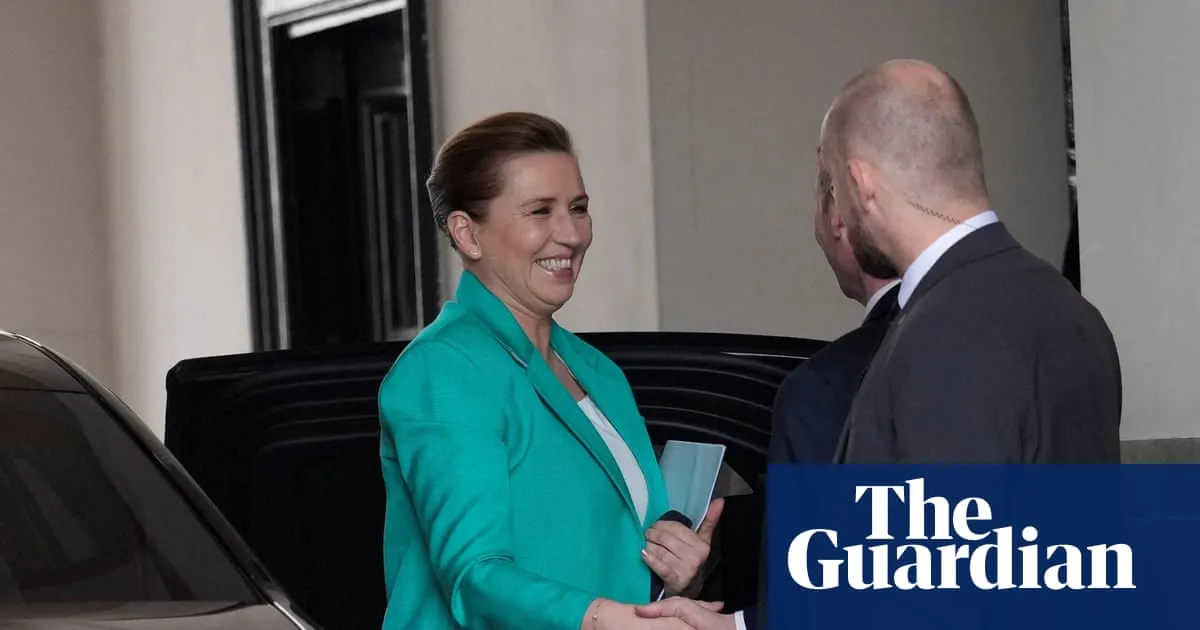
Denmark’s outgoing prime minister, Mette Frederiksen, has been given the first shot at forming another coalition government after an election which saw her leftwing bloc and the opposing rightwing parties fail to win a parliamentary majority.A statement released by the Danish palace on Wednesday said Frederiksen had been asked to see if she could pull together a new majority involving her Social Democrats, who had their worst general election since 1903 but remain the biggest force in parliament.The path ahead is not straightforward and the coalition talks could last for weeks. Earlier on Wednesday, Frederiksen said voters had handed leaders a “troublesome” result but that a “government must be formed”.Speaking in a debate involving the 12 party leaders in Copenhagen, she added: “The world is not waiting for us out there, and it has only become even more restless than when the election was called.”Frederiksen had said she would start exploring the possibility of forming a left-leaning government with the support of Lars Løkke Rasmussen’s centre-right Moderates.The failure of the left-leaning “red bloc” and right-leaning “blue bloc”, which won 84 seats and 77 seats respectively, to get a majority in the 179-seat parliament left the Moderates, with 14 seats, in a potentially powerful position to play a key role in forming a new coalition, putting Rasmussen, a committed centrist, in the position of kingmaker.Mette Frederiksen, the leader of the Social Democrats, speaking after the release of exit polls in Copenhagen. Photograph: Mads Claus Rasmussen/Ritzau Scanpix/AFP/Getty ImagesIn his election night speech he appealed to Frederiksen and Troels Lund Poulsen, the leader of the liberal Venstre party, with whom he has been in coalition for more than three years, to “come down from the trees” and join him in the centre ground.Lars Løkke Rasmussen, Denmark’s foreign minister and the chair of the Moderates party, arrives – with pipe – at his election celebration in Copenhagen. Photograph: Rasmus Flindt Pedersen/Ritzau Scanpix/AFP/Getty Images“What is clear – with all conceivable reservations – I think is that there is no red majority to the left of us, and there is no black-blue majority to the right of us,” he said, to cheers.Rasmussen was the foreign minister in the last government and has twice been prime minister.Frederiksen addressed her party at the Social Democrats’ gathering at Christiansborg in the early hours of the morning, saying the results were not as good as she had hoped but were “OK”.“We reach out for responsibility – even when it comes at a price. I am still prepared to take on the job as Denmark’s prime minister. There is just no indication that it will be easy,” she said.The chair of the Conservative People’s party, Mona Juul, left; the chair of the Liberal party, Troels Lund Poulsen, centre; and the political leader of the Liberal Alliance, Alex Vanopslagh, taking part in a leaders’ debate. Photograph: Liselotte Sabroe/APPoulsen said he was still a candidate for prime minister and ruled out forming a coalition with the Social Democrats. He told supporters: “We need a new government. And that’s also why I’m happy that Venstre has become the largest blue party.”Coalition negotiations are expected to take weeks. Among the election’s biggest winners was the Green Left, which for the first time became the second largest party in Folketing, the Danish parliament. They are believed to have benefited from leftwing voters deserting the Social Democrats after their three years in a centrist coalition, during which time Frederiksen doubled down on her hardline stance on immigration.At the opposite end of the spectrum, the far-right Danish People’s party (DPP) increased its support since the last election from five to 16 seats. The number is still far from the party’s peak levels of support in 2015, when it won 37 seats and 21% of the vote.Naaja Nathanielsen, a high-profile minister from the Greenlandic party Inuit Ataqatigiit (IA), won one of the Arctic island’s two seats in the Danish parliament. The other was won – for the first time – by a representative of the independence party Naleraq, meaning that a critic of the Copenhagen-Nuuk union will be sitting in parliament at crucial time in the kingdom’s history.Naleraq secured 24.6% of the vote in Greenland, a sharp increase from 12.2% in the 2022 election. “It is a very clear signal that the status quo is not acceptable,” the party’s new MP, Qarsoq Høegh-Dam, told Reuters.
SRCThe Guardian - World News
LANGEN
LeanCenter-Left
WORDS726
ENT8
WED · 2026-03-25 · 13:19 GMTBRIEF NSR-2026-0325-34929
NSR-2026-0325-34929News Report·EN·Political Strategy
Denmark braces for lengthy and challenging coalition talks
Following an inconclusive election in Denmark where neither the left nor right bloc secured a parliamentary majority, outgoing Prime Minister Mette Frederiksen has been tasked with forming a new coalition government. The Social Democrats, while remaining the largest party, experienced their worst election result in over a century.
Miranda Bryant in CopenhagenThe Guardian - World NewsFiled 2026-03-25 · 13:19 GMTLean · Center-LeftRead · 3 min
The Guardian - World NewsFIG 01
Reading time
3min
Word count
726words
Sources cited
7cited
Entities identified
8entities
NEWSAR · AI
Following an inconclusive election in Denmark where neither the left nor right bloc secured a parliamentary majority, outgoing Prime Minister Mette Frederiksen has been tasked with forming a new coalition government. The Social Democrats, while remaining the largest party, experienced their worst election result in over a century. The centrist Moderates party, led by Lars Løkke Rasmussen, holds a pivotal position as "kingmaker" due to the even split between the blocs. Rasmussen has urged both Frederiksen and the leader of the liberal Venstre party to join him in the center ground. Coalition talks are expected to be lengthy and challenging, potentially lasting for weeks, as leaders navigate a "troublesome" result.
Confidence 0.90Sources 7Claims 5Entities 8
Framing
Political Strategy
Diplomatic
Tone
Measured
AI-assessed
CalmNeutralAlarmist
Factuality
0.80 / 1.00
Factual
LowHigh
Sources cited
7
Well sourced
FewMany
01
Frederiksen's Social Democrats had their worst general election since 1903.
factual
Confidence
1.00
02
Voters had handed leaders a “troublesome” result but that a “government must be formed”.
quoteMette Frederiksen
Confidence
1.00
03
The left-leaning “red bloc” and right-leaning “blue bloc” failed to win a majority.
factual
Confidence
1.00
04
Mette Frederiksen has been asked to form a new government after the election.
factualDanish palace
Confidence
1.00
05
Coalition talks could last for weeks.
prediction
Confidence
0.70
§ 04
Full report
3 min read · 726 wordsKey playerOppositionContextPositiveNeutralNegative
People3
Organizations3
coalition talks
1.00
danish election
0.90
parliamentary majority
0.80
government formation
0.70
political parties
0.60
centre ground
0.50
left-leaning government
0.50
kingmaker
0.40
§ 07
Connections
Who appears together in the newsIn this articleWider coverageLine weight = articles in common
Laying out network…
Strongest ties articles in common
- 135
- 66
- 30
- 30
- 30
- 24
Recurring context not named in this article
- PDonald Trumplinks 8
- LUnited Stateslinks 8
- LGreenlandlinks 8
- OEuropean Unionlinks 7
- ONATOlinks 6
- PLars Lokke Rasmussenlinks 6
- LRussialinks 6
- LSwedenlinks 6