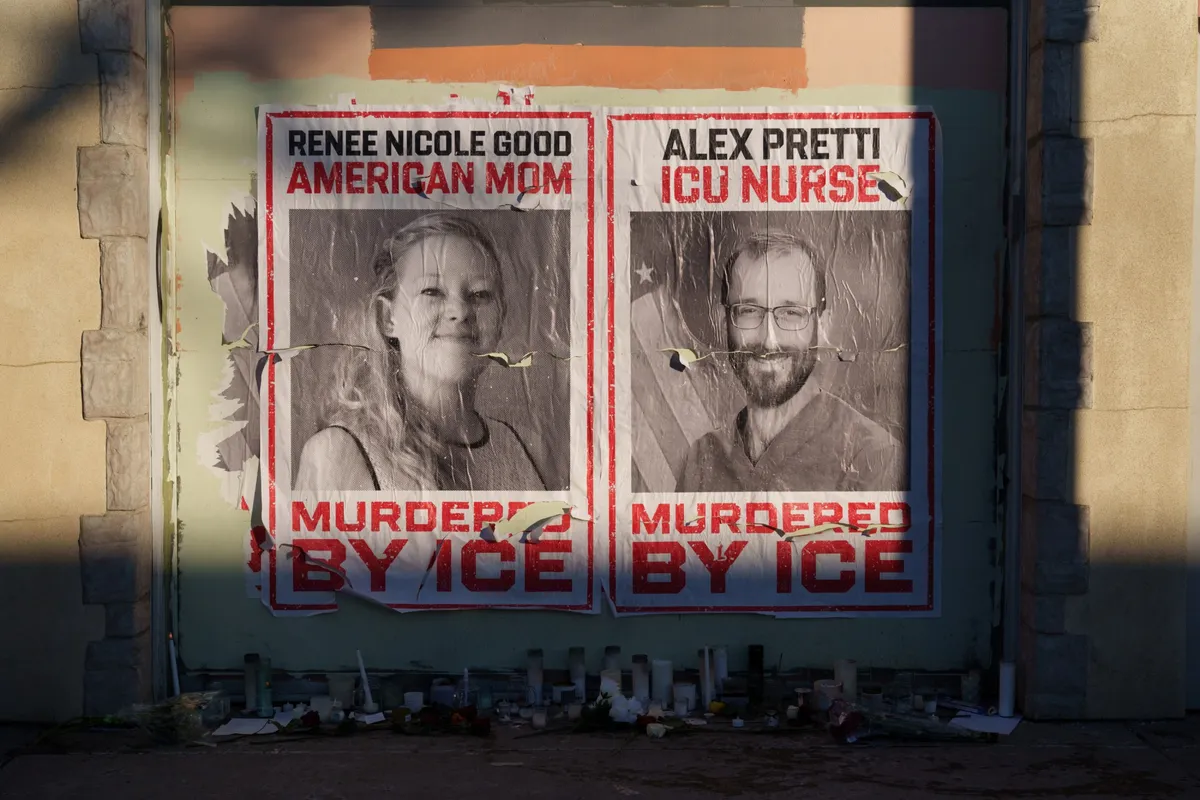
After an Immigration and Customs Enforcement agent shot and killed Renee Good, a 37-year-old mother of three who’d recently moved to Minneapolis, local law enforcement officials requested a partnership with the federal government to investigate the case, as they’d done in past shootings involving federal agents. When the Trump administration refused to cooperate, Minnesota prosecutors ratcheted up their efforts. They sent a series of strongly worded legal letters demanding evidence in the Good shooting as well as the shootings of Julio Cesar Sosa-Celis, a Venezuelan immigrant who was wounded a week after Good was shot, and Alex Pretti, who was killed on Jan. 24. This week, prosecutors from Hennepin County and the state of Minnesota took the next step to force the Trump administration’s hand. They filed a federal lawsuit against the departments of Homeland Security and Justice over the evidence in the shootings, an action that Hennepin County Attorney Mary Moriarty, whose jurisdiction covers Minneapolis, characterized as “unprecedented in American history.” The Trump administration has declined to release the names of the agents involved in the shootings, even after the Minnesota Star Tribune and ProPublica identified the officers involved in the Good and Pretti incidents. “The federal government has refused to cooperate with state law enforcement, which is unique, rare and simply cannot be tolerated,” Minnesota Attorney General Keith Ellison told reporters. “[We] can’t sit around and let them do it.” Minnesota Attorney General Keith Ellison holds up a copy of the state’s lawsuit against the federal government at a press conference on Tuesday. Peter DiCampo/ProPublica In the standoff over evidence, the case has already become a game of constitutional chicken over states’ rights versus federal immunity, a battle that will have implications for others who wish to hold agents in the president’s immigration surge criminally accountable. So far, neither side is showing signs of backing down, foreshadowing a fight that could take years. If prosecutors do eventually file charges against federal agents involved in the shootings, legal experts said the path to trial, much less winning convictions, will be filled with legal and procedural challenges. “State prosecutors across the country are going to be watching what happens in Minnesota really closely,” said Alicia Bannon, director of the judiciary program at the nonprofit Brennan Center for Justice. The first test for prosecutors, if they file charges, would be to prove the agents don’t qualify for immunity through the Constitution’s supremacy clause, a rarely invoked legal doctrine that protects federal officers from state prosecutions if they’re acting lawfully and within the scope of their duties. Failing to pass that test would likely end the case. The U.S. Supreme Court hasn’t taken up a case involving supremacy clause immunity in over 100 years, Bannon said, and judges have come down differently on legal issues related to its application. There’s no easy answer as to whether Minnesota will be able to get past a supremacy clause defense, said Jill Hasday, a constitutional law professor at the University of Minnesota. “That depends on the facts, but probably the odds are stacked against it,” she said. Even if they survive such a fight, the cases could be dogged by a series of logistical challenges. Moriarty, who has been leading the investigations, has decided not to seek reelection and will leave office at the end of the year. That means whoever wins the election for her seat in November could inherit the prosecutions. In addition to not having the names of the agents, prosecutors don’t know where those agents are now. Minnesota may need to extradite them, potentially from a MAGA-leaning state that may balk at sending them to Hennepin County to stand trial. “Will the federal government or other states cooperate with that? I think the answer to that is sort of iffy,” said Ilya Somin, a law professor at George Mason University in Virginia. (Indeed, in a case involving a doctor charged with illegally mailing abortion medication to a Louisiana woman, the state of California has rejected an extradition request, citing its own laws protecting doctors from prosecution elsewhere.) The fight is focused on three shootings. But Moriarty’s office has opened criminal investigations into 14 additional cases of potentially unlawful behavior by federal agents during Operation Metro Surge, which started in early December and has wound down over the past few weeks. The other cases Moriarty is examining involve allegations of excessive force or other misconduct by federal agents, such as an incident in early January in which agents allegedly used force on staff and students on the grounds of a high school. Prosecutors are also investigating Gregory Bovino, the outgoing Border Patrol commander who helped to lead immigration surges into several American cities and who was seen on video lobbing green-smoke canisters into crowds at a park in Minneapolis. A Department of Homeland Security spokesperson said at the time that Bovino and other agents were responding to a “hostile crowd.” The tension has played out in a series of demand letters sent by Moriarty to the Justice and Homeland Security departments. “Public transparency is vitally important in these cases — not just for the people of Hennepin County and Minnesota, but for the public nationwide,” Moriarty wrote in one of the letters. “The only way to achieve transparency is through investigation conducted at a local level.” Gregory Bovino, at the time a Border Patrol commander, and federal agents confront protesters following the shooting death of Good on Jan. 7. Prosecutors say they are investigating Bovino and the use of aggressive force by Immigration and Customs Enforcement agents during their deployment to the Twin Cities. Tim Evans In January, after the shooting of Good, federal officials had agreed to participate in a joint investigation with the Bureau of Criminal Apprehension — Minnesota’s state police agency tasked with examining use of deadly force cases — according to the letters signed by Moriarty. State officials presumed they’d be able to examine evidence, such as the car Good was driving and the guns used to shoot her and the other victims. But the investigators later learned through public statements by high-ranking Trump administration officials that federal agents were no longer planning to share evidence, the letter states. Local and state prosecutors don’t have the authority to subpoena them for evidence like in a typical criminal investigation. The demand letters, called Touhy letters, are formal written requests, used as an alternative to a subpoena, asking a federal agency to provide evidence or testimony in a case in which the government is not a party. Moriarty sought an extensive list of evidence in the shootings, from the guns fired by the agents in all three cases to official reports, agent GPS devices and witness statements. The Touhy letters asked for a response by Feb. 17. Normally, the federal government complies with Touhy letters as a matter of protocol, as long as releasing the information doesn’t violate an internal policy, said Timothy Johnson, a political science and law professor at the University of Minnesota. But on Feb. 13, the FBI told BCA investigators that it won’t share investigative materials in the Pretti case, BCA Superintendent Drew Evans said in a statement. Evans said the police agency had reiterated its requests for evidence in the Good and Sosa-Celis cases. More than a month after the deadline set by prosecutors, the Trump administration still hasn’t turned over the materials. “There has been no cooperation from federal authorities,” BCA spokesperson Michael Ernster said. The agents involved in the shootings have not spoken publicly, but a spokesperson for the Department of Homeland Security defended Good’s shooting, saying the agent acted in self-defense. They said the Pretti shooting was under investigation by the FBI and the Department of Homeland Security, with the Border Patrol conducting its own investigation. Those investigations could result in discipline or charges, including for civil rights violations. The Department of Homeland Security spokesperson said federal officials found that, after Sosa-Celis’ shooting, officers made false statements. But the agency did not say whether it would cooperate with the local authorities or follow a court ruling requiring it to do so.The Justice Department did not respond to a request for comment or to questions. Neither agency has responded to the lawsuit.Moriarty called the lawsuit “critically important” to investigating the shooting cases but also said she had not made any decisions on whether her office will file charges.“There has to be an investigation anytime a federal agent or a state agent takes the life of a person in our community,” she said. “And ultimately the decision may be it was lawful. You don’t know, but that’s why you do the investigation. You are transparent with the results of that investigation, and you are public with your transparency about the decision and how you got there.”But a lawsuit does not guarantee that prosecutors will get all they want. “The question then becomes, even if Hennepin County or Minneapolis wins the suit, will they comply then?” Johnson asked. “And the answer is probably no.”If the Trump administration did eventually defy a judge’s order, he said, prosecutors could try to appeal up to the U.S. Supreme Court. As far as what could happen next: “It’s anyone’s guess.”
SRCProPublica
LANGEN
LEANCenter-Left
WORDS1 531
ENT12
WED · 2026-03-25 · 20:00 GMTBRIEF NSR-2026-0325-35867
NSR-2026-0325-35867News Report·EN·Legal & Judicial
Minnesota Kicks Off Legal Battle With Trump Administration to Hold ICE Shooters Accountable
Minnesota has filed a federal lawsuit against the Departments of Homeland Security and Justice, seeking evidence related to three shootings involving ICE agents in the Minneapolis area in January 2020. The shootings resulted in the death of Renee Good and Alex Pretti, and the wounding of Julio Cesar Sosa-Celis.
Andy MannixProPublicaFiled 2026-03-25 · 20:00 GMTLean · Center-LeftRead · 7 min
ProPublicaFIG 01
Reading time
7min
Word count
1 531words
Sources cited
4cited
Entities identified
12entities
Quality score
100%
§ 01
Briefing Summary
AI-generatedNEWSAR · AI
Minnesota has filed a federal lawsuit against the Departments of Homeland Security and Justice, seeking evidence related to three shootings involving ICE agents in the Minneapolis area in January 2020. The shootings resulted in the death of Renee Good and Alex Pretti, and the wounding of Julio Cesar Sosa-Celis. State and local officials requested cooperation from the Trump administration to investigate the shootings, but were denied. Minnesota prosecutors are now seeking to compel the federal government to release the names of the agents involved and other evidence. The lawsuit, characterized as unprecedented, raises questions about states' rights versus federal immunity and could have national implications for holding federal agents accountable. The legal battle is expected to be lengthy and complex.
Confidence 0.90Sources 4Claims 5Entities 12
§ 02
Article analysis
Model · rule-basedFraming
Legal & Judicial
Political Strategy
Tone
Mixed Tone
AI-assessed
CalmNeutralAlarmist
Factuality
0.70 / 1.00
Factual
LowHigh
Sources cited
4
Well sourced
FewMany
§ 03
Key claims
5 extracted01
The federal government has refused to cooperate with state law enforcement.
quoteKeith Ellison
Confidence
1.00
02
The Trump administration has declined to release the names of the agents involved in the shootings.
factual
Confidence
1.00
03
Hennepin County Attorney Mary Moriarty characterized the lawsuit as “unprecedented in American history.”
quoteMary Moriarty
Confidence
1.00
04
Minnesota prosecutors filed a federal lawsuit against the departments of Homeland Security and Justice over evidence in the shootings.
factual
Confidence
1.00
05
The case has become a game of constitutional chicken over states’ rights versus federal immunity.
factual
Confidence
0.90
§ 04
Full report
7 min read · 1 531 words§ 05
Entities
12 identifiedKey playerOppositionContextPositiveNeutralNegative
People5
Organizations5
§ 06
Keywords & salience
10 termsice shootings
0.90
trump administration
0.80
legal battle
0.70
federal lawsuit
0.70
state law enforcement
0.60
evidence
0.60
federal immunity
0.50
criminal accountability
0.50
states' rights
0.50
minnesota
0.40
§ 07
Topic connections
Interactive graph Network visualization showing 51 related topics
View Full Graph Person Organization Location Event|Click node to navigate|Edge numbers = shared articles