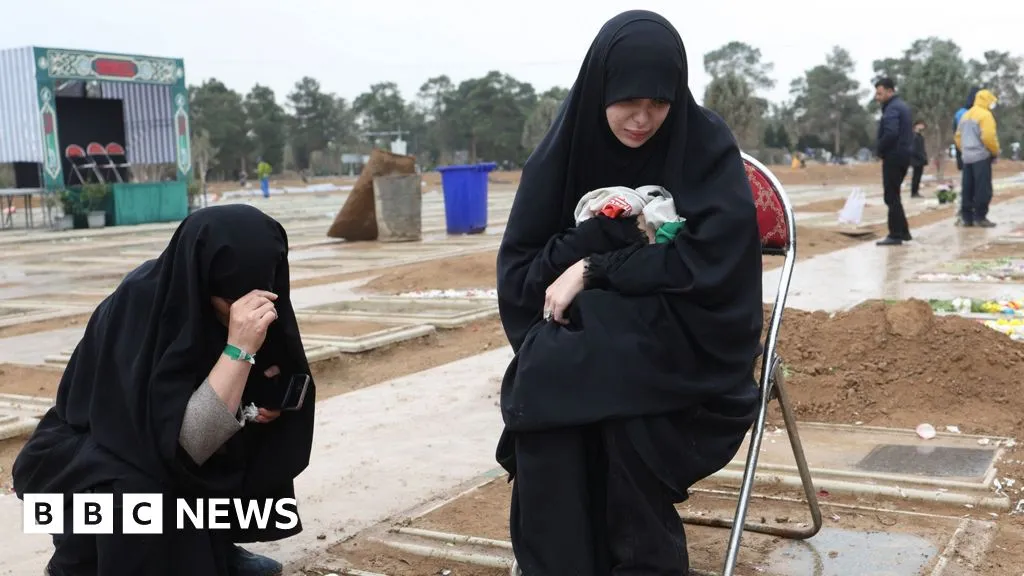
Are the US and Iran holding peace talks, and what do both sides want?3 days agoFrank GardnerSecurity correspondent, DohaReutersUS-based rights group HRANA estimates the recent conflict has killed 3,291 in Iran, including 1,455 civiliansDonald Trump has insisted the US is negotiating with Iran over an end to the war, but Tehran has repeatedly said talks are not taking place.Iran's foreign minister Abbas Araghchi admitted messages have been exchanged with the US via intermediaries, but said these constituted "neither dialogue nor negotiation, nor anything of the sort".Trump claimed on Wednesday that Iran is "afraid" to admit to talks "because they figure they'll be killed by their own people".So, who to believe? Is peace just around the corner? Or are both sides settling in for a costly, protracted war that will keep energy prices high, affecting the whole world right through the summer?The signs are that we are now entering into a situation not dissimilar to the logjam over ending the Russia-Ukraine war. Both sides say they want it to finish, but on their terms, which are still far apart from what the other side will accept.What the US and Israel wantWhen this war started, on 28 February, there were high hopes in Washington and Jerusalem that the overwhelming military superiority enjoyed by both these two nations over Iran would result in the inevitable collapse of the Islamic Republic.Failing that, Iran, already in dire straits economically, would be brought to its knees and sue for peace on America's terms. That has not happened. So what the US and Israel want, they may not necessarily get, as every day the Iranian regime survives it feels more emboldened.Details of a proposed US 15-point plan, published by Israel's Channel 12 network, include an end to Iran's nuclear programme, an end to its ballistic missile programme, and an end to Iran's support for "proxy militias" like the Houthis in Yemen and Hezbollah in Lebanon. In return, Iran would get sanctions relief and some shared control over the Strait of Hormuz.What Iran wantsInitially, Iran flatly rejected the US 15-point plan, calling it "excessive". Iran's Foreign Minister Abbas Araghchi was less explicit later on Wednesday. He told state TV that "some ideas" had been proposed to the country's senior leaders - and "if a position needs to be taken, it will certainly be determined".Instead, its state media has listed five conditions for ending the war, which include the payment of war reparations, international recognition of Iran's "sovereign right to exercise authority over the Strait of Hormuz", and a guarantee that Iran will not be attacked again.These demands would be a bitter pill for Washington and its Gulf Arab allies to swallow.Iran believes that as the largest nation in the region, with a population of more than 90 million people, with the longest coastline in the Gulf, it should resume its rightful role as "the policeman of the Gulf" - a role it enjoyed under the previous rule of the shah that ended with the Islamic Revolution in 1979. It would like to see the US Navy's 5th Fleet, headquartered in Bahrain, depart the region, allowing Iran to become the pre-eminent military power in the Gulf, supported by its allies Russia, China and North Korea.Iran says that it has a severe problem trusting the US since twice now it has sat down to negotiations - in 2025, and this year in February - only for the US to walk away and begin military strikes. Critics of Iran say it was simply stringing the talks along and had no intention of ever giving up the programmes and policies that threaten the whole region.ShutterstockIran has been carrying out retaliatory strikes on US-allied Gulf statesWhat the Gulf Arab states wantThe Gulf Arabs are dismayed by what has happened. They had no great fondness for the Islamic Republic regime - but they had reached an uneasy accommodation with it before this conflict began. Now they have watched in horror as the US has given this war its best shot and failed to bring down the Iranian regime, instead leaving it wounded and angry, lashing out at its neighbours on this side of the Gulf with drones and missiles.To the frustration of Washington and US Central Command (Centcom), Iran is now in a far stronger position strategically than it was a month ago, since it has been able to assert de facto control over the crucial Strait of Hormuz. This gives Tehran enormous leverage over the global energy market, knowing that the international pressure on US President Donald Trump to end this war will narrow his options.Ideally, the Gulf states would like things to go back to how they were a month ago, but too much has happened and Iran is now in no mood to back down.Trump's options may be about to multiply with the arrival of around 5,000 US Marines in the region, along with paratroopers from the US 82nd Airborne Division - but there are risks here, too. There are a number of locations they could be deployed to: from Iran's oil export terminal at Kharg Island, to Iran's coast in Hormuzgan province, to the Bab El Mandeb Strait at the southern entrance to the Red Sea. Or they could be just to exert more bargaining pressure on Tehran. But any ground operation carries a greater chance of US casualties - deeply unpopular at home - and risks drawing the US deeper into a conflict many are calling "a war of choice".The continued survival of the Islamic Republic regime has emboldened its members and its demands. It believes it has both time and geography on its side. The more the White House tells the world that Iran is desperate for a deal, the less inclined Iran is to make one.
SRCBBC News - World
LANGEN
LEANCenter
WORDS959
ENT12
WED · 2026-03-25 · 21:37 GMTBRIEF NSR-2026-0325-35969
NSR-2026-0325-35969Analysis·EN·Diplomatic
Who wants what and why from US-Iran peace talks?
Reports indicate potential US-Iran peace talks, though Iran denies direct negotiations, admitting only to indirect message exchanges. The conflict, ongoing since February 28th, has resulted in thousands of deaths in Iran, according to HRANA.
BBC News - WorldFiled 2026-03-25 · 21:37 GMTLean · CenterRead · 4 min
BBC News - WorldFIG 01
Reading time
4min
Word count
959words
Sources cited
5cited
Entities identified
12entities
Quality score
100%
§ 01
Briefing Summary
AI-generatedNEWSAR · AI
Reports indicate potential US-Iran peace talks, though Iran denies direct negotiations, admitting only to indirect message exchanges. The conflict, ongoing since February 28th, has resulted in thousands of deaths in Iran, according to HRANA. The US and Israel initially hoped for Iran's collapse or capitulation, but the regime's survival has complicated matters. A proposed US 15-point plan demands Iran cease its nuclear and missile programs, and end support for regional militias in exchange for sanctions relief and shared control of the Strait of Hormuz. Iran initially rejected the plan as "excessive" but later signaled openness to considering "some ideas," while listing conditions including war reparations. The situation resembles the Russia-Ukraine war stalemate, with both sides desiring an end but on vastly different terms.
Confidence 0.90Sources 5Claims 5Entities 12
§ 02
Article analysis
Model · rule-basedFraming
Diplomatic
National Security
Tone
Measured
AI-assessed
CalmNeutralAlarmist
Factuality
0.60 / 1.00
Mixed
LowHigh
Sources cited
5
Well sourced
FewMany
§ 03
Key claims
5 extracted01
Iran's state media has listed five conditions for ending the war, which include the payment of war reparations.
factualIran's state media
Confidence
1.00
02
Iran's foreign minister Abbas Araghchi admitted messages have been exchanged with the US via intermediaries.
quoteAbbas Araghchi
Confidence
1.00
03
Tehran has repeatedly said talks are not taking place.
factualTehran
Confidence
1.00
04
Donald Trump has insisted the US is negotiating with Iran over an end to the war.
quoteDonald Trump
Confidence
1.00
05
HRANA estimates the recent conflict has killed 3,291 in Iran, including 1,455 civilians
statisticHRANA
Confidence
0.90
§ 04
Full report
4 min read · 959 words§ 05
Entities
12 identifiedKey playerOppositionContextPositiveNeutralNegative
§ 06
Keywords & salience
9 termsus-iran peace talks
1.00
negotiations
0.80
war
0.70
sanctions relief
0.60
proxy militias
0.50
ballistic missile program
0.50
nuclear program
0.50
strait of hormuz
0.40
war reparations
0.40
§ 07
Topic connections
Interactive graph Network visualization showing 51 related topics
View Full Graph Person Organization Location Event|Click node to navigate|Edge numbers = shared articles