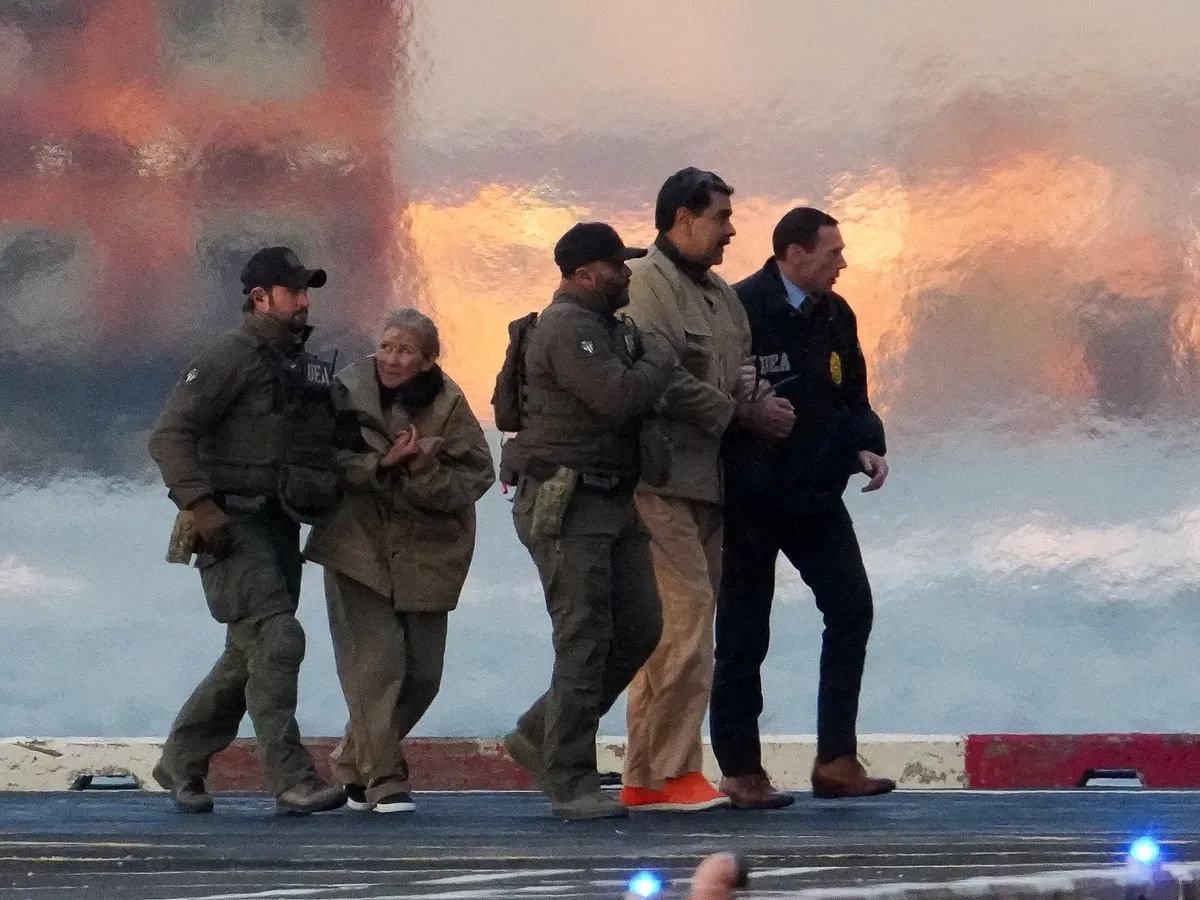
March 26 hearing will be second court appearance since Maduro’s January 3 abduction by US military.Law enforcement officials move abducted Venezuelan President Nicolas Maduro and his wife Cilia Flores in January 2026 [Adam Gray/Reuters]Published On 26 Mar 2026Nicolas Maduro, the former leader of Venezuela who was removed by United States forces on January 3, is set to appear in a US court for only the second time.In the weeks since he was abducted to the US, Maduro’s defence has offered only a preview of how it will approach the extraordinary case on Thursday. In his first court appearance, in January, Maduro maintained he was not a traditional defendant but a “prisoner of war” and “kidnapped” president.Recommended Stories list of 3 itemslist 1 of 3Maduro seeks dismissal of charges, claims US blocked legal defence fundslist 2 of 3Analysis – Trump’s foreign policy message in a nutshell: ‘We can reach you’list 3 of 3Who runs Venezuela now? Trump, oil and the fight for powerend of listMany questions surrounding Maduro’s prosecution remain unanswered in the run-up to Thursday’s hearing: how Maduro may deploy a carousel of legal arguments to challenge the case; what evidence prosecutors will present to support their claims of “narco-terrorism” and drug trafficking; and ultimately, what would happen in the event federal prosecutors prove unsuccessful.While the US has a history of enforcing its domestic law against foreign individuals, the prosecution of sitting and former heads of state has been exceedingly rare.The most recent examples include the prosecution of Manuel Antonio Noriega, then the leader of Panama, in 1989, and more recently, the prosecution of former Honduran leader Juan Orlando Hernandez in 2024, explained Renato Stabile, who served as the court-appointed defence lawyer for Orlando Hernandez.“We’re in largely uncharted territory,” Stabile told Al Jazeera.Will the case get thrown out?Legal experts have pointed to a range of challenges Maduro’s team could mount to get the case thrown out before a trial begins. The defence has already argued that the case should be null, pointing to Maduro’s role in Venezuela at the time of his abduction and maintaining that Maduro was taken into custody illegally.The US deployed 150 military aircraft in its raid to abduct Maduro, knocking out the country’s air defence as it created a massive power cut across the capital, Caracas. Both an FBI unit and the US Army’s specialised Delta Force were deployed to storm Maduro’s compound. Venezuela has said at least 75 people were killed in the operation.The Trump administration has maintained that the goals were purely domestic law enforcement, and unrelated to its explicit calls for regime change or access to Venezuela’s state-controlled oil industry that accompanied a weeks-long military build-up and oil embargo.Trump, however, has since pledged to “run” Venezuela with his administration continuing to assert influence over the government of interim-President Delcy Rodriguez.The US executive branch has long held the position that the federal government can pursue domestic law enforcement arrests abroad. But according to a panel of federal prosecution experts writing on the LawFare nonprofit website in January, “Maduro will undoubtedly argue that even if such authority exists, it is limited – and that his arrest falls outside the bounds of what’s permitted.”Maduro could chart several courses in making the case, including arguing that continuing with the case would make the court itself complicit in the government’s actions, an apparent blatant violation of international law. A form of that argument proved unsuccessful in the Norriega case, the panel noted, although Maduro will likely try to argue the details of the US military operation in Panama in 1989 and the January raid in Venezuela are markedly different.Maduro’s team could also argue that the government misused the US military in domestic law enforcement, although experts noted that the government has, for decades, maintained that the military can be used to “protect federal functions”.The panel assessed that all options available to Maduro will likely face an “uphill battle”.Finally, Maduro’s team could invoke the so-called “head of state” immunity doctrine, arguing he remains the head of state of Venezuela and therefore is protected from prosecution under US common law.The US government has, since 2019, maintained that Maduro is not the legitimate head of state of Venezuela, pointing to a string of disputed elections, the most recent in 2024.How strong is the indictment?If challenges related to Maduro’s position and how he was arrested prove unsuccessful, Orlando Hernandez’s defence lawyer, Stabile, argued the current indictment laid out by federal prosecutors is far from a slam dunk.Maduro is charged with one count of conspiracy to commit “narco-terrorism”, with the indictment saying he was involved in drug and arms trafficking in support of the FARC, the ELN and other groups designated “foreign terrorist organisations” by the US.But notably, the Department of Justice has largely backed away from a pillar of its initial 2020 indictment against Maduro: claims that he was the leader of the “Cartel de los Soles”, which it, at the time, described as “drug-trafficking organisation” that “prioritised using cocaine as a weapon against America and importing as much cocaine as possible into the United States”.The new indictment, unsealed shortly after Maduro’s abduction, instead describes the Cartel de los Soles as a system of “patronage” within Venezuela’s government, and removes any reference to a coordinated effort by the Cartel de Soles to use drugs as a weapon against the US. The original indictment referenced the Cartel de los Soles 33 times, reduced to only two mentions in the new version.The second charge focuses on drug trafficking, pointing to various instances where Maduro, his wife and other officials allegedly used their positions and resources – including the use of private planes under diplomatic cover – to directly support and benefit from drug trafficking. The third and fourth charges are largely seen as hinging on the first two: illegal possession and conspiracy to possess automatic machineguns.While more evidence could be presented in the weeks, months and possibly years ahead, Stabile said prosecutors appear to be building a case largely built on informants, in what he described as a “snitch indictment”.Notably, the indictment details the involvement of former Venezuelan General Hugo Carvajal in several of the alleged crimes. Carvajal has already pleaded guilty to “narcoterrorism”, drug trafficking and weapons charges in the US.Last year, in a letter addressed to the “American people”, Carvajal, who has yet to be sentenced, promised to “provide additional details” that would further reveal the Maduro government’s alleged crimes.Stabile argued the prosecution will “look very weak” if its case relies on witnesses who have already struck cooperation deals with the US government.That feeds the perception that “they’re going to say whatever they need to say to get out of jail.”He also pointed to the difficulty prosecutors face in empanelling a jury unaware of the case’s broader political landscape and the contradictory messaging from the Trump administration.“Any of the jurors will likely know the story. They will know how the US went in and took him out of Venezuela,” Stabile said.“In a typical criminal case, you’re not really able to argue the political aspects of the case. In other words, typically, you can’t argue the motivations of the prosecution team in bringing the charges … [The defence] benefit here.”“I could very easily see – if you get the right juror to be a holdout – a hung jury here,” he said, referring to situations where a jury is unable to reach a verdict, and prosecutors are confronted with needing to retry the case, strike a deal or abandon prosecution.
SRCAl Jazeera
LANGEN
LEANCenter
WORDS1 247
ENT11
THU · 2026-03-26 · 11:56 GMTBRIEF NSR-2026-0326-36955
NSR-2026-0326-36955News Report·EN·Legal & Judicial
Venezuela’s Maduro set to again appear in US court: How strong is the case?
Nicolas Maduro, the former Venezuelan leader removed by US forces in January 2026, is scheduled for a second US court appearance on March 26. Since his abduction, Maduro has claimed to be a "prisoner of war" and maintains he was illegally taken.
Joseph StepanskyAl JazeeraFiled 2026-03-26 · 11:56 GMTLean · CenterRead · 5 min
Al JazeeraFIG 01
Reading time
5min
Word count
1 247words
Sources cited
1cited
Entities identified
11entities
Quality score
100%
§ 01
Briefing Summary
AI-generatedNEWSAR · AI
Nicolas Maduro, the former Venezuelan leader removed by US forces in January 2026, is scheduled for a second US court appearance on March 26. Since his abduction, Maduro has claimed to be a "prisoner of war" and maintains he was illegally taken. The hearing raises questions about Maduro's legal strategy, the evidence against him regarding "narco-terrorism" and drug trafficking charges, and the potential consequences if the prosecution fails. Legal experts note the rarity of prosecuting current or former heads of state, citing past cases like Manuel Noriega and Juan Orlando Hernandez. Maduro's defense is expected to challenge the case's legitimacy, arguing his abduction was illegal and citing his role as Venezuela's leader at the time.
Confidence 0.90Sources 1Claims 5Entities 11
§ 02
Article analysis
Model · rule-basedFraming
Legal & Judicial
Political Strategy
Tone
Mixed Tone
AI-assessed
CalmNeutralAlarmist
Factuality
0.70 / 1.00
Factual
LowHigh
Sources cited
1
Limited
FewMany
§ 03
Key claims
5 extracted01
Venezuela has said at least 75 people were killed in the operation.
factualVenezuela
Confidence
1.00
02
The US deployed 150 military aircraft in its raid to abduct Maduro.
factual
Confidence
1.00
03
Maduro maintained he was a “prisoner of war” and “kidnapped” president in his first court appearance.
quoteMaduro
Confidence
1.00
04
Nicolas Maduro is set to appear in a US court for the second time since being removed by US forces on January 3.
factual
Confidence
1.00
05
The prosecution of sitting and former heads of state has been exceedingly rare.
factual
Confidence
0.90
§ 04
Full report
5 min read · 1 247 words§ 05
Entities
11 identifiedKey playerOppositionContextPositiveNeutralNegative
People5
Organizations2
§ 06
Keywords & salience
9 termsnicolas maduro
1.00
us court
0.80
venezuela
0.70
abduction
0.70
prosecution
0.60
drug trafficking
0.50
narco-terrorism
0.50
prisoner of war
0.40
us military
0.40
§ 07
Topic connections
Interactive graph Network visualization showing 51 related topics
View Full Graph Person Organization Location Event|Click node to navigate|Edge numbers = shared articles