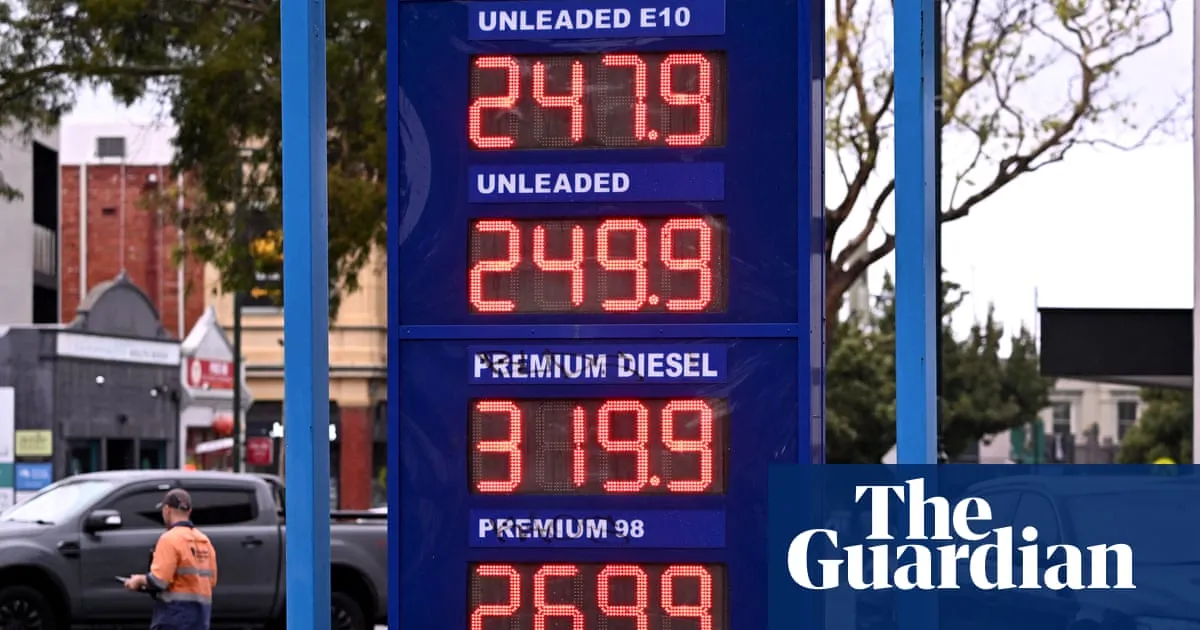
Petrol stations say drivers are filling up more regularly as governments come under pressure to devise a national plan to manage the fuel crisis. Photograph: William West/AFP/Getty Images View image in fullscreen Petrol stations say drivers are filling up more regularly as governments come under pressure to devise a national plan to manage the fuel crisis. Photograph: William West/AFP/Getty Images Australian petrol stations report 25% surge in demand as governments plan for ‘biggest energy crisis in history’ Rationing is not under consideration yet as hundreds of retailers report being without one or more types of fuel Follow our Australia news live blog for latest updates Get our breaking news email, free app or daily news podcast Petrol stations are reporting a surge in demand of up to 25% in the past fortnight alone on top of already major spikes earlier in the Iran war as Anthony Albanese comes under pressure to devise a national plan to cushion Australia against the “biggest energy crisis in history”. The Australasian Convenience and Petroleum Marketers Association has revealed the scale of the demand on retailers, which has left hundreds of stations across the country without one or more types of fuel. “Fuel retailers have reported an increase in demand of up to 25% over the past two weeks which followed a significant spike in demand,” the association’s chief executive, Rowan Lee, said. “Retailers are reporting that people are filling up more regularly. “Parts of the agriculture, freight and commercial sectors brought forward their buying of fuel, which has added to demand in the short term.” Lee said when an outlet runs out of one grade of fuel, it was “usually only temporary” and often rectified within two days. The prime minister is expected to meet premiers and chief ministers on Monday to thrash out a plan to manage the fuel crisis, which the federal government expects to cause months-long disruptions even if the war with Iran finishes tomorrow. The federal government and the states are not considering fuel rationing but have not ruled out other voluntary measures to reduce usage if the situations worsens, such as encouraging work from home if possible. The energy minister, Chris Bowen, signalled rationing would only be contemplated under a “worst-case scenario” in which the Middle East conflict continued for months, suffocating the supply of oil to refineries in Asia and in turn of petrol and diesel to Australia. “I don’t think we’re there,” Bowen told the 7am podcast. “I don’t envisage being there. But of course, we are dealing with the biggest energy crisis in history and so, you know, there will be, there does need to be governments working together about prudent contingency planning.” State premiers on Thursday reaffirmed calls for a nationally consistent plan to avoid a repeat of the confusion of the Covid-19 pandemic, when different restrictions often applied in different jurisdictions. The New South Wales premier, Chris Minns, said 30% of the state’s petrol was transported from Queensland, highlighting the need for consistent rules. “We believe there needs to be a national plan, particularly on borders,” he said. “We’ve got big populations on [the] Queensland border or Victorian border, we have to act in unison. There’s no reason to suggest or imply that won’t happen.” Laws that threaten fuel companies with fines of up $100m for price-gouging passed the Senate on Thursday afternoon, as part of the government’s efforts to shield motorists from even higher price spikes. “We won’t cop big corporates treating Australian consumers like mugs,” the treasurer, Jim Chalmers, said. The opposition leader, Angus Taylor, used a speech in parliament to warn of truck drivers cutting back on deliveries and farmers struggling to harvest crops, while Andrew Hastie claimed parents would have to “choose between food and getting their kids to school”. In his latest daily update to parliament, Bowen revealed there were 178 petrol stations in NSW with no diesel and 48 with no stock at all; 55 in Queensland with no diesel and 33 with no regular unleaded; 45 in Victoria with no diesel and 72 with no unleaded; nine in South Australia with no diesel and 10 with no unleaded; 40 in Western Australia with no diesel and 14 with no unleaded; five in Tasmania with no diesel and nine with some level of outage; and two in the ACT with no diesel. The daily numbers have fluctuated in recent days as the government has warned of “bumps” in supply, due to varying levels of demand and supply across the country. Bowen has blamed what he described as a “doubling” in demand for some types of petrol as the root of supply problems, with government figures urging Australians to only buy what they need. The energy minister maintained Australia had more fuel now than at the start of the American and Israeli strikes on Iran but that major increases in demand had led to supplies dwindling in some areas. Kevin Morrison, an energy analyst at the Institute for Energy Economics and Financial Analysis, said passenger vehicles only made up a quarter of overall fuel consumption and any moves toward rationing fuel for passenger vehicles would not have major effects on overall fuel supply. “Half the market is diesel,” he told Guardian Australia. “There’s only so much you can try to advise behavioural change. There’s so much out of our control, we’re vulnerable to what’s happening in the Middle East and Asia, where we import the finished product from.” Morrison said governments should consider options to assist diesel-intensive industries such as mining, farming, freight and transport. He said Australia only refined about 13% of its overall diesel needs, but a third of petrol requirements. With the remainder coming from imports, he said a key problem would be if import destinations stopped sending refined fuel. “There’s only so much the government can do … there are things they don’t have control over,” he said. “Some sort of fuel rationing would have to take place, that’s what happened in the past. This all depends on how long this conflict goes on for. The longer it goes on for, the more severe it will get.” Explore more on these topics Energy Transport Australian economy Business Australian politics Chris Bowen news Share Reuse this content
SRCThe Guardian - World News
LANGEN
LEANCenter-Left
WORDS1 041
ENT4
THU · 2026-03-26 · 14:00 GMTBRIEF NSR-2026-0326-37183
NSR-2026-0326-37183News Report·EN·Economic Impact
Australian petrol stations report 25% surge in demand as governments plan for ‘biggest energy crisis in history’
Australian petrol stations are experiencing a significant surge in demand, with a 25% increase in the last two weeks, exacerbating existing spikes related to the Iran war. The Australasian Convenience and Petroleum Marketers Association reports that hundreds of stations are running out of at least one fuel type.
Josh Butler and Dan Jervis-BardyThe Guardian - World NewsFiled 2026-03-26 · 14:00 GMTLean · Center-LeftRead · 5 min
The Guardian - World NewsFIG 01
Reading time
5min
Word count
1 041words
Sources cited
1cited
Entities identified
4entities
Quality score
100%
§ 01
Briefing Summary
AI-generatedNEWSAR · AI
Australian petrol stations are experiencing a significant surge in demand, with a 25% increase in the last two weeks, exacerbating existing spikes related to the Iran war. The Australasian Convenience and Petroleum Marketers Association reports that hundreds of stations are running out of at least one fuel type. This surge occurs as Prime Minister Anthony Albanese faces pressure to develop a national plan to mitigate what is being described as a major energy crisis. The increased demand is placing strain on retailers, but fuel rationing is not currently being considered.
Confidence 0.85Sources 1Claims 4Entities 4
§ 02
Article analysis
Model · rule-basedFraming
Economic Impact
Political Strategy
Tone
Mixed Tone
AI-assessed
CalmNeutralAlarmist
Factuality
0.70 / 1.00
Factual
LowHigh
Sources cited
1
Limited
FewMany
§ 03
Key claims
4 extracted01
Anthony Albanese comes under pressure to devise a national plan.
factualnull
Confidence
0.90
02
Petrol stations are reporting a surge in demand of up to 25% in the last fortnight.
statisticPetrol stations
Confidence
0.90
03
Hundreds of stations across the country are without one or more types of fuel.
factualAustralasian Convenience and Petroleum Marketers Association
Confidence
0.80
04
Governments plan for ‘biggest energy crisis in history’
predictionnull
Confidence
0.60
§ 04
Full report
5 min read · 1 041 words§ 05
Entities
4 identifiedKey playerOppositionContextPositiveNeutralNegative
§ 06
Keywords & salience
7 termsenergy crisis
1.00
fuel demand
0.90
petrol stations
0.80
fuel shortage
0.70
retailers
0.60
national plan
0.60
rationing
0.50
§ 07
Topic connections
Interactive graph Network visualization showing 51 related topics
View Full Graph Person Organization Location Event|Click node to navigate|Edge numbers = shared articles