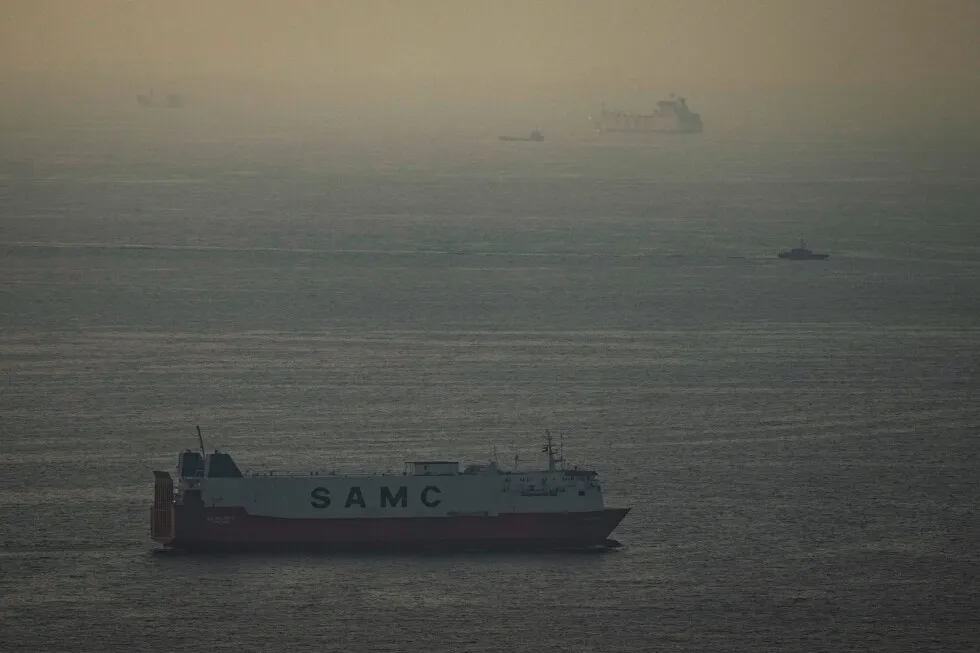
Iran starts to formalize its chokehold on the Strait of Hormuz with a ‘toll booth’ regime 1 of 2 | The Fars and Tasnim news agencies, both close to Iran’s paramilitary Revolutionary Guard, quoted lawmaker Mohammadreza Rezaei Kouchi as saying that parliament was working to formalize that process and that it was “natural” for ships to pay for it. Lloyd’s List Intelligence called it a “de facto ‘toll booth’ regime,” saying that at least two vessels have paid in yuan, China’s currency. 2 of 2 | Cargo ships sail in the Arabian Gulf towards Strait of Hormuz in United Arab Emirates, Thursday, March 19, 2026. (AP Photo) 1 of 2 The Fars and Tasnim news agencies, both close to Iran’s paramilitary Revolutionary Guard, quoted lawmaker Mohammadreza Rezaei Kouchi as saying that parliament was working to formalize that process and that it was “natural” for ships to pay for it. Lloyd’s List Intelligence called it a “de facto ‘toll booth’ regime,” saying that at least two vessels have paid in yuan, China’s currency. Add AP News on Google Add AP News as your preferred source to see more of our stories on Google. 2 of 2 Cargo ships sail in the Arabian Gulf towards Strait of Hormuz in United Arab Emirates, Thursday, March 19, 2026. (AP Photo) Add AP News on Google Add AP News as your preferred source to see more of our stories on Google. Updated [hour]:[minute] [AMPM] [timezone], [monthFull] [day], [year] FRANKFURT, Germany (AP) — Iran appears to be setting itself up as the gatekeeper for the Strait of Hormuz, the world’s most important artery for oil shipments. The move could cement Tehran’s de facto chokehold over the crucial waterway and formalize its ability to keep its own oil flowing to China. Iranian communications to the United Nations maritime authority and the experience of ships transiting the strait suggest the creation of something akin to a “toll booth.” Ships must enter Iranian waters and be vetted by Iran’s Islamic Revolutionary Guards Corps. At least two vessels have paid for passage. Traffic through the strait has fallen by 90% since the start of the Iran war, sending global oil prices skyrocketing and inflicting alarming shortages on the Asian nations that get their oil from Persian Gulf countries via the strait. Only about 150 vessels, including tankers and container ships, have transited since March 1, according to Lloyd’s List Intelligence shipping information firm. That’s a little more than one day’s normal traffic before the war. Iran’s Kharg Island terminal loaded 1.6 million barrels in March — largely unchanged from prewar monthly loading totals, according to data and analytic firm Kpler. Most of the customers are small, private refineries in China that don’t care about U.S. sanctions. A majority of the ships that have made it through in recent weeks headed east, out of the Gulf; Iran-affiliated ships accounted for 24% of transits, Greece 18%, and China 10% counted by ownership or flag registration. Yet on closer examination, vessels connected to Iran accounted for 60% of transits during the first part of the war and in the last few days, some 90%. About half of the vessels turn off radio identification systems that show their location before going through, and reappear on the other side in the Gulf of Oman. There’s a reason for their reluctance and caution. At least 18 ships have been hit and at least seven crew members have been killed, according to the U.N.’s International Maritime Organization, which tracks maritime security. It did not specify which nation attacked the vessels. Lloyd’s List says tolls are paid in yuan, China’s currency“Iran’s IRGC has imposed a de facto ‘toll booth’ regime in the Strait of Hormuz,” says shipping information firm Lloyd’s List Intelligence. Normally ships use a two-lane shipping channel in the middle of the strait. But increasingly, vessels are taking a different route, to the north around Larak Island, placing them in Iran’s territorial waters and closer to the Iranian coastline.Entities that want their vessels to safely pass through must submit their details to what Lloyd’s List Intelligence refers to as “approved intermediaries” of the Revolutionary Guard, including the cargo, owners, destination and a complete crew list. Approved vessels receive a code and are escorted by an IRGC vessel. Oil is prioritized and vessels are subject to “geopolitical vetting,” Lloyd’s said.“While not all ships are paying a direct toll, at least two vessels have and the payment is settled in yuan,” Lloyd’s List said, referring to the Chinese currency.Some ships appear to have been allowed through following diplomatic pressure. Two Indian vessels loaded with liquid petroleum gas have been able to pass, according to Lloyd’s. Iran appears to be setting up a permanent systemOn Tuesday, the IMO received a letter from the Iranian government saying it “had implemented a set of precautionary measures aimed at preserving maritime safety and security.” The letter claimed Iran was acting within the principles of international law. Iran’s parliament appears to be working on a bill to formalize fees for some ships in the Strait of Hormuz, local media reported.The Fars and Tasnim news agencies, both close to Iran’s Revolutionary Guard, quoted lawmaker Mohammadreza Rezaei Kouchi saying “parliament is pursuing a plan to formally codify Iran’s sovereignty, control and oversight over the Strait of Hormuz, while also creating a source of revenue through the collection of fees.”The IMO has condemned the attacks on vessels and called for an internationally coordinated approach to secure passage through the strait that respects freedom of navigation. An Emirati oil executive calls Iran’s chokehold ‘economic terrorism’The comment by Sultan al-Jaber, who leads the massive state-run Abu Dhabi National Oil Co., signaled the hardening rhetoric of the United Arab Emirates as the war nears its one-month mark.“Weaponizing the Strait of Hormuz is not an act of aggression against one nation,” al-Jaber said in a speech for an event hosted by the Middle East Institute in Washington.“It is economic terrorism against every consumer, every family that depends on affordable energy and food. When Iran holds Hormuz hostage, every nation pays the ransom, at the gas pump, at the grocery store and at the pharmacy,” he said. “No country can be allowed to destabilize the global economy in this way.” Iran’s approach may violate international lawArticle 19 of the U.N.'s Law of the Sea Treaty states that countries must allow “innocent passage” of peaceful, law-abiding vessels in their territorial waters. “There’s no provision in international law anywhere to set up a toll booth and shake down shipping. … This is Iran using the element that they have right now, which is control of the Strait of Hormuz,” said Sal Mercogliano, a maritime historian at Campbell University in North Carolina. The secretary general of the Gulf Cooperation Council, Jasem Mohamed al-Budaiwi, said Iran’s collection of fees for passage is “an aggression and a violation of the United Nations agreement on the law of the sea.”Such payments likely run afoul of American and European sanctions on the Guard, a key power center within Iran that controls its ballistic missile arsenal and was key in suppressing nationwide protests in January.___Gambrell contributed from Dubai, United Arab Emirates. Gambrell is the news director for the Gulf and Iran for The Associated Press. He has reported from each of the Gulf Cooperation Council countries, Iran and other locations across the world since joining the AP in 2006.
SRCAssociated Press (AP)
LANGEN
LEANCenter
WORDS1 230
ENT12
FRI · 2026-03-27 · 13:53 GMTBRIEF NSR-2026-0327-39331
NSR-2026-0327-39331News Report·EN·Political Strategy
Iran starts to formalize its chokehold on the Strait of Hormuz with a ‘toll booth’ regime
Iran is formalizing control over the Strait of Hormuz, a vital waterway for global oil shipments, potentially establishing a "toll booth" regime. According to Iranian news agencies, parliament is working to formalize a process where ships pay for passage.
By
DAVID MCHUGH and JON GAMBRELLAssociated Press (AP)Filed 2026-03-27 · 13:53 GMTLean · CenterRead · 5 min
Associated Press (AP)FIG 01
Reading time
5min
Word count
1 230words
Sources cited
4cited
Entities identified
12entities
Quality score
100%
§ 01
Briefing Summary
AI-generatedNEWSAR · AI
Iran is formalizing control over the Strait of Hormuz, a vital waterway for global oil shipments, potentially establishing a "toll booth" regime. According to Iranian news agencies, parliament is working to formalize a process where ships pay for passage. Lloyd’s List Intelligence reports that at least two vessels have already paid, using China's currency. Ships must enter Iranian waters and be vetted by Iran’s Islamic Revolutionary Guards Corps. Since the start of the Iran war, traffic through the strait has fallen by 90%, with only about 150 vessels transiting since March 1. This has caused global oil prices to skyrocket and inflict alarming shortages on Asian nations.
Confidence 0.90Sources 4Claims 5Entities 12
§ 02
Article analysis
Model · rule-basedFraming
Political Strategy
Economic Impact
Tone
Mixed Tone
AI-assessed
CalmNeutralAlarmist
Factuality
0.70 / 1.00
Factual
LowHigh
Sources cited
4
Well sourced
FewMany
§ 03
Key claims
5 extracted01
Lloyd’s List Intelligence called it a “de facto ‘toll booth’ regime”.
quoteLloyd’s List Intelligence
Confidence
1.00
02
Traffic through the strait has fallen by 90% since the start of the Iran war.
statistic
Confidence
0.90
03
At least two vessels have paid for passage [through the Strait of Hormuz].
factual
Confidence
0.90
04
Ships must enter Iranian waters and be vetted by Iran’s Islamic Revolutionary Guards Corps.
factual
Confidence
0.90
05
Iran appears to be setting itself up as the gatekeeper for the Strait of Hormuz.
factual
Confidence
0.80
§ 04
Full report
5 min read · 1 230 words§ 05
Entities
12 identifiedKey playerOppositionContextPositiveNeutralNegative
Organizations4
§ 06
Keywords & salience
9 termsstrait of hormuz
1.00
iran
0.90
toll booth regime
0.80
oil shipments
0.70
maritime security
0.60
revolutionary guard
0.50
shipping
0.50
yuan
0.40
kharg island
0.40
§ 07
Topic connections
Interactive graph Network visualization showing 51 related topics
View Full Graph Person Organization Location Event|Click node to navigate|Edge numbers = shared articles