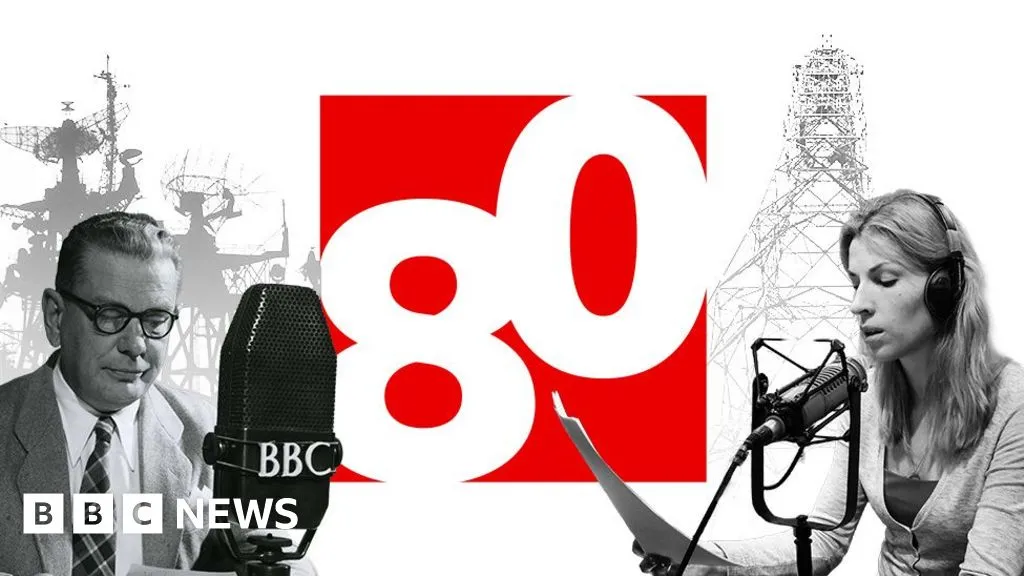
3 days agoOleg BoldyrevBBC News RussianBBCThe Kremlin is tightening its grip over what Russians can do and see online, making it harder for outlets like the BBC to reach their audiences. For the past 80 years BBC Russian has sought to bypass those restrictions, which for decades featured jamming of its short-wave radio broadcasts and now involve blocking its website.The latest restrictions in Russia have included widespread mobile internet outages and a reported plan to block the Telegram news and messaging app.On 24 March 1946, the BBC started its first regular radio broadcast in the Russian language aiming at giving listeners behind the Iron Curtain in the Soviet Union an alternative to state propaganda and a tightly controlled cultural scene.By 1949, jamming of the signal was already the norm.For almost half the 20th Century, Soviet people had to jump through hoops to listen to foreign broadcasts, and for some it was truly a sport, remembers Natalia Rubinstein, an ex-BBC presenter and former resident of Leningrad, or modern-day St Petersburg."We really wanted to know what was being hidden from us," she says.Rubinstein remembers how people who were fond of cross-country skiing – a very popular pastime in winter in Russia – used to take their radios with them out of town, where there were fewer jammers."I still have this picture before my eyes: a person leaning on a tree, with ski poles next to him, listening to the radio somehow nestled on their chest," she recalls.Natalia Rubinstein worked in the Russian service for almost a quarter of a centuryJamming of foreign broadcasts was pioneered by Nazi Germany during World War Two, using noise or signals from more powerful transmitters located closer to the listeners.During the Cold War, the BBC would repeat its 90-minute Russian-language bulletin three times a week, so people could listen at least once.It was not all news: Soviets could tune in to Western rock music, hear extracts from banned literature and even, for a brief time, take part in quizzes."My dad used to listen to the 'enemy voices' at night," reads one post on a forum dedicated to foreign-broadcast listeners."He would sit on a three-legged stool, press his forehead against the radio, and patiently, through the crackling and the wail of the jammers, tune in to the right frequency... it seemed as if those were the sounds of outer space reaching us."Not every broadcast was blocked. According to a CIA memo from 1960, stories about life in Britain or the US went on air without interference, but discussions of global conflicts or reports on the economic and political life in the Socialist bloc were always jammed.Occasionally BBC Russian succeeded in outfoxing the jammers. Peter Udell, who ran the BBC's East European service remembers what happened when Soviet leader Leonid Brezhnev died in 1982."We went off air in Russian as usual at midnight, Moscow time. And then a few minutes later, unexpectedly for the jamming teams in the Soviet Union, we popped up again with a special programme on the Brezhnev death. "And I believe, for a quite a few minutes, it went through clear because the jammers had assumed that they were off shift and perhaps had abandoned ship for the night."Before the fall of the Iron Curtain, the BBC Russian's team worked out of LondonThe secrecy and tardiness of Russian state media gave foreign broadcasters an advantage. In 1964 the BBC reported the removal of another Soviet leader, Nikita Khrushchev, from power well before Russians heard about it at home.By 1987, amid the liberal reforms under Mikhail Gorbachev, Natalia Rubinstein was in London reading BBC news bulletins instead of just listening to them."We've just got a call from BBC Monitoring," a studio manager said in her ear. "Ten minutes ago the Russians stopped the jamming. It's official. We're broadcasting without interference. You should tell our listeners that."For decades the BBC Russian team had only a faint idea of who their audience was. Finally now they were getting some feedback."First of all, we started receiving sacks of wonderful letters from the [Russian] provinces," recalls Rubinstein. "Secondly, Russian radio stations – both regional and Moscow-based – started picking up our programmes."In 1988 BBC Russian listeners tuned in live to UK Prime Minister Margaret Thatcher answering their questions. More than 800 calls came in from the whole of the USSR, and 15 of them made it to broadcast.Then-Prime Minister Margaret Thatcher gave a live interview to BBC Russian in 1988It was around that time that BBC Russian moved into its first office in Moscow, and by 2022, together with the team in London, the service had grown to more than 100 journalists competing with the best independent media in the country. Although the original platform of radio broadcasts had by now given way to the website and social media.In the final week of February, as Russia launched its full-scale invasion of Ukraine, BBC Russian's audience more than trebled in size, reaching 10 million people.On 4 March 2022, the BBC's website, as well as those of other main independent and foreign media, were blocked in Russia, accused of "spreading false information of public interest".New laws meant it was now illegal even to call the invasion a "war", contradicting the official term "special military operation".Getty ImagesRussians have been subjected to repeated mobile internet outagesFor local BBC Russian staff it meant having to leave the country if they wanted to continue objectively and safely reporting on it. A new office was set up in the Latvian capital Riga.That change has come at a real personal cost to every member of the BBC Russian team.Eight BBC Russian journalists have been declared "foreign agents" by the Russian state, a status that recalls Soviet-era campaigns against "enemies of the people" and almost inevitably leads to criminal prosecution.Jenny Norton, head of BBC-news-russian" class="entity-link entity-organization" data-entity-id="33548" data-entity-type="organization">BBC News Russian, says with cuts to US foreign broadcast networks and independent Russian outlets struggling for funding, the BBC's service is becoming an increasingly lonely but vital voice."A new generation of Russians are now having to fight to stay connected to the world," she says. "And our team has to battle internet blocking and shutdowns to keep on reaching them."In the four years since the war began, Russia's digital Iron Curtain has become increasingly hard to bypass.One poll suggests 36% of Russians use virtual private networks to get around the blockade, but Russia's internet watchdog is never far behind, blocking VPNs as they become popular.Cities across Russia have seen internet outages, most recently in the capital Moscow, raising fears that only a "whitelist" of government-approved services and websites will be available during shutdowns, similar to one used in Iran.The most popular messaging apps, such as Telegram and WhatsApp, are being restricted in favour of the government-backed Max.Russians are still defying the blockade, always adept at finding new ways to access our journalism. The current audience is up to 12 million people a week, proving the need for BBC Russian is as strong as it was in 1946.
SRCBBC News - World
LANGEN
LEANCenter
WORDS1 162
ENT12
SAT · 2026-03-28 · 01:37 GMTBRIEF NSR-2026-0328-40256
NSR-2026-0328-40256News Report·EN·Political Strategy
From jammed broadcasts to a blocked website: BBC Russian's 80 years of defiance
For 80 years, BBC Russian has strived to provide an alternative to state-controlled media in Russia, facing persistent restrictions. Initially launched in 1946 to counter Soviet propaganda with radio broadcasts, the BBC quickly encountered signal jamming by 1949.
BBC News - WorldFiled 2026-03-28 · 01:37 GMTLean · CenterRead · 5 min
BBC News - WorldFIG 01
Reading time
5min
Word count
1 162words
Sources cited
3cited
Entities identified
12entities
Quality score
100%
§ 01
Briefing Summary
AI-generatedNEWSAR · AI
For 80 years, BBC Russian has strived to provide an alternative to state-controlled media in Russia, facing persistent restrictions. Initially launched in 1946 to counter Soviet propaganda with radio broadcasts, the BBC quickly encountered signal jamming by 1949. Listeners devised creative methods to circumvent the jamming, seeking uncensored news, Western music, and banned literature. As Russia has tightened its control over online content, the BBC's website has been blocked, and mobile internet outages have occurred. Despite these challenges, BBC Russian continues its efforts to reach Russian audiences with independent reporting.
Confidence 0.90Sources 3Claims 5Entities 12
§ 02
Article analysis
Model · rule-basedFraming
Political Strategy
Human Rights
Tone
Measured
AI-assessed
CalmNeutralAlarmist
Factuality
0.70 / 1.00
Factual
LowHigh
Sources cited
3
Well sourced
FewMany
§ 03
Key claims
5 extracted01
By 1949, jamming of the signal was already the norm.
factualBBC News Russian
Confidence
1.00
02
On 24 March 1946, the BBC started its first regular radio broadcast in the Russian language.
factualBBC News Russian
Confidence
1.00
03
BBC Russian has sought to bypass restrictions for 80 years, including jamming and website blocking.
factualBBC News Russian
Confidence
1.00
04
Stories about life in Britain or the US went on air without interference, according to a CIA memo from 1960.
factualCIA memo
Confidence
0.90
05
The Kremlin is tightening its grip over what Russians can do and see online.
factualBBC News Russian
Confidence
0.90
§ 04
Full report
5 min read · 1 162 words§ 05
Entities
12 identifiedKey playerOppositionContextPositiveNeutralNegative
Organizations5
Locations4
Events1
§ 06
Keywords & salience
9 termsbbc russian
1.00
media censorship
0.90
internet restrictions
0.80
radio jamming
0.80
soviet union
0.70
cold war
0.60
propaganda
0.60
alternative media
0.50
online blocking
0.50
§ 07
Topic connections
Interactive graph Network visualization showing 51 related topics
View Full Graph Person Organization Location Event|Click node to navigate|Edge numbers = shared articles