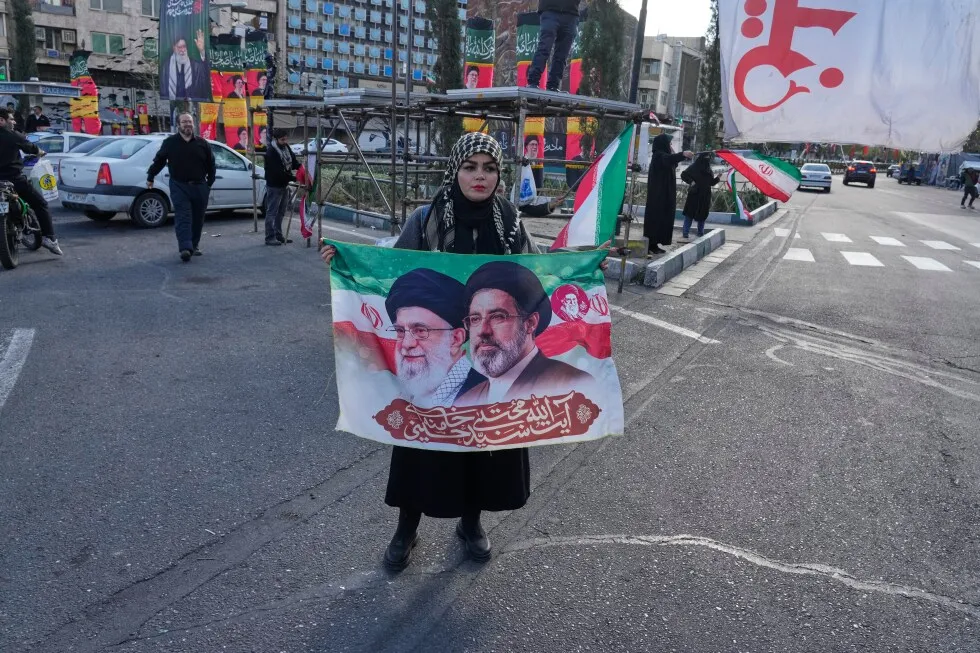
US attacks Iranian nuclear site while Tehran hits oil tanker off the Dubai coast 1 of 6 | The U.S. Central Command on Monday posted on the social media platform X video of military strikes in Iran. The post read “U.S. forces continue to eliminate the Iranian regime’s ability to project power in meaningful ways outside of Iran’s borders.” 2 of 6 | Portraits of Hezbollah’s late leaders Hassan Nasrallah, right, and his cousin, Hashem Safieddine, are seen, as smoke rises following an Israeli airstrike in Dahiyeh, Beirut’s southern suburbs, Lebanon, Monday, March 30, 2026. (AP Photo/Hassan Ammar) 3 of 6 | A portrait of Iran’s late Supreme Leader Ayatollah Ali Khamenei, left, is seen, as smoke rises following an Israeli airstrike in Dahiyeh, Beirut’s southern suburbs, Lebanon, Monday, March 30, 2026. (AP Photo/Hassan Ammar) 4 of 6 | Israeli authorities inspect a damaged house following an Iranian missile strike in Haifa, Israel, Monday, March 30, 2026. (AP Photo/Ariel Schalit) 5 of 6 | Monsignor Simon Khoury inspects a damaged house following an Iranian missile strike in Shefaram, Israel, Monday, March 30, 2026. (AP Photo/Ariel Schalit) 6 of 6 | Members of the Basij paramilitary force stand at a checkpoint in Tehran, Iran, Sunday, March 29, 2026. (AP Photo/Vahid Salemi) 1 of 6 The U.S. Central Command on Monday posted on the social media platform X video of military strikes in Iran. The post read “U.S. forces continue to eliminate the Iranian regime’s ability to project power in meaningful ways outside of Iran’s borders.” Add AP News on Google Add AP News as your preferred source to see more of our stories on Google. 2 of 6 Portraits of Hezbollah’s late leaders Hassan Nasrallah, right, and his cousin, Hashem Safieddine, are seen, as smoke rises following an Israeli airstrike in Dahiyeh, Beirut’s southern suburbs, Lebanon, Monday, March 30, 2026. (AP Photo/Hassan Ammar) Add AP News on Google Add AP News as your preferred source to see more of our stories on Google. 3 of 6 A portrait of Iran’s late Supreme Leader Ayatollah Ali Khamenei, left, is seen, as smoke rises following an Israeli airstrike in Dahiyeh, Beirut’s southern suburbs, Lebanon, Monday, March 30, 2026. (AP Photo/Hassan Ammar) Add AP News on Google Add AP News as your preferred source to see more of our stories on Google. 4 of 6 Israeli authorities inspect a damaged house following an Iranian missile strike in Haifa, Israel, Monday, March 30, 2026. (AP Photo/Ariel Schalit) Add AP News on Google Add AP News as your preferred source to see more of our stories on Google. 5 of 6 Monsignor Simon Khoury inspects a damaged house following an Iranian missile strike in Shefaram, Israel, Monday, March 30, 2026. (AP Photo/Ariel Schalit) Add AP News on Google Add AP News as your preferred source to see more of our stories on Google. 6 of 6 Members of the Basij paramilitary force stand at a checkpoint in Tehran, Iran, Sunday, March 29, 2026. (AP Photo/Vahid Salemi) Add AP News on Google Add AP News as your preferred source to see more of our stories on Google. Updated [hour]:[minute] [AMPM] [timezone], [monthFull] [day], [year] Dubai, United Arab Emirates (AP) — A likely strike by the United States hit the central Iranian city of Isfahan early Tuesday, sending a massive fireball into the sky, and Tehran struck a fully loaded Kuwaiti oil tanker in the Persian Gulf.The attacks were testament to the intensity of the monthlong war the U.S. and Israel launched against Iran, which has maintained its chokehold on the Strait of Hormuz, closing off the vital waterway for global energy shipments, sending oil prices skyrocketing and roiling world markets.U.S. President Donald Trump, who has been insisting there is progress in diplomatic talks toward a ceasefire, shared video of the attack on Isfahan, with fiery explosions lighting up the night sky. Isfahan is home to one of three sites earlier attacked by the U.S. military in June and some of Iran’s highly enriched uranium is likely stored or buried or there. Meanwhile, Israel said another four soldiers had been killed in its invasion of Lebanon, as were two more United Nations peacekeepers, prompting the U.N. Security Council to schedule an emergency session for later Tuesday. Iranian launches new attacks on Gulf neighbors and hits oil tanker in Dubai watersSpot prices of Brent crude, the international standard, hovered around $107 a barrel in early trading, up more than 45% since the war started Feb. 28 when the U.S. and Israel attacked Iran. Iran’s stranglehold on the Strait of Hormuz, the waterway leading our of Persian Gulf through which a fifth of the world’s oil is transported during peacetime, has driven up global oil prices, as have its attacks on Gulf regional energy infrastructure.In response to growing Gulf Arab anger, Iranian Foreign Minister Abbas Araghchi insisted Tuesday that Tehran is only targeting U.S. forces. Several states have been encouraging Washington to continue the war until Iran’s military capabilities are destroyed. “Our operations are aimed at enemy aggressors who have no respect for Arabs or Iranians, nor can provide any security,” Araghchi wrote on X. “High time to eject U.S. forces.” Despite these words, attacks on civilian targets continued as an Iranian drone hit a Kuwaiti oil tanker in Dubai waters, sparking a blaze that was later put out, the Dubai Media Office said. Four people in Dubai were also wounded when debris from an intercepted drone fell into a residential area. Air raid sirens sounded in Bahrain, while Saudi Arabia’s Defense Ministry said it had intercepted three ballistic missiles launched toward Riyadh, and falling debris from a drone intercepted southeast of the capital caused minor damage to six homes. Sirens were also heard in Jerusalem and loud explosions were heard not long after Israel’s military warned of an incoming missile barrage from Iran. Israel and US launch new wave of strikes on IranIsrael and the U.S. launched a new wave of strikes on Iran, hitting Tehran in the early morning hours. The video shared by Trump appeared to show a massive attack on Isfahan, where NASA fire-tracking satellites suggest the explosions happened near Mount Soffeh, an area believed to have military positions. Iran has not yet confirmed the attack. A satellite image taken just before the 12-day war in June between Iran and Israel suggests Tehran transferred a truckload of highly enriched uranium to its nuclear facility at Isfahan.The image from an Airbus Defense and Space Pléiades Neo satellite shows a truck loaded with 18 blue containers going into a tunnel at the Isfahan Nuclear Technology Center about two weeks before the U.S. bombed the site. Analysts determined that the truck likely carried most or all of Iran’s stockpile of uranium enriched up to 60% purity. That’s a short, technical step to weapons-grade levels of 90%. Eyes on Kharg Island as more US assault troops head to regionTrump has said this week that “great progress is being made” in talks with Iran to end military operations. But he said if a deal is not reached “shortly,” and if the Strait of Hormuz is not immediately reopened, the U.S. would broaden its offensive by “completely obliterating” power plants, oil wells, Kharg Island and possibly even desalination plants.The U.S. has also sent a contingent of 2,500 Marines to the region, and another is on its way, while ordering 1,000 paratroopers to the theatre as well. Trump has openly talked about the possibility of trying to seize Kharg Island, Iran’s main oil export hub, and Iran has accused the U.S. of using diplomacy to stall until more troops can be brought in. The U.S. already has targeted military positions on Kharg. Iran has threatened to launch its own ground invasion of Gulf Arab countries and to mine the Persian Gulf if U.S. troops set foot on its territory.Twice during Trump’s second term, the U.S. has attacked Iran during high-level diplomatic talks, including with the Feb. 28 strikes that started the current war. Peacekeepers killed in Lebanon as Israel battles HezbollahThe U.N. Security Council planned to convene an emergency session Tuesday after officials said three peacekeepers in southern Lebanon had been killed in less than 24 hours. The U.N. peacekeeping mission in the region where Israel is battling the Iran-backed Hezbollah did not say who was responsible for the deaths.In Iran, authorities say more than 1,900 people have been killed, while 19 have been reported dead in Israel.Two dozen people have been killed in Gulf states and the occupied West Bank. In Lebanon, officials said more than 1,200 people have been killed, and more than 1 million have been displaced.Ten Israeli soldiers have died in Lebanon, including the four announced Tuesday, while 13 U.S. service members have been killed in the war.___Rising reported from Bangkok. Sally Abou AlJoud in Beirut contributed to this report. Gambrell is the news director for the Gulf and Iran for The Associated Press. He has reported from each of the Gulf Cooperation Council countries, Iran and other locations across the world since joining the AP in 2006. Rising covers regional Asia-Pacific stories for The Associated Press. He has worked around the world, including covering the wars in Iraq, Afghanistan and Ukraine, and was based for nearly 20 years in Berlin before moving to Bangkok.
SRCAssociated Press (AP)
LANGEN
LEANCenter
WORDS1 546
ENT12
TUE · 2026-03-31 · 06:23 GMTBRIEF NSR-2026-0331-44590
NSR-2026-0331-44590News Report·EN·Conflict
US attacks Iranian nuclear site while Tehran hits oil tanker off the Dubai coast
On Monday, March 30, 2026, the U.S. Central Command announced military strikes in Iran, stating the goal was to diminish Iran's ability to project power beyond its borders.
By
JON GAMBRELL and DAVID RISINGAssociated Press (AP)Filed 2026-03-31 · 06:23 GMTLean · CenterRead · 7 min
Associated Press (AP)FIG 01
Reading time
7min
Word count
1 546words
Sources cited
1cited
Entities identified
12entities
Quality score
100%
§ 01
Briefing Summary
AI-generatedNEWSAR · AI
On Monday, March 30, 2026, the U.S. Central Command announced military strikes in Iran, stating the goal was to diminish Iran's ability to project power beyond its borders. Simultaneously, an oil tanker off the coast of Dubai was hit by Iranian forces. In response to these events, Israel conducted airstrikes in Dahiyeh, a suburb of Beirut, Lebanon. Iranian missile strikes also caused damage to houses in Haifa and Shefaram, Israel. The attacks and counter-attacks signal an escalation of conflict in the region.
Confidence 0.90Sources 1Claims 5Entities 12
§ 02
Article analysis
Model · rule-basedFraming
Conflict
National Security
Tone
Mixed Tone
AI-assessed
CalmNeutralAlarmist
Factuality
0.80 / 1.00
Factual
LowHigh
Sources cited
1
Limited
FewMany
§ 03
Key claims
5 extracted01
Smoke rises following an Israeli airstrike in Dahiyeh, Beirut’s southern suburbs, Lebanon, Monday, March 30, 2026.
factualAP Photo/Hassan Ammar
Confidence
1.00
02
Israeli authorities inspect a damaged house following an Iranian missile strike in Haifa, Israel, Monday, March 30, 2026.
factualAP Photo/Ariel Schalit
Confidence
1.00
03
U.S. forces continue to eliminate the Iranian regime’s ability to project power in meaningful ways outside of Iran’s borders.
quoteU.S. Central Command
Confidence
1.00
04
Tehran hits oil tanker off the Dubai coast.
factualArticle Title
Confidence
1.00
05
US attacks Iranian nuclear site.
factualArticle Title
Confidence
1.00
§ 04
Full report
7 min read · 1 546 words§ 05
Entities
12 identifiedKey playerOppositionContextPositiveNeutralNegative
People3
Organizations3
§ 06
Keywords & salience
9 termsus attacks
0.90
iran
0.90
iranian nuclear site
0.80
oil tanker
0.70
military strikes
0.70
israel
0.60
missile strike
0.60
hezbollah
0.50
us central command
0.50
§ 07
Topic connections
Interactive graph Network visualization showing 51 related topics
View Full Graph Person Organization Location Event|Click node to navigate|Edge numbers = shared articles