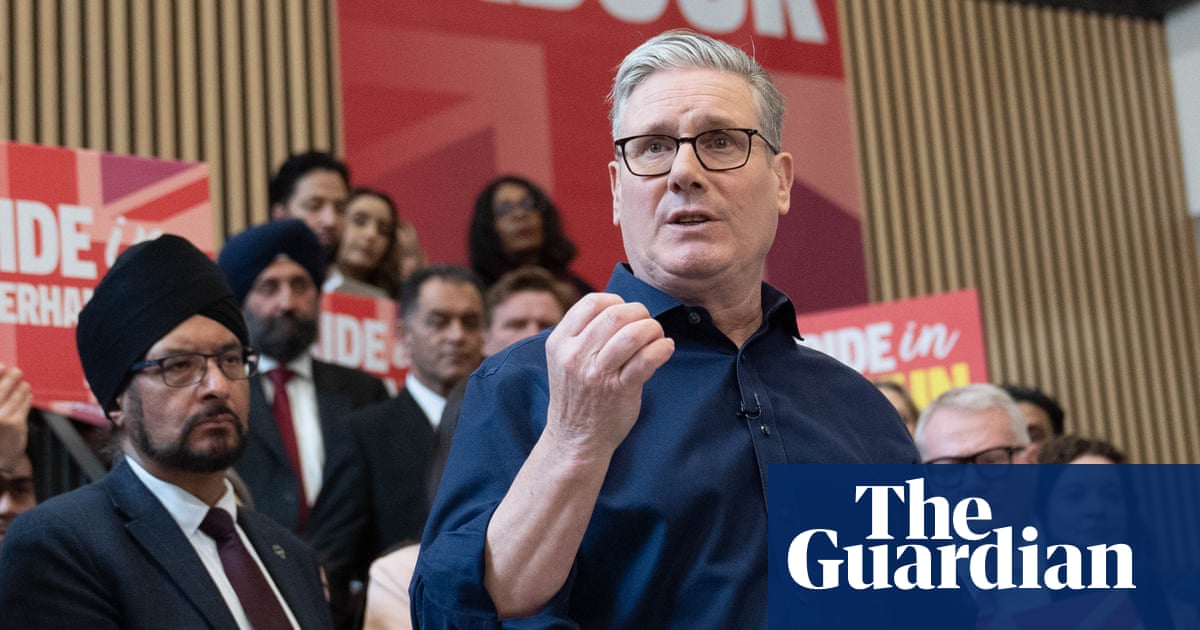
Prime Minister Keir Starmer at the launch of Labour’s local elections campaign in Wolverhampton yesterday. Photograph: Stefan Rousseau/PA View image in fullscreen Prime Minister Keir Starmer at the launch of Labour’s local elections campaign in Wolverhampton yesterday. Photograph: Stefan Rousseau/PA Tuesday briefing: How to make sense of England’s local elections campaigns In today’s newsletter: From breakthroughs to breakdowns, what we can expect to see – and what the consequences of the vote could be Good morning. On 7 May, voters in England will go to the polls for a series of local elections, on the same day that Scotland and Wales vote for new governments. It promises to be a torrid time for Keir Starmer and his governing Labour Party, with Nigel Farage’s Reform UK, Zack Polanski’s Green Party and Rhun ap Iorwerth’s Plaid Cymru expected to make breakthroughs. Recent polling, though, suggests that the overall balance between those on the right and those on the left has barely shifted – rather, previously loyal Conservative voters are moving towards Farage’s party, while Labour voters are deserting to other progressive options. For today’s newsletter, I spoke to Jessica Elgot, the Guardian’s deputy political editor, about what we can expect to see in England’s local elections, and what the consequences of the vote could be. First, the headlines. Middle East crisis | Donald Trump has threatened to “obliterate” Iran’s power stations and fresh water plants if Tehran does not agree to peace terms “shortly”. Israel | Israel’s parliament has passed a law imposing the death penalty on Palestinians convicted of fatal attacks, a measure sharply criticised as discriminatory by European countries and rights groups. BBC | The BBC has sacked the Radio 2 presenter Scott Mills after allegations about his personal conduct. The corporation said that “while we do not comment on matters relating to individuals, we can confirm Scott Mills is no longer contracted and has left the BBC”. Politics | Zack Polanski has kicked off a charm offensive designed to convince trade unions to stop funding Labour and throw their weight behind the Green Party, as he delivered the first in a series of speeches to union conferences. Travelodge | A woman who was sexually assaulted by an employee at a Travelodge has said she was shocked to learn the hotel chain’s boss cancelled a meeting with a group of MPs seeking to discuss concerns about the case. In depth: ‘Unfamiliar territory for British politics’ View image in fullscreen Kemi Badenoch launching a campaign against fuel tax. Photograph: Neil Hall/EPA In England, there are just over 5,000 council seats up for grabs on 7 May, with elections spanning all 32 London borough councils, 32 metropolitan boroughs, 18 unitary authorities, six county councils, 48 district councils and six directly elected mayors in England. “There was always an expectation in Labour HQ that these elections would function like a midterm referendum on the government,” Jessica Elgot tells me. “What wasn’t anticipated was quite how perilous Keir Starmer’s position would look among his own MPs by this point – and just how many different directions Labour’s vote is now being pulled in.” The increasingly fragmented, multiparty landscape makes these elections particularly difficult to judge, says Jess. “Normally, you can map out best-case and worst-case scenarios for a party,” she says. “This time, with so many parties competing across different parts of the country, you could end up with a very confusing, mixed picture.” Labour, she says, isn’t losing support in just one direction – it’s potentially losing it to parties across the spectrum. “There’s a much bigger story here about how new and unfamiliar this territory is for British politics.” One important note: even if you are an elections geek, it is probably not worth pulling an all-nighter on the day of the elections. Most councils in England won’t start counting until the next day, and some results won’t come through until the Saturday. Starmer’s central argument to the electorate is essentially: stick with us, don’t take a risk on alternatives. Labour is framing the election as a choice between stability and volatility, arguing that switching to Reform or other parties would jeopardise progress on tackling the cost of living. Ministers are pointing to measures to address energy bills, wages, childcare and pensions as evidence that things are beginning to improve, urging voters to “stay the course”. Alongside that economic message is a broader appeal to security and values. In what Starmer is casting as an increasingly unstable world, Labour’s pitch is that “a Britain built for all” based on the “fairness we stand for” at home and stability abroad are linked – and that rival parties represent poor judgment. Reform and the Conservatives are being portrayed as reckless, particularly on foreign policy, while the Greens are dismissed as offering the “wrong answers”. The underlying strategy is to consolidate Labour’s vote by presenting it as the only credible, responsible option in a fragmented political landscape. None of which, of course, is about what local councils do – get the bins emptied, potholes filled and cover the costs of social care. Who is best placed to benefit from Labour’s unpopularity? “With Reform, you’d expect gains from Labour and the Conservatives,” Jess says. “Some of their council wins are likely to come directly at the Conservatives’ expense – particularly in places such as Essex and outer London. But they’re also targeting Labour heartlands in the north and the Midlands – places such as Sunderland and Barnsley – where they could make significant inroads.” The Greens, by contrast, are targeting dissatisfied Labour voters. “You could see them make real advances in parts of London that have traditionally been very safe for Labour – places such as Hackney, Newham, Lambeth or Waltham Forest.” The Liberal Democrats, meanwhile, “are operating in a very different lane to the Greens”, Jess says. Their strategy has been to target disaffected Conservative voters, particularly in more affluent areas. “That’s why you can walk from Land’s End to London without going through a Tory constituency.” For Kemi Badenoch’s Conservatives, the best hope of good news may come in traditional London bellwethers – Westminster, Barnet and Wandsworth – where they could claw back some ground. This past weekend, my colleague Peter Walker reported that, perhaps contrary to expectations, many of Badenoch’s MPs are “relative to their mood in recent years, quite cheery”. View image in fullscreen A clash of animosities may define the local elections in England. Photograph: Alicia Canter/The Guardian In her analysis last week, Guardian political editor Pippa Crerar suggested a clash of animosities was likely to define the vote as people opt for “anyone but Labour” or “anyone but Reform”. “Local elections are often a kind of ‘free hit’ for voters,” Jess says. “People don’t always feel they have to think about the national picture in the same way, or vote tactically. That can make them a space where frustration is expressed more freely.” London and the north-east will be critical for Labour. Many of its MPs are in London, and “what happens in their own back yard will really matter for internal party confidence”. Meanwhile, “you could see Reform making advances in places where you’d never previously expect Labour to be seriously challenged, such as areas of Liverpool. That will give us one of the clearest indications yet of how deep that shift in support really is.” Senior party figures have warned that voters would punish the party further at the ballot box for indulging in a leadership contest while Starmer was trying to navigate through the international crisis of a war in the Middle East, which may insulate him from the most severe outcome. The king’s speech on 13 May and a potential cabinet reshuffle will, Downing Street hopes, quickly shift focus away from a local election debacle. What Labour are ultimately banking on, Jess says, is that at a general election voters will return to them as the best “stop Farage” option. That may come as cold comfort to Keir Starmer, on what looks set to be a very difficult set of results. What else we’ve been reading View image in fullscreen People are pumping themselves with fat from corpses to perk up their pecs, boobs and butts. Composite: Rita Liu/The Guardian/Getty Images I had no idea what “zombie filler” was before I read this extraordinary piece on the use of cadaver tissue in cosmetic surgery. It’s a horrifying read but it is hard to look away. Patrick Daffodils bloom, a cuckoo sounds, frogspawn appears, Ali Martin writes a preview of the English county cricket season, and you know that spring is almost here. Martin From Atonement to the X-Men, James McAvoy is a fixture on screens small and large. Now, the Glaswegian actor has made his directorial debut with California Schemin’, a true-life story about a Scottish rap duo who pretend to be American to make their dreams come true. He spoke to the Guardian’s Libby Brooks about the film. Patrick In case you missed it, this story by Oliver Holmes about the woman who alerts the world when an asteroid could hit is well worth a read. It made me feel safer. Patrick For the Quietus, Simon Price speaks to the electronic band Ladytron about 10 of their most impressive tracks. Martin Sport View image in fullscreen Declan Rice and Jude Bellingham of England talk to James Maddison during a training session. Photograph: Eddie Keogh/The FA/Getty Images Football | Thomas Tuchel has plotted a diplomatic course through the storm that has followed the withdrawals of Declan Rice and Bukayo Saka from the England squad, saying the optics may look bad but he has “100% trust” in their integrity. Football | Roberto De Zerbi has moved closer to becoming Tottenham’s new manager after further negotiations on Monday. The club have made him their prime target to replace Igor Tudor and save them from what would be a ruinous relegation to the Championship. Cricket | Worcestershire’s new overseas signing has arrived under a cloud after leaving a one-day final in South Africa to catch his flight to England. Beyers Swanepoel set off for the airport “around the 43rd over” of the second innings without informing his teammates as to why. The front pages View image in fullscreen Photograph: Guardian The Guardian leads with “Trump threat to ‘obliterate’ all Iranian power plants”. The i has “PM meets UK fuel bosses as prices rise at the pumps”. The Times says “War brings in £20m a day extra in energy taxes”. The Telegraph splashes on “Starmer’s 48-hour ultimatum to doctors”. The Financial Times reports “Mistral raises $830m to build AI data centres in drive for digital ‘sovereignty’”. The Sun is among a number of papers leading on the sudden sacking of BBC radio DJ Scott Mills; its headline is “Mills crisis for BBC”. Today in Focus View image in fullscreen Nasa’s next-generation moon rocket, the Space Launch System (SLS) rocket with the Orion crew capsule, ahead of the Artemis II mission launch. Photograph: Brendan McDermid/Reuters Astronaut Tim Peake and Guardian journalist Richard Luscombe talk through Artemis II, the first manned mission to the moon for 50 years. Cartoon of the day | Ben Jennings View image in fullscreen Illustration: Ben Jennings/The Guardian The Upside A bit of good news to remind you that the world’s not all bad View image in fullscreen John Amanam, right, and his brother Ubokobong, with the prosthetic arm created at their Immortal Cosmetic Art laboratory. Photograph: Sodiq Adelakun/Reuters Seven years ago, Ubokobong Amanam (pictured above, left) was seriously injured in a fireworks accident. Although doctors saved his life, they could not save his fingers, reports Valentine Benjamin from Uyo, Nigeria. Today, Amanam has a lifelike prosthetic – but finding it has not been without a challenge. “The first thing I discovered is that prosthetics aren’t really made for people like us,” he says. Artificial limbs for Nigerians and other Africans are often hard to access, prohibitively expensive and made for western bodies. So Amanam and his brother John, a special effects artist, decided to design prosthetics for Africans, by Africans. The Ubokobong Bionic Arm took three years to create, and the Amanam’s company, Immortal Cosmetic Art, has become a leader in accessible, lifelike prosthetics across the continent. And finally, the Guardian’s puzzles are here to keep you entertained throughout the day. Until tomorrow. Explore more on these topics UK news First Edition newsletter England Reform UK Nigel Farage Labour Keir Starmer Conservatives newsletters Share Reuse this content
SRCThe Guardian - World News
LANGEN
LEANCenter-Left
WORDS2 081
ENT12
TUE · 2026-03-31 · 05:45 GMTBRIEF NSR-2026-0331-44672
NSR-2026-0331-44672News Report·EN·Political Strategy
Tuesday briefing: How to make sense of England’s local elections campaigns
England is preparing for local elections on May 7th, coinciding with elections in Scotland and Wales. The Labour party, led by Keir Starmer, is expected to face challenges from Reform UK, the Green party, and Plaid Cymru.
Martin BelamThe Guardian - World NewsFiled 2026-03-31 · 05:45 GMTLean · Center-LeftRead · 9 min
The Guardian - World NewsFIG 01
Reading time
9min
Word count
2 081words
Sources cited
0cited
Entities identified
12entities
Quality score
100%
§ 01
Briefing Summary
AI-generatedNEWSAR · AI
England is preparing for local elections on May 7th, coinciding with elections in Scotland and Wales. The Labour party, led by Keir Starmer, is expected to face challenges from Reform UK, the Green party, and Plaid Cymru. Recent polling indicates a shift in voter allegiance, with Conservative voters moving towards Reform UK and Labour voters exploring other progressive options. In other news, Donald Trump threatened to attack Iran's infrastructure if peace terms aren't agreed upon, while Israel passed a law imposing the death penalty on Palestinians convicted of fatal attacks. The BBC has terminated Scott Mills' contract following allegations about his personal conduct. Finally, the Green party is actively seeking support from trade unions, and Travelodge faces criticism after its boss cancelled a meeting with MPs regarding a sexual assault case.
Confidence 0.90Claims 5Entities 12
§ 02
Article analysis
Model · rule-basedFraming
Political Strategy
Conflict
Tone
Measured
AI-assessed
CalmNeutralAlarmist
Factuality
0.70 / 1.00
Factual
LowHigh
Sources cited
0
No named sources
FewMany
§ 03
Key claims
5 extracted01
Israel’s parliament has passed a law imposing the death penalty on Palestinians convicted of fatal attacks.
factual
Confidence
1.00
02
Donald Trump has threatened to “obliterate” Iran’s power stations and fresh water plants.
quoteDonald Trump
Confidence
1.00
03
Scotland and Wales vote for new governments on 7 May.
factual
Confidence
1.00
04
Voters in England will go to the polls for local elections on 7 May.
factual
Confidence
1.00
05
Recent polling suggests the balance between right and left has barely shifted.
factual
Confidence
0.80
§ 04
Full report
9 min read · 2 081 words§ 05
Entities
12 identifiedKey playerOppositionContext
LP
Labour Party organization · Key Player
80
KS
Keir Starmer person · Key Player
70
NF
Nigel Farage person · Key Player
60
GP
Green Party organization · Key Player
60
ZP
Zack Polanski person · Key Player
60
RU
Reform UK organization · Key Player
60
CP
Conservative Party organization · Context
50
I
Israel location · Context
50
DT
Donald Trump person · Opposition
50
I
Iran location · Opposition
50
PC
Plaid Cymru organization · Key Player
40
RA
Rhun ap Iorwerth person · Key Player
40
§ 06
Keywords & salience
7 termslocal elections
1.00
political parties
0.80
voters
0.70
polling
0.60
middle east crisis
0.50
sexual assault
0.40
trade unions
0.40
§ 07
Topic connections
Interactive graph Network visualization showing 51 related topics
View Full Graph Person Organization Location Event|Click node to navigate|Edge numbers = shared articles