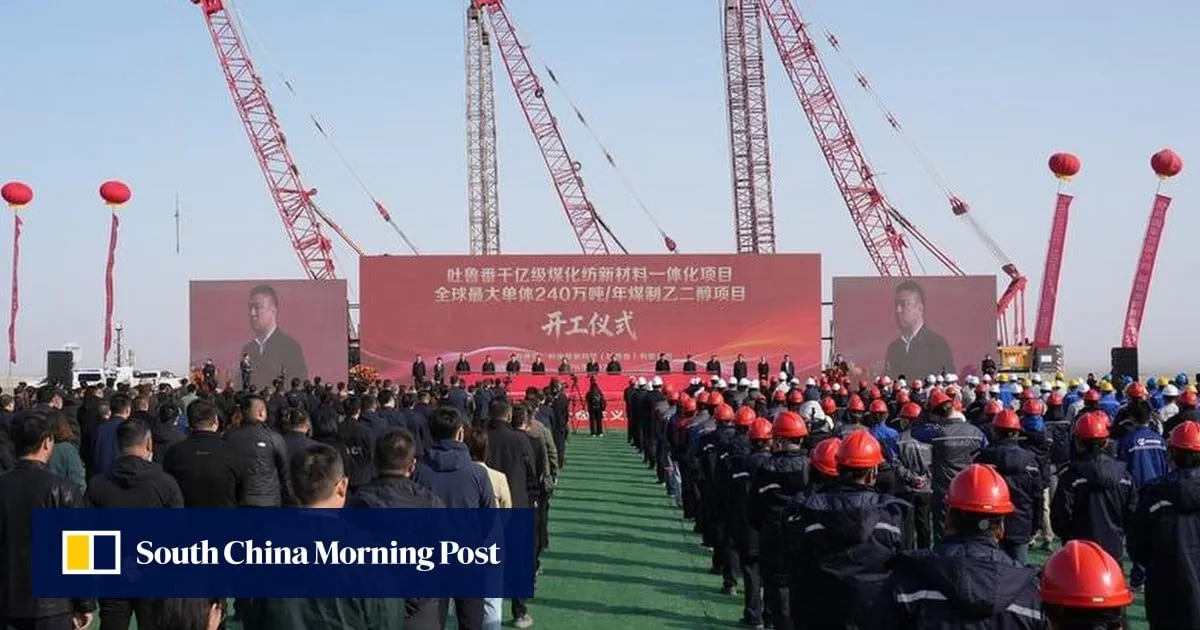
China is doubling down on mega chemical plants to secure the “industrial gold” needed for its green technology and to scale the coal-based production of chemicals whose global supply is stalled by conflict in the Middle East.On March 20, construction began on the world’s largest coal-to-ethylene glycol project in Xinjiang’s Turpan prefecture, which is expected to produce 2.4 million tonnes per year, according to state news agency Xinhua.China’s first 100,000-tonne/year solution process-based polyolefin elastomer (POE) industrial plant using entirely domestic technology entered a critical commissioning stage at state-owned Sinopec’s Tianjin Petrochemical facility, according to an article published on March 22 in China Science Daily, a newspaper run by the Chinese Academy of Sciences.The Turpan prefecture coal-to-ethylene glycol project is expected to produce 2.4 million tonnes per year, according to Xinhua. Photo: CCTVDomestic tech innovations, especially in coal-to-chemical efficiency and novel POE catalysts, help China fast track these mega plant expansions. These projects could secure critical chemicals for green tech and manufacturing while reducing dependence on overseas supplies.China is the world’s largest producer of standard chemicals, but it has long had gaps in the production of advanced, high-end chemicals. These gaps are now being filled with the help of technology breakthroughs that could insulate it from external market shocks amid rising global tensions.The global supply chain for high-end chemicals – many of them derived from oil and natural gas – has been significantly affected by the effective closure of the Strait of Hormuz since the US and Israel launched the war on Iran.The Middle East not only supplies oil and natural gas for petrochemical production worldwide, but is also a major production and export hub for finished chemicals, whose major buyers include China.Ethylene glycol is a toxic alcohol used as an industrial antifreeze for vehicles and aeroplanes, and is also used as a raw material in manufacturing plastics.
SRCSouth China Morning Post
LANGEN
LEANCenter-Right
WORDS307
ENT12
WED · 2026-04-01 · 04:00 GMTBRIEF NSR-2026-0401-46480
NSR-2026-0401-46480News Report·EN·Economic Impact
China doubles down on chemical plant expansion with tech breakthrough amid Iran war
China is expanding its chemical production capabilities by constructing mega chemical plants, including the world's largest coal-to-ethylene glycol project in Xinjiang, which began construction on March 20. This project aims to produce 2.4 million tonnes per year.
Victoria BelaSouth China Morning PostFiled 2026-04-01 · 04:00 GMTLean · Center-RightRead · 2 min
South China Morning PostFIG 01
Reading time
2min
Word count
307words
Sources cited
2cited
Entities identified
12entities
Quality score
100%
§ 01
Briefing Summary
AI-generatedNEWSAR · AI
China is expanding its chemical production capabilities by constructing mega chemical plants, including the world's largest coal-to-ethylene glycol project in Xinjiang, which began construction on March 20. This project aims to produce 2.4 million tonnes per year. Additionally, Sinopec's Tianjin Petrochemical facility is commissioning China's first domestic 100,000-tonne/year polyolefin elastomer (POE) plant. These expansions are driven by technological advancements in coal-to-chemical efficiency and POE catalysts. The goal is to secure critical chemicals for green technology and manufacturing, reduce reliance on foreign supplies, and address gaps in high-end chemical production amid global supply chain disruptions caused by Middle East tensions.
Confidence 0.90Sources 2Claims 5Entities 12
§ 02
Article analysis
Model · rule-basedFraming
Economic Impact
Technology
Tone
Measured
AI-assessed
CalmNeutralAlarmist
Factuality
0.80 / 1.00
Factual
LowHigh
Sources cited
2
Limited
FewMany
§ 03
Key claims
5 extracted01
Ethylene glycol is a toxic alcohol used as an industrial antifreeze and as a raw material in manufacturing plastics.
factual
Confidence
1.00
02
China’s first 100,000-tonne/year solution process-based polyolefin elastomer (POE) industrial plant entered a critical commissioning stage.
factualChina Science Daily
Confidence
1.00
03
The Turpan prefecture coal-to-ethylene glycol project is expected to produce 2.4 million tonnes per year.
statisticXinhua
Confidence
1.00
04
Construction began on the world’s largest coal-to-ethylene glycol project in Xinjiang’s Turpan prefecture on March 20.
factualXinhua
Confidence
1.00
05
The global supply chain for high-end chemicals has been significantly affected by the effective closure of the Strait of Hormuz.
factual
Confidence
0.80
§ 04
Full report
2 min read · 307 words§ 05
Entities
12 identifiedKey playerOppositionContextPositiveNeutralNegative
Organizations4
§ 06
Keywords & salience
10 termschina
0.90
chemical plant expansion
0.90
coal-to-chemicals
0.80
ethylene glycol
0.70
green technology
0.70
poe (polyolefin elastomer)
0.70
technology breakthrough
0.60
supply chain
0.60
middle east conflict
0.60
industrial gold
0.50
§ 07
Topic connections
Interactive graph Network visualization showing 51 related topics
View Full Graph Person Organization Location Event|Click node to navigate|Edge numbers = shared articles