FIRST ON FOX: A new report is raising concerns about Turkey’s role in the Middle East, arguing that under President Recep Tayyip Erdoğan, the country has moved away from its traditional Western alignment and toward deeper engagement with Islamist movements, including the Muslim Brotherhood. The Foundation for Defense of Democracies report , led by senior fellow Sinan Ciddi and titled "Islamist Domination of Turkey: A Forward Base for Muslim Brotherhood-Aligned Jihadism," argues that Turkey has ties to Hamas — the U.S.-designated terrorist group responsible for the Oct. 7 massacre — as well as to the Muslim Brotherhood — an Islamist movement whose affiliates have recently been designated as terrorist organizations by the United States — placing Turkey’s policies under renewed scrutiny as it prepares to host a NATO summit. Ciddi told Fox News Digital the shift reflects a broader transformation in how Turkey defines threats. "What we have is Turkey has completely rewritten the rules of how you interpret what a jihadist terrorist entity may be," Ciddi said. "Erdoğan has reinvented what is interpreted as a terrorist entity … groups such as Hamas or al-Nusra fall into line with his pan-Islamist view of the world." EXPERT WARNS RADICAL ISLAMIST NETWORKS COULD SHIFT WEST AFTER Iran REGIME SHAKEUP A central focus of the report is Turkey’s relationship with Hamas , which the United States designates as a terrorist organization, and yet Hamas expanded its presence in Turkey after 2011, establishing offices and networks inside the country. "From 2011 onward … Hamas used this opportunity inside of Turkey with a friendly government to establish offices, engage in recruitment (and) fundraising," Ciddi said. U.S. authorities have taken action against some of those networks. The Treasury Department has designated Hamas-linked individuals and entities operating in Turkey, a point Ciddi said underscores longstanding concerns. "The United States Treasury has been tracking and designating Hamas-affiliated NGOs and individuals inside of Turkey," he said. The report also alleges that some Hamas operatives have been able to travel using Turkish-issued documents and that senior figures have been publicly received by Erdoğan. Beyond Hamas, the report describes Turkey as a hub for Muslim Brotherhood figures from across the region, including Egypt and Yemen, many of whom relocated there following crackdowns in their home countries. Across parts of the Arab world, the Muslim Brotherhood has been banned or restricted for years. Egypt outlawed the movement in 2013, accusing it of inciting unrest and undermining state institutions. Saudi Arabia and the United Arab Emirates later designated it a terrorist organization, describing it as a threat to national stability, while Bahrain adopted a similar stance. Jordan dissolved its local chapter this year following arrests authorities said were linked to illicit weapons activity. Some European countries also have taken steps targeting networks linked to the movement. Austria, for example, has pursued legal action against individuals and organizations it says are connected to Brotherhood-linked activity as part of its counter-extremism policies. Officials in these countries have argued that the Brotherhood operates through a mix of religious outreach, political activism, charitable organizations and media platforms to influence public opinion and challenge state authority. ISRAEL SHUTS DOOR ON Turkey IN GAZA AS TRUMP PRAISES ERDOGAN, PLAYS DOWN CLASH The report also examines Turkey’s role in Syria , where the country backed opposition forces during the civil war, supporting a range of armed factions, including groups that later formed the Syrian National Army. "The Syrian National Army … was a hodgepodge collection of militias that Turkey directly armed, paid and organized," he said. The report links Turkish support to groups such as al-Nusra and Hayat Tahrir al-Sham, raising questions among analysts about whether such ties could expose Turkish officials to potential sanctions under U.S. law. TRUMP FACES MIDDLE EAST TEST AS NETANYAHU BALKS AT ERDOGAN’S GAZA TROOP HOPES Despite these concerns, other analysts say Turkey’s relationship with the United States continues to act as a constraint on its behavior, while the relationship between Donald Trump and Turkish President Recep Tayyip Erdoğan has been characterized by renewed trust, with Trump praising Erdoğan's role in Gaza diplomacy. As Trump celebrated the Gaza ceasefire agreement in Sharm el-Sheikh, Egypt in October 2025, he singled out one leader for extraordinary praise — Erdoğan, whose leadership he credited for helping deliver the Gaza ceasefire. "A guy who’s been a friend of mine for a long time. I don’t know why I like the tough people better than the soft, easy ones," Trump said about Erdoğan at the Sharm el-Sheikh summit in October 2025. "This gentleman from a place called Turkey is one of the most powerful in the world … He’s a tough cookie — but he’s my friend." Hişyar Özsoy, a Turkish politician and academic, described the relationship between Erdoğan and Trump as "transactional," noting Washington often relies on Turkey for regional coordination. In a policy webinar hosted by the Jerusalem Institute for Strategy and Security, Turkish academic Hüseyin Bağcı emphasized that Ankara remains closely tied to Washington. "The Turkish state is not interested in fighting with Israel because the Turkish government has very good relations with (the) United States of America," he said. "You cannot be good with America and then be in conflict with Israel." Bağcı also suggested Turkey has at times limited Islamist actors domestically . "Today do you hear anything about" the Muslim Brotherhood, he said. "No … because the president said stop." Turkey, a NATO member since 1952, remains a key partner for the United States, providing logistical access, military capabilities and diplomatic reach. But Ciddi argued Turkey's current trajectory increasingly diverges from alliance priorities. "There is an established track record … where Turkey significantly undermines the transatlantic alliance’s core security concerns," he said. He pointed to U.S. sanctions on Turkish entities accused of supplying dual-use goods to Russia, as well as Ankara’s broader strategy of maintaining ties with competing powers. As far as Turkey’s positioning itself amid tensions with Iran, Ciddi said Turkey is likely to favor a weakened Iranian regime rather than a complete collapse that could produce a more pro-Western government. "A weakened Iranian regime is Erdoğan’s safest bet," he said. Bağcı offered a similar assessment of the rivalry. "Iran is not an enemy of Turkey, but not necessarily its best friend. Turkey and Iran are two regional competitors," he said. The report recommends potential U.S. policy responses, including sanctions and increased scrutiny of Turkey’s financial system, steps that could reshape relations between Washington and Ankara . Fox News Digital reached out multiple times to the Turkish government and to the State Department for comment but did not receive a response in time for publication.
SRCFox News - World
LANGEN
LEANCenter-Right
WORDS1 102
ENT11
WED · 2026-04-01 · 15:52 GMTBRIEF NSR-2026-0401-47913
NSR-2026-0401-47913News Report·EN·National Security
Turkey’s NATO role under scrutiny amid new report on Hamas, Muslim Brotherhood ties
A new report by the Foundation for Defense of Democracies is raising concerns about Turkey's alignment with Islamist movements. The report alleges that under President Erdoğan, Turkey has deepened its engagement with groups like Hamas and the Muslim Brotherhood, diverging from its traditional Western orientation.
Fox News - WorldFiled 2026-04-01 · 15:52 GMTLean · Center-RightRead · 5 min
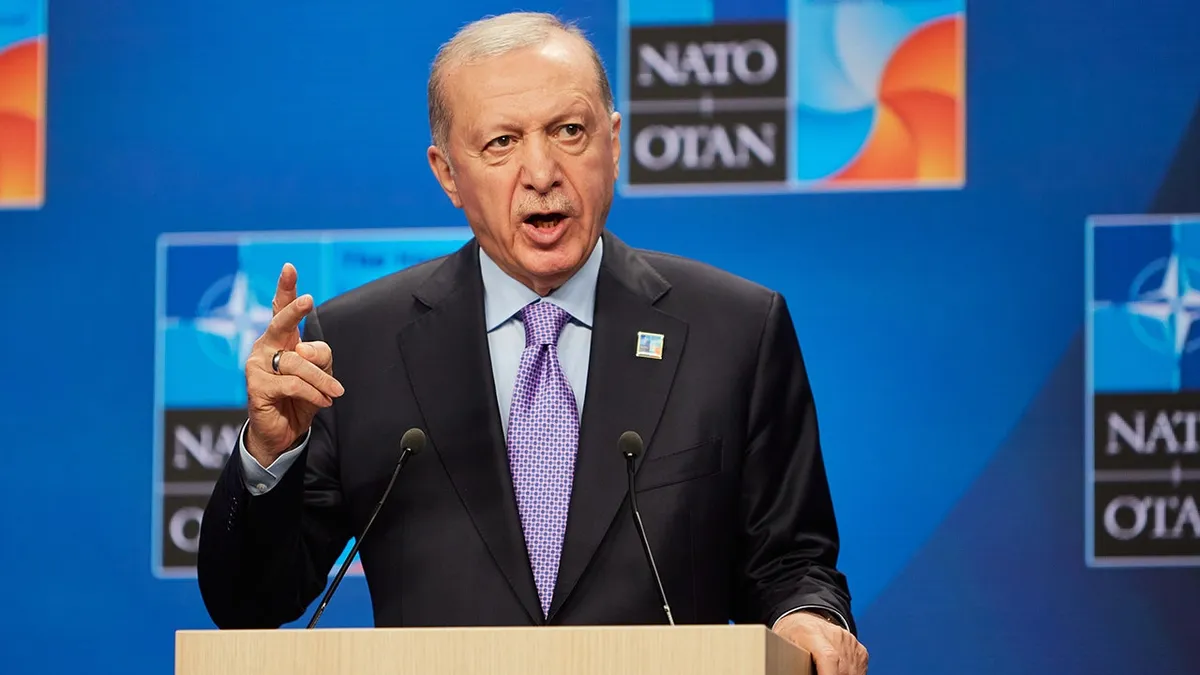
Fox News - WorldFIG 01
Reading time
5min
Word count
1 102words
Sources cited
1cited
Entities identified
11entities
Quality score
100%
§ 01
Briefing Summary
AI-generatedNEWSAR · AI
A new report by the Foundation for Defense of Democracies is raising concerns about Turkey's alignment with Islamist movements. The report alleges that under President Erdoğan, Turkey has deepened its engagement with groups like Hamas and the Muslim Brotherhood, diverging from its traditional Western orientation. It claims that Hamas expanded its presence in Turkey after 2011, establishing offices and networks for recruitment and fundraising. The report also states that Turkey has become a hub for Muslim Brotherhood figures from across the region. These allegations are placing Turkey’s policies under scrutiny as it prepares to host a NATO summit, particularly regarding its relationship with Hamas, a U.S.-designated terrorist organization. The report suggests Turkey has redefined its interpretation of terrorist entities, aligning with a pan-Islamist worldview.
Confidence 0.90Sources 1Claims 5Entities 11
§ 02
Article analysis
Model · rule-basedFraming
National Security
Diplomatic
Tone
Mixed Tone
AI-assessed
CalmNeutralAlarmist
Factuality
0.70 / 1.00
Factual
LowHigh
Sources cited
1
Limited
FewMany
§ 03
Key claims
5 extracted01
The U.S. Treasury Department has designated Hamas-affiliated NGOs and individuals inside of Turkey.
factualSinan Ciddi
Confidence
1.00
02
Hamas expanded its presence in Turkey after 2011, establishing offices and networks.
factualSinan Ciddi
Confidence
0.90
03
Turkey has moved toward deeper engagement with Islamist movements under President Erdoğan.
factualFoundation for Defense of Democracies report
Confidence
0.80
04
Turkey has ties to Hamas, a U.S.-designated terrorist group.
factualFoundation for Defense of Democracies report
Confidence
0.70
05
Some Hamas operatives have been able to travel using Turkish-issued documents.
factualFoundation for Defense of Democracies report
Confidence
0.60
§ 04
Full report
5 min read · 1 102 words§ 05
Entities
11 identifiedKey playerOppositionContextPositiveNeutralNegative
Organizations4
§ 06
Keywords & salience
9 termsturkey
1.00
hamas
0.90
muslim brotherhood
0.80
terrorism
0.70
recep tayyip erdoğan
0.60
nato
0.60
islamist movements
0.50
us treasury
0.40
jihadism
0.40
§ 07
Topic connections
Interactive graph Network visualization showing 51 related topics
View Full Graph Person Organization Location Event|Click node to navigate|Edge numbers = shared articles