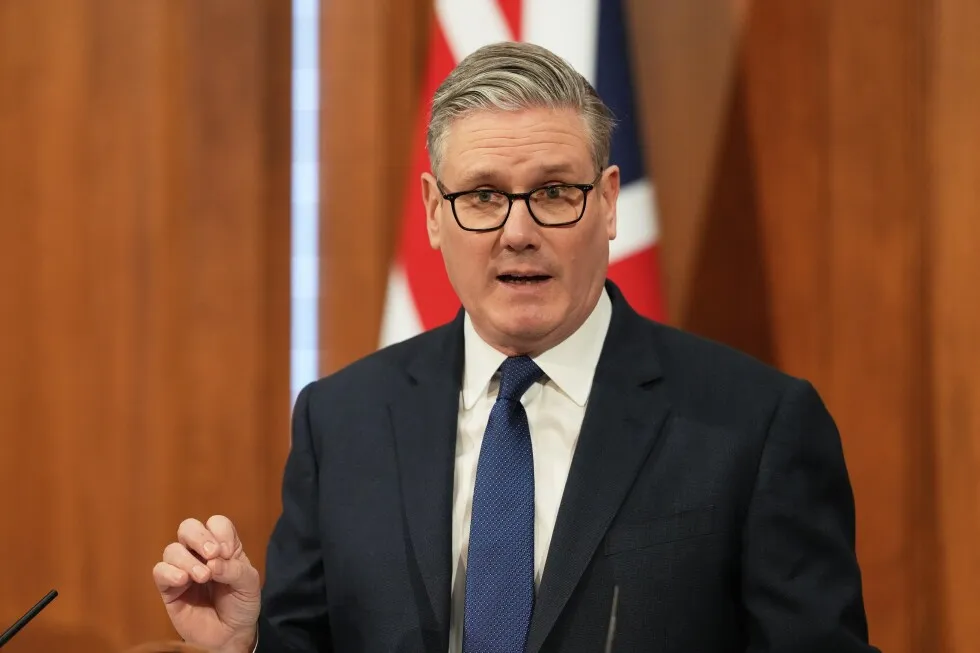
UK gathers more than 40 countries to press Iran to reopen the Strait of Hormuz 1 of 6 | The narrow, bending waterway in the Persian Gulf is a key trade route between the Middle East and the rest of the world, with global impact. It links crude oil producers in the Middle East to key markets in Asia, Europe, North America and beyond, with around 20% of the world’s traded crude oil, and a similar share of natural gas passing through it. The AP’s Luke Garratt explains. 2 of 6 | Britain’s Foreign Secretary Yvette Cooper, right, attends a virtual summit at the Foreign & Commonwealth Office in London, on Thursday April 2, 2026, with around 35 countries to discuss ways of reopening the Strait of Hormuz. (Leon Neal/Pool Photo via AP) 3 of 6 | Britain’s Foreign Secretary Yvette Cooper, center, speaks during a virtual summit at the Foreign & Commonwealth Office in London, on Thursday April 2, 2026, with around 35 countries to discuss ways of reopening the Strait of Hormuz. (Leon Neal/Pool Photo via AP) 4 of 6 | Britain’s Foreign Secretary Yvette Cooper speaks during a virtual summit at the Foreign & Commonwealth Office in London, on Thursday April 2, 2026, with around 35 countries to discuss ways of reopening the Strait of Hormuz. (Leon Neal/Pool Photo via AP) 5 of 6 | Britain’s Foreign Secretary Yvette Cooper, second right, attends a virtual summit at the Foreign & Commonwealth Office in London, on Thursday April 2, 2026, with around 35 countries to discuss ways of reopening the Strait of Hormuz. (Leon Neal/Pool Photo via AP) 6 of 6 | Britain’s Prime Minister Keir Starmer speaks during a press conference at Downing Street in London, Wednesday, April 1, 2026. (AP Photo/Frank Augstein, Pool) 1 of 6 The narrow, bending waterway in the Persian Gulf is a key trade route between the Middle East and the rest of the world, with global impact. It links crude oil producers in the Middle East to key markets in Asia, Europe, North America and beyond, with around 20% of the world’s traded crude oil, and a similar share of natural gas passing through it. The AP’s Luke Garratt explains. Add AP News on Google Add AP News as your preferred source to see more of our stories on Google. 2 of 6 Britain’s Foreign Secretary Yvette Cooper, right, attends a virtual summit at the Foreign & Commonwealth Office in London, on Thursday April 2, 2026, with around 35 countries to discuss ways of reopening the Strait of Hormuz. (Leon Neal/Pool Photo via AP) Add AP News on Google Add AP News as your preferred source to see more of our stories on Google. 3 of 6 Britain’s Foreign Secretary Yvette Cooper, center, speaks during a virtual summit at the Foreign & Commonwealth Office in London, on Thursday April 2, 2026, with around 35 countries to discuss ways of reopening the Strait of Hormuz. (Leon Neal/Pool Photo via AP) Add AP News on Google Add AP News as your preferred source to see more of our stories on Google. 4 of 6 Britain’s Foreign Secretary Yvette Cooper speaks during a virtual summit at the Foreign & Commonwealth Office in London, on Thursday April 2, 2026, with around 35 countries to discuss ways of reopening the Strait of Hormuz. (Leon Neal/Pool Photo via AP) Add AP News on Google Add AP News as your preferred source to see more of our stories on Google. 5 of 6 Britain’s Foreign Secretary Yvette Cooper, second right, attends a virtual summit at the Foreign & Commonwealth Office in London, on Thursday April 2, 2026, with around 35 countries to discuss ways of reopening the Strait of Hormuz. (Leon Neal/Pool Photo via AP) Add AP News on Google Add AP News as your preferred source to see more of our stories on Google. 6 of 6 Britain’s Prime Minister Keir Starmer speaks during a press conference at Downing Street in London, Wednesday, April 1, 2026. (AP Photo/Frank Augstein, Pool) Add AP News on Google Add AP News as your preferred source to see more of our stories on Google. Updated [hour]:[minute] [AMPM] [timezone], [monthFull] [day], [year] LONDON (AP) — Britain accused Iran on Thursday of holding the world’s economy hostage as diplomats from more than 40 countries held talks on ways to press Tehran to reopen the Strait of Hormuz, a vital oil route that has been choked off by the U.S.-Israeli war against Iran.The U.S. didn’t attend the virtual meeting, which came after U.S. President Donald Trump made clear that he thinks securing the waterway is not America’s job. Trump has also disparaged America’s European allies for failing to support the war and renewed his threats to pull the U.S. out of NATO.U.K. Foreign Secretary Yvette Cooper said the talks, which focused on political and diplomatic rather than military means, showed “the strength of our international determination” to reopen the strait. The 41 countries represented came from all continents except Antarctica, a reflection of the global tremors from a war that has sparked shortages of fuel and fertilizer and higher prices for food far beyond the Middle East.“We have seen Iran hijack an international shipping route to hold the global economy hostage,” Cooper said at the start of the meeting. Cooper said “unsustainable” spikes in oil and food prices were “hitting households and businesses in every corner of the world.” Shipping in the strait has slowed to a trickleIranian attacks on commercial ships, and the threat of more, have halted nearly all traffic in the waterway that connects the Persian Gulf to the rest of the globe’s oceans, shutting a critical path for the world’s flow of oil and sending petroleum prices soaring.There have been 23 direct attacks on commercial vessels in the Gulf since the war began on Feb. 28, and 11 crew members have been killed, according to shipping data firm Lloyd’s List Intelligence.Traffic through the strait has slowed to a trickle, with what remains dominated by sanctions-evading tankers carrying Iranian oil, Lloyd’s List Intelligence said in a briefing Thursday. It said a murky operation under which Iran vets who can pass continues to operate as Tehran maintains its chokehold over the key waterway. In a televised address on Wednesday night, Trump said countries that depend on oil flowing through the Strait of Hormuz “must grab it and cherish it” — because the U.S. would not. No country appears willing to try and open the strait by force while fighting rages and Iran can target vessels with anti-ship missiles, drones, attack craft and mines. French President Emmanuel Macron said opening the strait by force is “unrealistic.” The reopening of the strait “can only be done in coordination with Iran,” through negotiations that would follow a potential ceasefire, Macron told reporters Thursday during a visit to South Korea.France is pushing for an international mission involving European and non-European nations to escort oil and gas tankers through the waterway after the most intense phase of the conflict is over. The British government said military planners from an unspecified number of countries will meet next week to plot ways to ensure security once the fighting ends, including potential mine-clearing work and “reassurance” for commercial shipping. The U.K. hopes Thursday’s meeting will help isolate Tehran and weaken its desire to block shipping. Cooper said participants — senior officials from countries including France, Germany, Italy, Canada, Japan and the United Arab Emirates — discussed increasing diplomatic pressure over Iran’s “reckless” attacks and tightening economic screws to prevent Tehran profiting from control of the strait.The meeting also discussed working with the U.N.'s International Maritime Organization to free 2,000 ships and 20,000 seafarers trapped by the conflict, she said.No concrete measures were announced, however. The meeting sends a message to TrumpThe international effort idea has echoes of the international “coalition of the willing” that has been assembled, led by the U.K. and France, to underpin Ukraine’s security after a future ceasefire in that war. That coalition is, in part, an attempt to demonstrate to the Trump administration that Europe is stepping up to do more for its own security.The urgency of stronger continental defenses has been reinforced by Trump’s renewed suggestion that the U.S. could leave NATO. He said Wednesday that the military alliance had “treated us very badly.”David B. Roberts, reader in Middle East Security Studies at King’s College London, said international coalition-building efforts over Hormuz are “definitely linked to the wider Trumpian antagonism toward NATO, that other members of NATO are not pulling their weight.“Without a doubt, this is Britain and France, notably, trying to lead the way, to very visibly show a certain sort of utility” to the Trump administration.“There’s also the very pragmatic reality that America is an oil exporter,” he added. “The immediate pressures about the fallout of the of the energy blockage in the Gulf, they fall on Europe and of course Asia, far more than America.”———Associated Press writers David McHugh in Frankfurt, Germany and Sylvie Corbet in Paris contributed to this report. Lawless is based in London, covering British politics, diplomacy and culture and top stories from the UK and beyond. She has reported for the AP from two dozen countries on four continents.
SRCAssociated Press (AP)
LANGEN
LEANCenter
WORDS1 541
ENT11
THU · 2026-04-02 · 04:53 GMTBRIEF NSR-2026-0402-48446
NSR-2026-0402-48446News Report·EN·Diplomatic
UK gathers more than 30 countries to plot ways of reopening the Strait of Hormuz
In April 2026, the UK convened a virtual summit in London with approximately 35 countries to address the closure of the Strait of Hormuz. The meeting, led by Foreign Secretary Yvette Cooper, focused on strategies to persuade Iran to reopen the crucial waterway.
By
JILL LAWLESSAssociated Press (AP)Filed 2026-04-02 · 04:53 GMTLean · CenterRead · 7 min
Associated Press (AP)FIG 01
Reading time
7min
Word count
1 541words
Sources cited
1cited
Entities identified
11entities
Quality score
100%
§ 01
Briefing Summary
AI-generatedNEWSAR · AI
In April 2026, the UK convened a virtual summit in London with approximately 35 countries to address the closure of the Strait of Hormuz. The meeting, led by Foreign Secretary Yvette Cooper, focused on strategies to persuade Iran to reopen the crucial waterway. The Strait of Hormuz is a vital trade route in the Persian Gulf, connecting Middle Eastern oil and gas producers to global markets in Asia, Europe, and North America. Roughly 20% of the world's traded crude oil and a similar proportion of natural gas pass through this strategic chokepoint. The closure has significant global implications for trade and energy supply.
Confidence 0.90Sources 1Claims 4Entities 11
§ 02
Article analysis
Model · rule-basedFraming
Diplomatic
Economic Impact
Tone
Measured
AI-assessed
CalmNeutralAlarmist
Factuality
0.80 / 1.00
Factual
LowHigh
Sources cited
1
Limited
FewMany
§ 03
Key claims
4 extracted01
Britain’s Foreign Secretary Yvette Cooper attends a virtual summit on April 2, 2026, to discuss reopening the Strait of Hormuz.
factualArticle
Confidence
1.00
02
Around 20% of the world’s traded crude oil passes through the Strait of Hormuz.
statisticArticle
Confidence
1.00
03
The Strait of Hormuz is a key trade route between the Middle East and the rest of the world.
factualArticle
Confidence
1.00
04
UK gathers more than 40 countries to press Iran to reopen the Strait of Hormuz.
factualArticle
Confidence
1.00
§ 04
Full report
7 min read · 1 541 words§ 05
Entities
11 identifiedKey playerOppositionContextPositiveNeutralNegative
Organizations1
§ 06
Keywords & salience
9 termsstrait of hormuz
1.00
reopening
0.70
crude oil
0.60
trade route
0.60
uk
0.50
middle east
0.50
natural gas
0.50
iran
0.40
virtual summit
0.40
§ 07
Topic connections
Interactive graph Network visualization showing 51 related topics
View Full Graph Person Organization Location Event|Click node to navigate|Edge numbers = shared articles