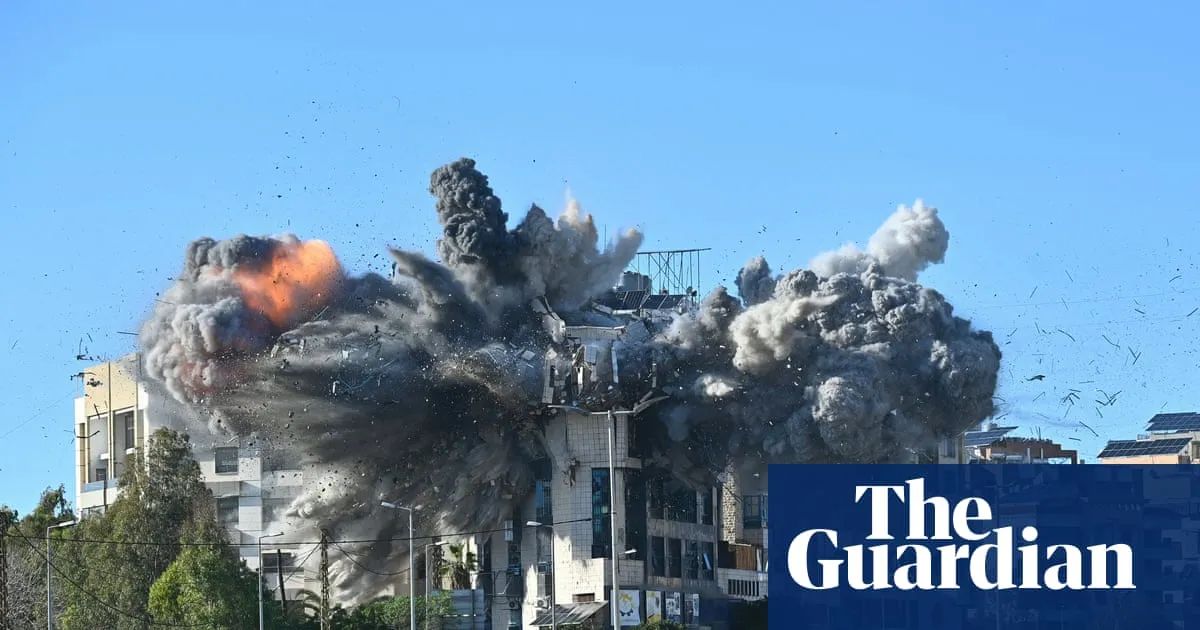
The human costs of Israel’s attacks on Lebanon were plain to see when the Irish MEP Barry Andrews visited Beirut last month. He met people who had fled Israeli airstrikes and complied with evacuation orders in southern Lebanon.At makeshift shelters – converted schools – conditions were even worse than during Israel’s last incursion in 2024, he was told. “There are dirty mattresses, dirty blankets, [people] are getting infections, they are getting rashes,” he said recalling a picture of misery compounded by swingeing aid budget cuts.Andrews, who chairs the parliament’s development committee, was in Lebanon two weeks after Hezbollah, an Iranian proxy, fired rockets into Israel, triggering massive retaliatory strikes by Israeli forces.On his return from Lebanon, Andrews was one of the first European lawmakers to call for the EU to revive sanctions against Israel. He believes the EU must respond to Israel’s attacks on Lebanon, but also state-backed settler violence in the West Bank, attacks on health workers in Gaza, and Israel’s potential reinstatement of the death penalty against Palestinians after a vote in the Knesset this week.A mother holds her newborn child in a school now used as a temporary shelter for displaced people in Beirut, Lebanon. Photograph: Emilie Madi/ReutersYet, one month into the Iran war, the EU – one of Israel’s closest allies and most important economic partners – has not gone beyond words in an attempt to sway Benjamin Netanyahu’s government. Critics say the EU can and should use its economic and diplomatic leverage. Andrews said: “When the European Union takes a principled stand on these issues the Israelis do pay attention.”The EU could exert economic pressure via its association agreement with Israel, a commerce and cooperation accord that underpins a €68bn (£59bn) trading relationship and promotes cooperation in areas, including energy and scientific research.Sven Kühn von Burgsdorff, the EU representative to the Palestinian territories until 2023, believes the EU should suspend this agreement with Israel, halt all military support and cease trade with illegal settlements. He fears that without action to defend international law in Gaza and the West Bank, the EU’s reputation “will be further severely affected”. He said: “The usual words of concern and condemnation are not enough; they are meaningless when not followed by effective measures to hold Israel to account.”Andrews said the EU’s response to the war on Iran and Israel’s attacks on Lebanon had been “weak and pathetic”. “It demonstrates that time and time again, Israel has been given a permission slip for endless war crimes.”For its part, the European Commission condemned the Knesset vote for the death penalty, which would apply to Palestinians but not Jewish extremists, as “very concerning” and “a clear step backwards”. The Council of Europe, the continental human rights body, which has signed 28 treaties with Israel, described the vote as “a legal anachronism incompatible with contemporary human rights standards”.Israel approves death penalty for Palestinians convicted of carrying out fatal attacks – videoWestern leaders have warned Israel against a ground offensive in Lebanon, while condemning Hezbollah’s attacks on Israel. In the past four weeks, more than 1,240 people have been killed in Lebanon, including at least 124 children, while more than 1.1 million people have been forced to flee their homes. Away from the headlines, at least 673 people have been killed in Gaza since the October ceasefire, bringing the death toll in the devastated territory to 72,260.The EU’s reluctance to take measures against Israel is a familiar story. The European Commission president, Ursula von der Leyen, last September proposed unprecedented sanctions against Israel, citing the “manmade famine” in Gaza and “a clear attempt to undermine the two-state solution” with settlement plans in the West Bank. Von der Leyen, a German conservative, had previously been accused of being an uncritical defender of Israel.She was responding to intense public scrutiny of the horrors unfolding in Gaza, where Israel is accused of committing genocide, and the call by a large majority of EU member states to review the bloc’s association agreement. But the sanctions never found majority support in the EU council of ministers and momentum dissipated when Trump announced his Gaza ceasefire plan in October.Ursula von der Leyen, the president of the European Commission, has been accused of being an uncritical defender of Israel. Photograph: Olivier Hoslet/EPAEU countries remain concerned about the dire humanitarian situation in Gaza and relentless violence in the West Bank, which the Israeli state has been accused of enabling. “There may come a point when we need to increase the pressure on Israel again,” said one senior EU diplomat in mid-March, describing the situation in Gaza and the West Bank as “highly problematic”.The EU’s initial response to the war was cautious in part, diplomats suggested, because Israel and the US targeted Iran, a regime strongly condemned by the EU for massacring its own people and sowing bloody mayhem in the Middle East and Ukraine via drone supplies from Russia.A second EU diplomat, who supported the association agreement review in 2025, emphasised the importance of maintaining contacts with Israeli society, citing an open letter from 600 Israeli security officials calling for an end to the war in Gaza last August – an appeal published as Israel considered intensifying the war on the devastated territory. “These are not peaceniks … these are people from the Israeli security establishment, who are very much concerned about the policies of their own government. The EU has to relate to that in one way or another.”Moreover, the EU has been historically divided on the its stance towards Israel. Ireland, Spain and Slovenia, for instance, have been staunch defenders of the Palestinian cause, while Germany and Austria, for historical reasons, have been deeply reluctant to criticise Israel. Adding to the complexity, the Hungarian prime minister, Viktor Orbán, is Netanyahu’s ideological soulmate and has played a crucial role in vetoing otherwise uncontentious measures, such as sanctions on extremist settlers in the West Bank.A commission spokesperson emphasised this week that diplomatic engagement with Israel was continuing “and this is what we do with our regular partners when we don’t see developments eye to eye”.Kühn von Burgsdorff, the former EU envoy, argues for a more robust approach. “How can it serve Europe to be seen as a sidekick of an erratic, unreliable and apparently megalomaniac US president, or of a warmongering, annexationist Israeli prime minister. That cannot be in Europe’s interest, because it comes at the expense of relations with other parts of the world.”
SRCThe Guardian - World News
LANGEN
LEANCenter-Left
WORDS1 072
ENT11
THU · 2026-04-02 · 04:00 GMTBRIEF NSR-2026-0402-48547
NSR-2026-0402-48547News Report·EN·Diplomatic
‘Weak and pathetic’: why is the EU not using its leverage to stop Israel?
Following Israeli retaliatory strikes on Lebanon after rocket fire from Hezbollah, and amidst concerns over actions in Gaza and the West Bank, some European lawmakers are urging the EU to leverage its economic and diplomatic power to influence Israel. Irish MEP Barry Andrews, after visiting Lebanon, called for the EU to revive sanctions against Israel, citing attacks on Lebanon, settler violence, and potential reinstatement of the death penalty against Palestinians.
Jennifer Rankin in BrusselsThe Guardian - World NewsFiled 2026-04-02 · 04:00 GMTLean · Center-LeftRead · 5 min
The Guardian - World NewsFIG 01
Reading time
5min
Word count
1 072words
Sources cited
3cited
Entities identified
11entities
Quality score
100%
§ 01
Briefing Summary
AI-generatedNEWSAR · AI
Following Israeli retaliatory strikes on Lebanon after rocket fire from Hezbollah, and amidst concerns over actions in Gaza and the West Bank, some European lawmakers are urging the EU to leverage its economic and diplomatic power to influence Israel. Irish MEP Barry Andrews, after visiting Lebanon, called for the EU to revive sanctions against Israel, citing attacks on Lebanon, settler violence, and potential reinstatement of the death penalty against Palestinians. Critics argue the EU, a major economic partner of Israel with a €68 billion trading relationship, is not doing enough beyond verbal condemnation. Suggestions include suspending the EU-Israel Association Agreement, halting military support, and ceasing trade with illegal settlements to hold Israel accountable and protect the EU's reputation.
Confidence 0.90Sources 3Claims 5Entities 11
§ 02
Article analysis
Model · rule-basedFraming
Diplomatic
Human Rights
Tone
Mixed Tone
AI-assessed
CalmNeutralAlarmist
Factuality
0.60 / 1.00
Mixed
LowHigh
Sources cited
3
Well sourced
FewMany
§ 03
Key claims
5 extracted01
The Knesset voted on the potential reinstatement of the death penalty against Palestinians.
factualnull
Confidence
1.00
02
The EU has a €68bn trading relationship with Israel.
statisticnull
Confidence
1.00
03
Israel's attacks on Lebanon have resulted in displaced people living in makeshift shelters with poor conditions.
quoteBarry Andrews
Confidence
0.90
04
The EU has not gone beyond words in attempting to influence the Israeli government.
factualnull
Confidence
0.80
05
The EU could suspend its association agreement with Israel and halt military support.
predictionSven Kühn von Burgsdorff
Confidence
0.70
§ 04
Full report
5 min read · 1 072 words§ 05
Entities
11 identifiedKey playerOppositionContextPositiveNeutralNegative
People3
§ 06
Keywords & salience
10 termsisrael
0.90
eu
0.90
leverage
0.70
economic pressure
0.70
sanctions
0.60
association agreement
0.60
gaza
0.50
west bank
0.50
international law
0.50
aid budget cuts
0.40
§ 07
Topic connections
Interactive graph Network visualization showing 51 related topics
View Full Graph Person Organization Location Event|Click node to navigate|Edge numbers = shared articles