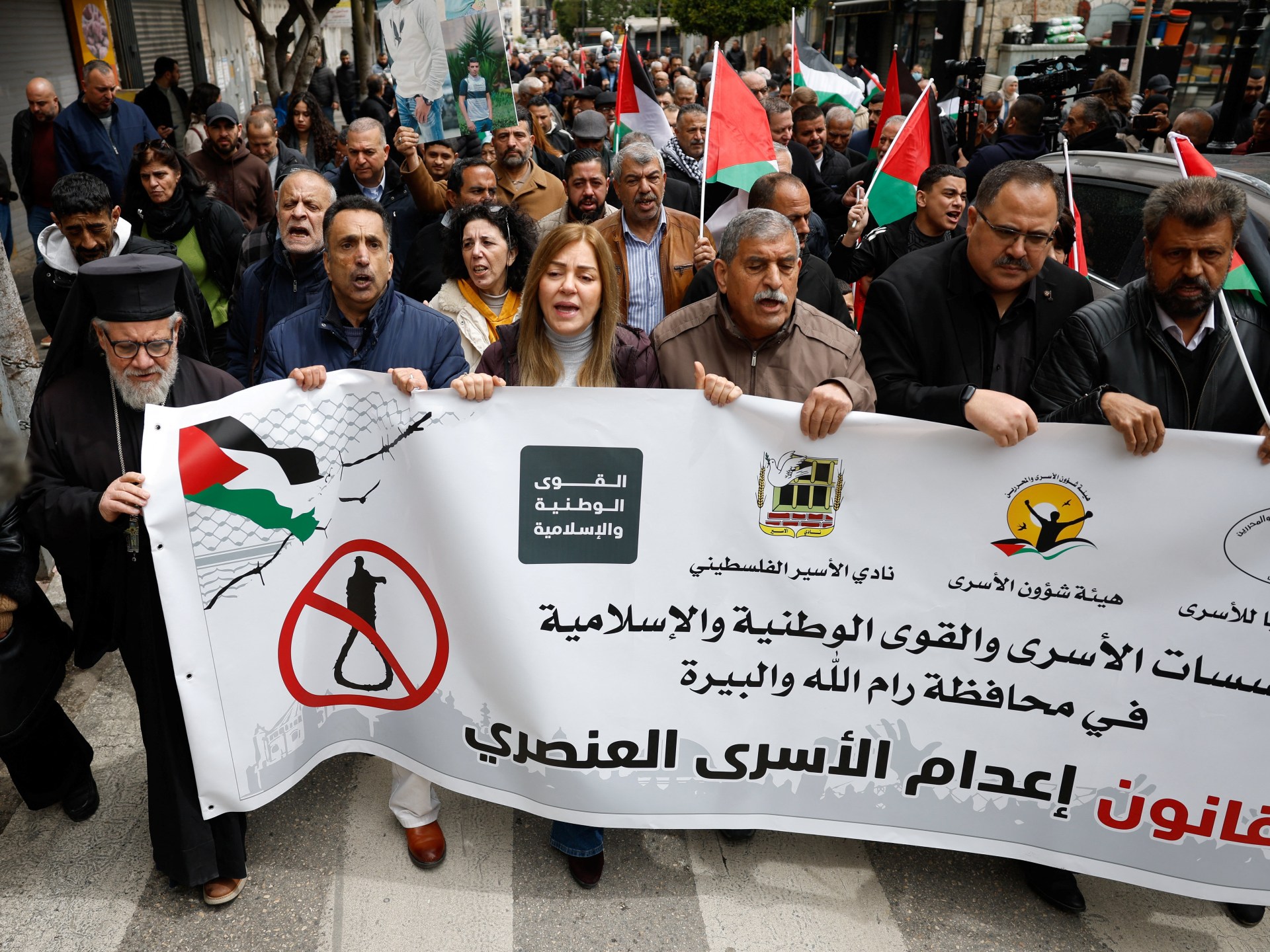
It is about eliminating Palestinian existence in Palestine.Palestinian American writer based in Ramallah.Published On 2 Apr 2026Palestinians take part in a protest against the execution of the Israeli death penalty law for Palestinians convicted of lethal attacks, in Ramallah, in the Israeli-occupied West Bank on April 1, 2026 [Mohammed Torokman/Reuters]On Monday, Israel passed a death penalty law allowing it to hang those convicted of “terror offences” within an accelerated 90-day period.The law is no surprise for Palestinians; it is only another step in a longstanding strategy of elimination. In the last two and a half years, at least 87 Palestinian detainees have been killed in what human rights organisations describe as a “network of torture camps” – the highest recorded number since 1967.While United Nations bodies and various states have expressed concern and condemnation, Palestinians understand this law for what it is: the institutionalisation of a practice well under way.Israel’s timing: A message to the PalestiniansIt is not just the provisions of the law that are significant, but also the context in which it is passed. It comes less than a month after Israel dropped all charges against its soldiers accused of mass raping Palestinian detainees at the notorious detention camp of Sde Teiman.This is not incidental. Israel is legalising a pattern of impunity. One population is granted explicit impunity for organised sexual violence while the other is now subject to execution within 90 days, in a military court system that convicts 96 percent of Palestinians – often on the basis of confessions extracted through torture.It also comes at a time of visible and intensified Israeli violence in the occupied West Bank. In the last month alone, and in tandem with the United States and Israel’s war on Iran, armed Israeli militias carried out more than 7,300 violations against Palestinians in the West Bank alone, including killings, raids, arrests, damage and destruction of property and blocking of the freedom of movement.In late 2023, the entire population of Khirbet Zanuta, in the southern West Bank, was forced out after relentless settler attacks that made remaining impossible. In the north, in 2025, refugee camps were destroyed, depopulated, and turned into Israeli military bases. Previously dismantled illegal Israeli settlements are being rebuilt and legally recognised by Israel.In recent months, not only has the frequency of Israeli attacks against Palestinians increased, but the violence has also become more ferocious and savage.Between January and March, Israeli settlers and soldiers kidnapped children, carried out pogroms, sexually assaulted Palestinian men – even going as far as tying their genitals and parading them around their village – and point-blank executed Palestinian families.Not a single Israeli has been held accountable for these crimes. Meanwhile, Palestinians are being displaced from their homes, and those who have attempted to protect their communities from settler attacks have been arrested by the Israeli army.The message of the death penalty law is deliberate and precise: in the Israeli legal order, Palestinians have no rights. Their removal, either by displacement, death, or exhaustion, is the intended outcome.Erasing Palestinian capacity to resistFor decades, Israel has been criticised and condemned for its discriminatory legal frameworks against Palestinians in the West Bank, and even against Palestinians with Israeli citizenship.Yet this segregation is meant not merely to emphasise racial supremacy, but to facilitate systemic ruptures. According to a UN report released in January, such laws by Israel are designed to obliterate Palestinian self-determination and destroy possibilities of territorial, political, or cultural continuity.The death penalty law remains true to Israel’s longstanding practice of apartheid and segregated justice frameworks. It is carefully worded to ensure it is applied only to the Palestinians.The most dangerous element of this law is not its discriminatory structure – it is the logic encoded within it. The law imposes the death penalty or life sentence on “a person who intentionally causes the death of another with the aim of harming a citizen or resident of Israel, with the intent of rejecting the existence of the State of Israel”.That clause alone does something remarkable. It is not criminalising violence, but the very political condition of being Palestinian under Israeli occupation.As a settler-expansionist state, what Israel is saying is that a people being systemically dispossessed do not even have the right to resist that dispossession. With that, a Palestinian watching their village systemically emptied by armed settlers who face no legal consequence for attacking and killing is now subject to execution because their very will to survive and protect their loved ones is designated as a capital offence.What Israeli policymakers are ensuring is that amid the gradual but accelerated depopulation of Palestinian towns and villages, resistance becomes impossible. With that, what Israel is actually doing is institutionalising the non-existence of a people.To understand the death penalty law as a policy focused on detainees only is to miss its purpose entirely. Palestinians are already being executed in their own homes and streets with no court, no charge, and no 90-day waiting period.This law, the legalisation of settlements, the military courts, the demolition orders, and the siege on Gaza should not be seen as separate policies responding to separate problems. These are instruments of a single project, which is the total conquest of Palestinian lands through total control over Palestinian bodies. They each target different bodies in different contexts but serve the same agenda.Rather than one single dramatic act of extermination, Israel has been constructing a reality where Palestinians cannot remain on the land and cannot survive the attempt at resisting their erasure. The law just adds a new layer to an entire infrastructure of elimination that has already been in operation.The death penalty for Palestinians did not begin with this law. It began with the first Israeli settlement.The views expressed in this article are the author’s own and do not necessarily reflect Al Jazeera’s editorial stance.
SRCAl Jazeera
LANGEN
LEANCenter
WORDS967
ENT10
THU · 2026-04-02 · 06:11 GMTBRIEF NSR-2026-0402-48778
NSR-2026-0402-48778Opinion·EN·Human Rights
Israel’s death penalty law is not about executing Palestinians
In April 2026, Israel passed a law allowing the death penalty for those convicted of "terror offenses" within 90 days. The law follows a pattern of impunity, occurring shortly after charges were dropped against Israeli soldiers accused of raping Palestinian detainees.
Mariam BarghoutiAl JazeeraFiled 2026-04-02 · 06:11 GMTLean · CenterRead · 4 min
Al JazeeraFIG 01
Reading time
4min
Word count
967words
Sources cited
1cited
Entities identified
10entities
Quality score
100%
§ 01
Briefing Summary
AI-generatedNEWSAR · AI
In April 2026, Israel passed a law allowing the death penalty for those convicted of "terror offenses" within 90 days. The law follows a pattern of impunity, occurring shortly after charges were dropped against Israeli soldiers accused of raping Palestinian detainees. The author contends that this law is part of a broader strategy to eliminate Palestinian existence, citing the deaths of at least 87 Palestinian detainees in the last two and a half years and a 96% conviction rate for Palestinians in military courts, often based on confessions obtained through torture. The law coincides with increased Israeli violence in the occupied West Bank, including attacks by armed militias, displacement of communities, and the rebuilding of dismantled settlements. The author argues that the timing of the law sends a message to Palestinians amidst these escalating tensions.
Confidence 0.90Sources 1Claims 5Entities 10
§ 02
Article analysis
Model · rule-basedFraming
Human Rights
Political Strategy
Tone
Sensational
AI-assessed
CalmNeutralAlarmist
Factuality
0.30 / 1.00
Opinion-Heavy
LowHigh
Sources cited
1
Limited
FewMany
§ 03
Key claims
5 extracted01
Israel passed a death penalty law allowing it to hang those convicted of “terror offences” within an accelerated 90-day period.
factualArticle itself
Confidence
1.00
02
Israel dropped all charges against its soldiers accused of mass raping Palestinian detainees at the notorious detention camp of Sde Teiman.
factualArticle itself
Confidence
0.90
03
The law is only another step in a longstanding strategy of elimination.
quoteArticle itself
Confidence
0.80
04
At least 87 Palestinian detainees have been killed in what human rights organisations describe as a “network of torture camps”.
statisticArticle itself, citing human rights organizations
Confidence
0.70
05
Armed Israeli militias carried out more than 7,300 violations against Palestinians in the West Bank alone in the last month.
statisticArticle itself
Confidence
0.60
§ 04
Full report
4 min read · 967 words§ 05
Entities
10 identifiedKey playerOppositionContextPositiveNeutralNegative
Organizations1
§ 06
Keywords & salience
10 termspalestinians
1.00
israel
0.90
death penalty law
0.90
elimination
0.80
occupied west bank
0.70
impunity
0.60
human rights
0.60
settler attacks
0.50
torture
0.50
military court
0.40
§ 07
Topic connections
Interactive graph Network visualization showing 51 related topics
View Full Graph Person Organization Location Event|Click node to navigate|Edge numbers = shared articles