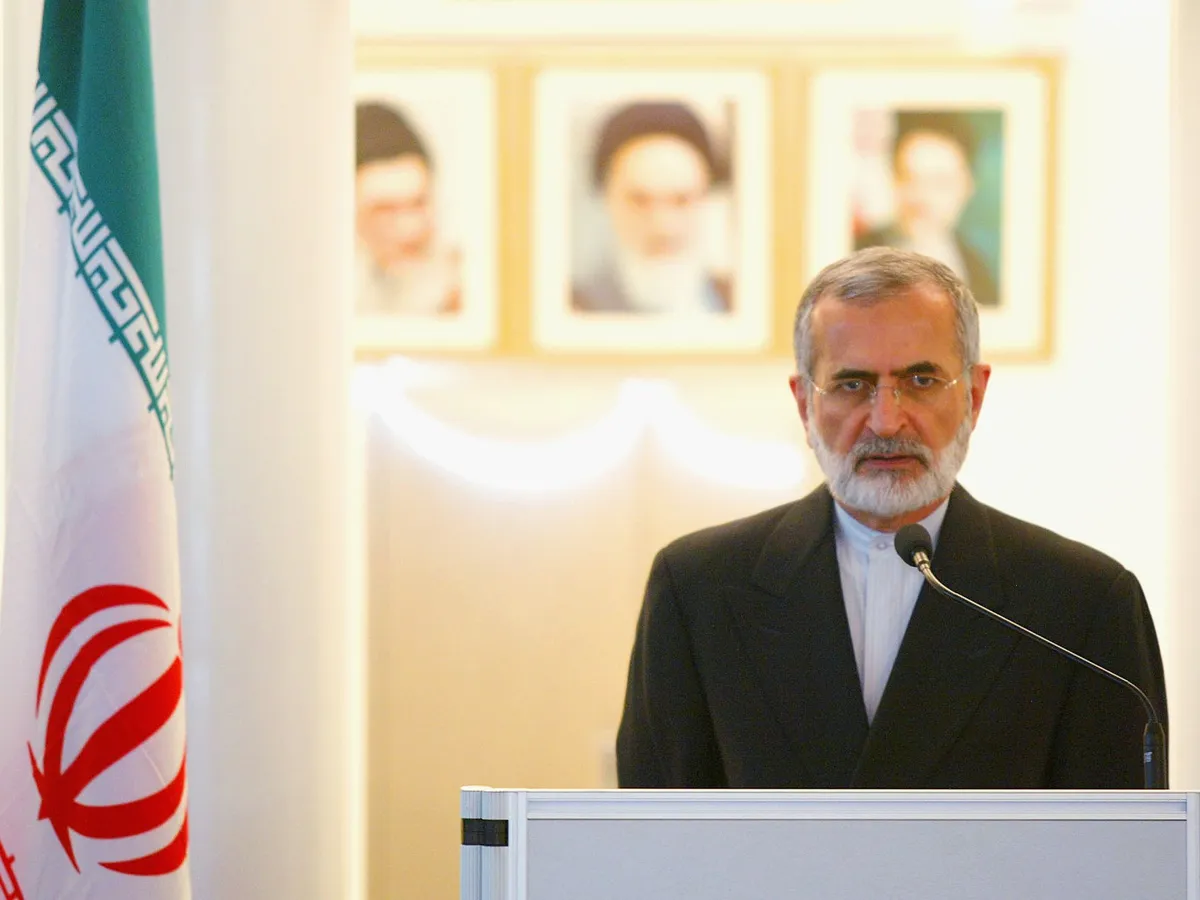
Apparent assassination attempt comes as Iran’s army pledges to fight back until the US, Israel face ‘permanent surrender’.Kamal Kharazi, Iran's former foreign minister, was also an adviser to the late Supreme Leader Ayatollah Ali Khamenei [File: Chung Sung-Jun/Getty Images]Published On 2 Apr 2026Former Iranian foreign minister Kamal Kharazi has been seriously wounded in an apparent assassination attempt that killed his wife, as United States-Israeli strikes continue to pound Iran for a fifth week.Iranian media on Thursday reported that Kharazi’s home in Tehran was targeted the previous day in an air strike. The official was hospitalised with serious injuries, according to newspapers Shargh, Etemad and Ham Mihan.Recommended Stories list of 3 itemslist 1 of 3‘Which interests being served by war?’ Iran’s Pezeshkian asks US publiclist 2 of 3Central Israel hit by one of Iran’s largest missile barrages in weekslist 3 of 3Smoke and embers seen over Iran’s Isfahan after strikeend of list“We have seen what looks like an assassination attempt against the former foreign minister, Kamal Kharazi … We don’t know why he’s been targeted. He has been gravely wounded, and his wife was killed,” said Al Jazeera’s Mohamed Vall, reporting from Tehran.Air strikes were reported on Thursday across Iran, including in Tehran, Isfahan and Shiraz. Four people were reported killed in Larestan, in southern Iran.Iran’s Health Ministry spokesman Hossein Kermanpour said an attack targeted the Iran" class="entity-link entity-organization" data-entity-id="92038" data-entity-type="organization">Pasteur Institute of Iran, a medical research centre founded in 1920, severely damaging it.In a post on X, Kermanpour called the attack on the “century-old pillar of global health” in Tehran a “direct assault on international health security”.Meanwhile, the spokesperson of the armed forces’ unified command said Tehran will press on with the Middle East war until the US and Israel face “permanent regret and surrender”, the semiofficial Tasnim news agency reported.Ebrahim Zolfaghari, spokesperson of the Khatam al-Anbiya central headquarters, said US and Israeli assessments of Iran’s military capabilities were “incomplete” and that Tehran would step up its military actions, with “more crushing, broader and more destructive” attacks in store for its adversaries.The threat followed comments by US President Donald Trump that Washington would hit Iran “extremely hard” within weeks, although Iran was “essentially decimated” and the US was on track to achieve its military objectives.In response to Trump’s speech, Iran’s Foreign Ministry spokesperson Esmaeil Baghaei said Tehran “will not tolerate this vicious cycle of war, negotiations, ceasefire, and then repeating the same pattern.”“This is an unjust war that has been imposed on the Iranian people. We have no choice but to fight back strongly,” he added.More than 2,000 people have been killed in Iran since the US and Israel launched joint air strikes on February 28. At least 24 people have been killed in Israel, as well as 13 US soldiers in the region.At least four Israelis were injured in Bnei Brak, east of Tel Aviv, following an Iranian missile attack late on Wednesday. Israel’s Home Front Command on Thursday issued several warnings of incoming rocket fire, advising the public to take shelter.‘No room for diplomacy’Last week, several media reports quoted Kharazi saying that Iran had not shut down all avenues for negotiation and was open to possible indirect talks, even though in an interview with CNN last month, he said he saw “no room for diplomacy” with the US.“Trump had been deceiving others and not keeping with his promises, and we experienced this in two times of negotiations – that while we were engaged in negotiation, they struck us,” Kharazi told CNN.Al Jazeera’s Vall said that while the exact motives for the attempted assassination are unclear, Kharazi was known to be the head of the Strategic Council on Foreign Relations and a former adviser to the late Supreme Leader Ayatollah Ali Khamenei, who was killed by the US and Israel on the first day of the war.“The Israelis and the Americans haven’t taken responsibility for this operation, but it is a subject of concern,” Vall said.“The Iranians have warned that any more assassinations in the country means that they will retaliate against more American interests, particularly tech and AI technology companies and facilities in the region, because they think those companies are helping with the targeted assassinations in Iran.”In their latest war on Iran, the US and Israeli military have killed Iranian nuclear scientists, as well as senior government figures, including Iranian security official Ali Larijani and the commander of Iran’s internal Basij forces, Gholamreza Soleimani.
SRCAl Jazeera
LANGEN
LEANCenter
WORDS733
ENT12
THU · 2026-04-02 · 08:13 GMTBRIEF NSR-2026-0402-48980
NSR-2026-0402-48980News Report·EN·Conflict
Iran’s ex-foreign minister Kharazi ‘gravely wounded’ in attack on his home
Former Iranian Foreign Minister Kamal Kharazi was seriously wounded, and his wife killed, in an apparent assassination attempt at his Tehran home on Wednesday. The attack occurred amid ongoing US-Israeli strikes on Iran, now in their fifth week.
Al Jazeera StaffAl JazeeraFiled 2026-04-02 · 08:13 GMTLean · CenterRead · 3 min
Al JazeeraFIG 01
Reading time
3min
Word count
733words
Sources cited
7cited
Entities identified
12entities
Quality score
100%
§ 01
Briefing Summary
AI-generatedNEWSAR · AI
Former Iranian Foreign Minister Kamal Kharazi was seriously wounded, and his wife killed, in an apparent assassination attempt at his Tehran home on Wednesday. The attack occurred amid ongoing US-Israeli strikes on Iran, now in their fifth week. Air strikes were reported across Iran, including Tehran, Isfahan, and Shiraz, with additional casualties reported. The Pasteur Institute of Iran, a medical research center, was also severely damaged in an attack. In response, an Iranian military spokesperson vowed to continue fighting until the US and Israel surrender, promising escalated military actions. This follows US President Trump's statement that Washington would hit Iran "extremely hard" soon.
Confidence 0.90Sources 7Claims 5Entities 12
§ 02
Article analysis
Model · rule-basedFraming
Conflict
National Security
Tone
Mixed Tone
AI-assessed
CalmNeutralAlarmist
Factuality
0.70 / 1.00
Factual
LowHigh
Sources cited
7
Well sourced
FewMany
§ 03
Key claims
5 extracted01
Tehran will press on with the Middle East war until the US and Israel face ‘permanent regret and surrender’.
quotespokesperson of the armed forces’ unified command
Confidence
1.00
02
An attack targeted the Pasteur Institute of Iran, severely damaging it.
factualHossein Kermanpour, Iran’s Health Ministry spokesman
Confidence
0.90
03
Air strikes were reported on Thursday across Iran, including in Tehran, Isfahan and Shiraz.
factualAl Jazeera
Confidence
0.90
04
Kamal Kharazi was seriously wounded in an apparent assassination attempt that killed his wife.
factualAl Jazeera
Confidence
0.90
05
More than 2,000 people have been killed in Iran since the US and Israel launched joint air strikes on February 28.
statisticAl Jazeera
Confidence
0.80
§ 04
Full report
3 min read · 733 words§ 05
Entities
12 identifiedKey playerOppositionContextPositiveNeutralNegative
People6
§ 06
Keywords & salience
10 termsiran
1.00
kamal kharazi
0.90
assassination attempt
0.90
air strikes
0.80
us-israeli strikes
0.70
military actions
0.60
middle east war
0.60
pasteur institute of iran
0.50
international health security
0.50
political violence
0.40
§ 07
Topic connections
Interactive graph No topic relationship data available yet. This graph will appear once topic relationships have been computed.