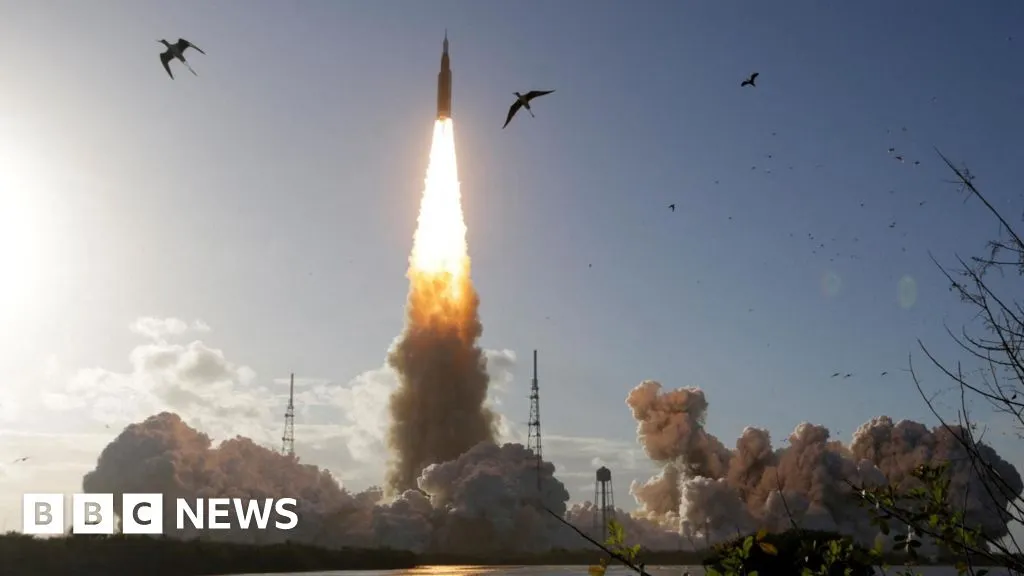
2 hours agoGeorgina RannardScience reporterWatch the moment Artemis II blasts into space on historic missionYou could almost hear a sigh of relief from NASA on Wednesday as its Artemis II rocket finally blasted off.There's a lot riding on this mission - the safety of its four astronauts, NASA's reputation, and the credibility of America's claim to be leading the new global space race. There are mundane questions too: Could the onboard toilet break again? When can the crew nap? Here's what the next 24 hours should look like for Artemis II.Where are the astronauts now?Commander Reid Wiseman, Victor Glover, Christina Koch and Jeremy Hansen are now orbiting Earth about 42,500 miles away, testing out the Orion spacecraft.The craft's solar wings were fully deployed not long after launch, giving it power to help sustain its journey.About the size of a minibus, its never been flown in space before by humans so pilot Victor Glover is spending the day pushing it to the extreme. NASA want to be sure Orion is voyage-worthy before the crew push on into deep space from where there is no easy return.They're testing out the life support systems too. But if something goes wrong, the crew has specially-designed suits that could keep them alive for around six days.What are the crew doing?Unlike the Apollo missions in the 1960s and 1970s, we can watch a huge amount of what's happening on this voyage as NASA livestreams the mission. Cameras above the astronauts' heads show them checking monitors, holding up mobile phones, and pressing buttons.Then about eight hours after launch, the crew were allowed their first sleep onboard.NASATwo of the crew inside Orion spacecraftOn the radio the crew use to communicate with mission command, we heard Commander Reid Wiseman asking where are the team's pyjamas.He asked for their "comfort garments", before the astronauts went into the sleeping area for about four hours.Schedules in space are incredibly strict. Every minute is accounted for by Mission Control.Today, the crew are sleeping for about four hours at a time, adding up to eight hours over a 24-hour period.Sleeping in space can be tricky. The crew must strap themselves into special hanging sleeping bags, and generally some astronauts struggle to nod off as their bodies adapt to weightlessness.But others say their best sleep ever is in space.This crew have strict instructions to exercise for 30 minutes every day to protect their muscle and bone density as they live without gravity. Reid Wiseman and Victor Glover went first, testing out Orion's "flywheel exercise device", which is about the size of a carry-on suitcase.Christina Koch and Jeremy Hansen were scheduled to exercise later on - using the wheel for rowing, squats and deadlifts. We assume they've had their first meals too, from NASA's tailor-made Artemis II menu.NASAThe crews' view from the Orion spacecraft during the last few hoursThere is no fridge in Orion, so a lot of the food is freeze-dried and activated using water from an onboard tap.The crew were allowed to pick their meals in advance, which include macaroni cheese, beef brisket, and five different hot sauces.They're allowed two drinks a day, including coffee or a "chocolate breakfast drink".And crucially, as far as we know, the toilet is working. During launch, the facilities broke, raising worries that the team would have to spend 10 days in a craft without a toilet.After giving astronaut Christina Koch instructions on how to fix the specially-designed loo, Mission Control radioed the crew: "Happy to report that toilet is go for use.... We do recommend letting the system get to operating speed before donating fluid". When do they go to the Moon?Today is building up to the snazzily named "trans-lunar injection" burn. Basically, it is a massive push that will propel them out of Earth's orbit and on course to the Moon. It is supposed to happen Thursday night UK time, but if there are problems, it could be postponed or even cancelled.A cancellation would be a major setback for NASA and America as it tries to become the first country to land humans again on the lunar surface by 2028.EPAThe crew are "safe, secure and in great spirits", according to a NASA officialIf it all goes to plan, the burn will fire for six minutes to send them on a trajectory around the Moon that also uses lunar gravity to slingshot them back to Earth.Eventually they should fly 6,400 miles (10,299km) beyond the far side of the Moon, which always faces away from the Earth.That's meant to happen on Monday (6 April). The astronauts will be the first people to see some areas of the far side, although probes from countries including India and China have previously documented this region.They'll be taking photographs and making observations of this mysterious place for us to see and learn from back on Earth.
SRCBBC News - World
LANGEN
LEANCenter
WORDS803
ENT10
THU · 2026-04-02 · 12:20 GMTBRIEF NSR-2026-0402-49206
NSR-2026-0402-49206News Report·EN·Technology
Artemis II is in orbit - what happens next?
The Artemis II mission, carrying four astronauts, successfully launched and is currently orbiting Earth at a distance of 42,500 miles. The crew, including Commander Reid Wiseman and pilot Victor Glover, are testing the Orion spacecraft's systems, including life support, and ensuring its readiness for deep space travel.
BBC News - WorldFiled 2026-04-02 · 12:20 GMTLean · CenterRead · 4 min
BBC News - WorldFIG 01
Reading time
4min
Word count
803words
Sources cited
1cited
Entities identified
10entities
Quality score
100%
§ 01
Briefing Summary
AI-generatedNEWSAR · AI
The Artemis II mission, carrying four astronauts, successfully launched and is currently orbiting Earth at a distance of 42,500 miles. The crew, including Commander Reid Wiseman and pilot Victor Glover, are testing the Orion spacecraft's systems, including life support, and ensuring its readiness for deep space travel. NASA is livestreaming the mission, allowing observation of the crew's activities, which include system checks, communication with mission control, and scheduled sleep periods. The astronauts are adhering to a strict schedule that includes exercise to combat the effects of weightlessness. The mission aims to validate the Orion spacecraft and ensure the safety of the crew before venturing further into space.
Confidence 0.90Sources 1Claims 5Entities 10
§ 02
Article analysis
Model · rule-basedFraming
Technology
Human Interest
Tone
Measured
AI-assessed
CalmNeutralAlarmist
Factuality
0.80 / 1.00
Factual
LowHigh
Sources cited
1
Limited
FewMany
§ 03
Key claims
5 extracted01
Commander Reid Wiseman asked where the team's pyjamas were.
quoteCommander Reid Wiseman
Confidence
1.00
02
The crew are sleeping for about four hours at a time, adding up to eight hours over a 24-hour period.
factual
Confidence
1.00
03
The crew has specially-designed suits that could keep them alive for around six days if something goes wrong.
factual
Confidence
1.00
04
The Orion spacecraft's solar wings were fully deployed after launch.
factual
Confidence
1.00
05
Artemis II astronauts are orbiting Earth about 42,500 miles away, testing the Orion spacecraft.
factual
Confidence
1.00
§ 04
Full report
4 min read · 803 words§ 05
Entities
10 identifiedKey playerOppositionContextPositiveNeutralNegative
People4
Locations1
§ 06
Keywords & salience
9 termsartemis ii
1.00
space mission
0.80
orion spacecraft
0.70
astronauts
0.70
nasa
0.60
life support systems
0.50
deep space
0.50
weightlessness
0.40
sleeping in space
0.40
§ 07
Topic connections
Interactive graph Network visualization showing 9 related topics
View Full Graph Person Organization Location Event|Click node to navigate|Edge numbers = shared articles