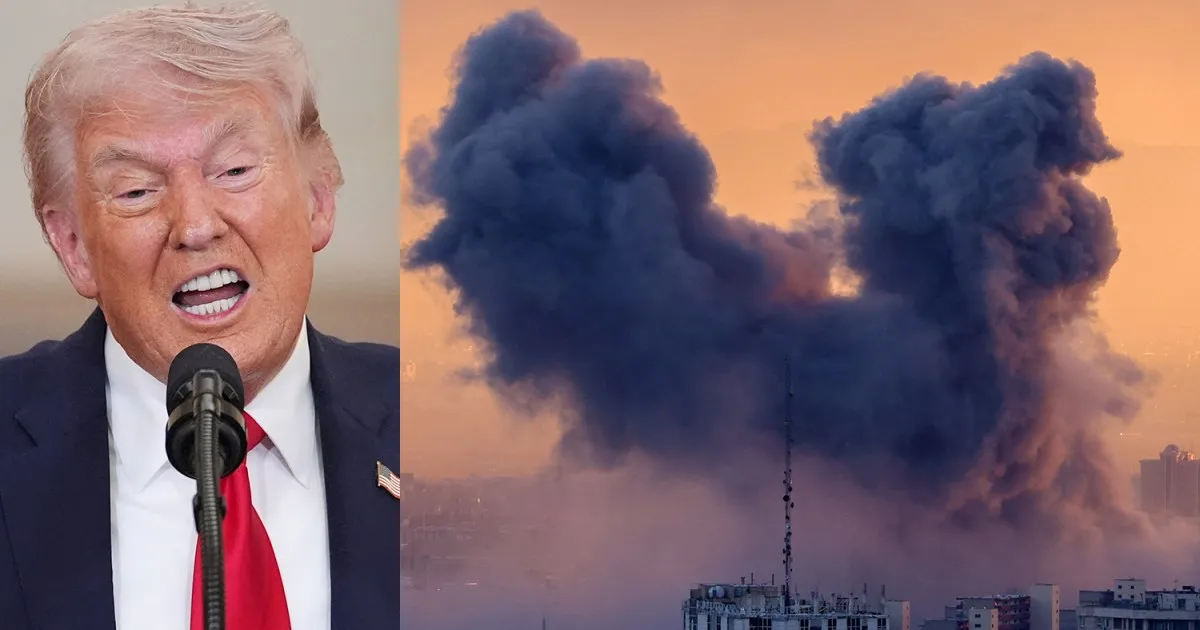
EXPLAINERAnalysts say carpet bombing countries is a war crime. But such threats and actual campaigns are not new for the US.Published On 2 Apr 2026United States President Donald Trump warned Iran on Wednesday that he would bomb the country “back to the stone ages”.Minutes later, his Secretary of Defense Pete Hegseth doubled down on that rhetoric, with a short post on X that only said: “Back to the Stone Age.”To bomb a place to the Stone Age typically refers to carpet bombing it, destroying all its modern infrastructure so it reaches a primitive state.But these threats from Trump and the US aren’t novel — instead, they build on Washington’s decades-old legacy of threatening to carpet bomb countries during its military campaigns, often delivering on those threats.Here is more about what Trump recently said, and what US presidents have said and done before.What did Trump say in his speech about Iran?During his prime-time address to the nation, Trump said, referring to Iran: “We are going to hit them extremely hard over the next two to three weeks, we’re going to bring them back to the stone ages, where they belong.”Trump also said “discussions are ongoing”, adding that the conflict could end over the same period.The current war on Iran began on February 28 when the US and Israel launched their attacks. Tehran hit back, targeting Israel and Gulf countries.More than 2,000 Iranians have been killed in the war so far. Thousands of civilian sites, including hospitals, schools, universities and pharmaceutical factories, have been attacked by Israel and the US.Janina Dill, a global security professor at the University of Oxford, told Al Jazeera that if Trump’s “stone ages” threat implies that the US will destroy structures and buildings that characterise a modern society, “then this would be illegal because it implies directing attacks against civilian objects”.Structures and buildings that characterise a modern society comprise energy infrastructure, telecommunication structures, civilian industry, educational, cultural or medical facilities.“An announcement that they will nonetheless be targeted wholesale would be an announcement of systematic and serious violations of longstanding laws of war,” Dill said.International humanitarian law prohibits targeting civilian objects deliberately during war, according to the International Committee of the Red Cross (ICRC).“The statement is particularly appalling since it repudiates the claim that the United States is fighting the Iranian regime, implying rather a war against the Iranian people and society more broadly.”Iran is home to one of the oldest human civilisations — and its empires built canals, highways, militaries, modern currency systems, and made major advances in science, medicine and philosophy – more than a millennium before the US was born.Has the US made similar threats before?The phrase “bombing back to the stone ages” is widely associated with US Air Force officer Curtis LeMay, in the context of US threats against North Vietnam in LeMay’s 1965 book, Mission with LeMay.“We’re going to bomb them back into the Stone Age,” he wrote. LeMay, who had played a central role in executing the World War II carpet bombing of Japanese cities in which between 240,000 and 900,000 people were killed, had by the time of the Vietnam War risen in rank to chief of Air Staff before he retired the year his book was published.While he was no longer in office during some of the bloodiest US campaigns in Vietnam, American leaders appeared to follow through on Curtis’s advice.Vietnam WarThe Vietnam War grew out of France’s attempt after World War II to re‑establish control over its colony of Indochina. Communist‑led Vietnamese nationalists, the Viet Minh under Ho Chi Minh, fought the French and defeated them in 1954.Vietnam was then temporarily divided at the 17th parallel: North Vietnam under a communist government led by Ho Chi Minh, and South Vietnam as an anti‑communist state backed by the United States.The US steadily deepened its involvement, moving from financial aid and military advisers for the South Vietnamese government in the 1950s to full‑scale military intervention in the mid‑1960s, including large troop deployments and extensive bombing.In December 1972, President Richard Nixon ordered a major bombing campaign against North Vietnam, especially Hanoi and Haiphong, known in the US as the “Christmas bombings”.The US also carried out intensive bombing in South Vietnam, as well as in Cambodia and Laos, claiming to target enemy bases and supply routes.Overall, millions of Vietnamese soldiers and civilians were killed or wounded in the war.First Gulf WarIn August 1990, Iraqi President Saddam Hussein ordered the invasion of Kuwait, accusing leaders of overproducing oil to drive down prices and harming Iraq’s war-battered economy after the protracted conflict with Iran for much of the 1980s.Iraq justified the invasion by reviving its longstanding territorial claim over Kuwait, dating back to Ottoman and British-era borders.The Iraqi army rapidly overran Kuwait, occupying its capital within days and forcing the 13th emir of Kuwait to escape to Saudi Arabia. Sheikh Jaber al-Ahmad al-Jaber al-Sabah led the Kuwaiti government in exile while Iraqi forces controlled his homeland.In January 1991, the US led a global coalition of several dozen countries, including Western, Arab and other Muslim-majority states, to force out Iraqi forces at the request of Kuwait and several of its Gulf neighbours, especially Saudi Arabia. The invasion was named Operation Desert Storm.Amid this, former US Secretary of State James Baker met Iraqi Foreign Minister Tariq Aziz in Geneva on January 9. In that meeting, Baker threatened that the US would bomb Iraq “back to the Stone Age” if it did not withdraw from Kuwait.Some analysts say that, especially from the 1991 Gulf War onwards, the United States increasingly relied on precision‑guided munitions and targeted specific military and strategic sites rather than indiscriminately bombing whole cities.But other analysts argue that US bombing in Iraq amounted to carpet bombing in practice, because US forces dropped large numbers of unguided, or “dumb”, bombs that caused widespread damage to infrastructure and urban areas.Post 9/11On September 11, 2001, 19 al-Qaeda hijackers seized four US commercial airliners. Two were flown into the World Trade Center towers in New York, another hit the Pentagon in Virginia, and one crashed in a field in Pennsylvania after passengers resisted.Nearly 3,000 people were killed, and the attacks prompted the United States to launch a global “war on terror” targeting al-Qaeda and other groups it designated as terrorist organisations.After the attacks, Pakistan’s Pervez Musharraf, who was president from 2001 to 2008, later recounted that senior US official Richard Armitage warned his country would be “bombed back to the Stone Age” if it refused to join the war on the Taliban.Has the US carpet bombed other countries?During World War II, the US carpet bombed Japanese cities, as well as cities in Asia that were controlled by Japanese forces — including in the Philippines.During the Korean War, which lasted from 1950 to 1953, the US carried out heavy bombing in North Korea, which some officials said destroyed almost every town. The US bombing destroyed 95 percent of North Korea’s power generation capacity and more than 80 percent of its buildings.
SRCAl Jazeera
LANGEN
LEANCenter
WORDS1 161
ENT9
THU · 2026-04-02 · 13:06 GMTBRIEF NSR-2026-0402-49236
NSR-2026-0402-49236News Report·EN·Conflict
‘Bomb back to the Stone Age’: US history of threats and carpet bombing
In April 2026, US President Donald Trump threatened to bomb Iran "back to the stone ages," a statement echoed by his Secretary of Defense. This threat, interpreted as a reference to carpet bombing and destroying modern infrastructure, is part of a historical pattern of the US threatening and employing such tactics.
Sarah ShamimAl JazeeraFiled 2026-04-02 · 13:06 GMTLean · CenterRead · 5 min
Al JazeeraFIG 01
Reading time
5min
Word count
1 161words
Sources cited
1cited
Entities identified
9entities
Quality score
100%
§ 01
Briefing Summary
AI-generatedNEWSAR · AI
In April 2026, US President Donald Trump threatened to bomb Iran "back to the stone ages," a statement echoed by his Secretary of Defense. This threat, interpreted as a reference to carpet bombing and destroying modern infrastructure, is part of a historical pattern of the US threatening and employing such tactics. Trump's statement came during a prime-time address amidst an ongoing war with Iran, which began in February 2026 and has resulted in thousands of Iranian casualties and attacks on civilian sites. Experts like Janina Dill from the University of Oxford, point out that intentionally targeting civilian infrastructure would violate international humanitarian law, which prohibits deliberate attacks on civilian objects during war.
Confidence 0.90Sources 1Claims 5Entities 9
§ 02
Article analysis
Model · rule-basedFraming
Conflict
Legal & Judicial
Tone
Mixed Tone
AI-assessed
CalmNeutralAlarmist
Factuality
0.70 / 1.00
Factual
LowHigh
Sources cited
1
Limited
FewMany
§ 03
Key claims
5 extracted01
Janina Dill, a global security professor at the University of Oxford, said that Trump’s “stone ages” threat would be illegal.
quoteJanina Dill
Confidence
1.00
02
More than 2,000 Iranians have been killed in the war so far.
statisticArticle
Confidence
1.00
03
The current war on Iran began on February 28 when the US and Israel launched their attacks.
factualArticle
Confidence
1.00
04
Secretary of Defense Pete Hegseth doubled down on that rhetoric, with a short post on X that only said: “Back to the Stone Age.”
quoteArticle (reporting Hegseth's statement)
Confidence
1.00
05
Donald Trump warned Iran he would bomb the country “back to the stone ages”.
quoteArticle (reporting Trump's statement)
Confidence
1.00
§ 04
Full report
5 min read · 1 161 words§ 05
Entities
9 identifiedKey playerOppositionContextPositiveNeutralNegative
People3
Organizations3
§ 06
Keywords & salience
10 termscarpet bombing
0.90
war crime
0.80
iran
0.70
threats
0.70
united states
0.70
laws of war
0.60
donald trump
0.60
military campaigns
0.50
international humanitarian law
0.50
civilian objects
0.50
§ 07
Topic connections
Interactive graph Network visualization showing 51 related topics
View Full Graph Person Organization Location Event|Click node to navigate|Edge numbers = shared articles