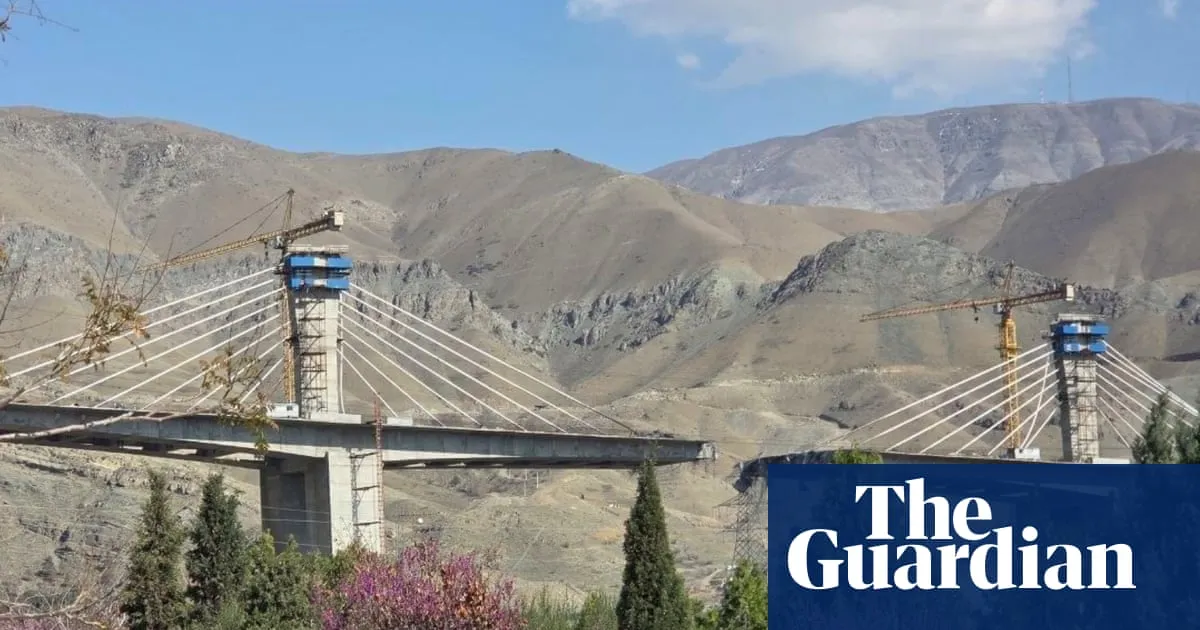
Donald Trump claimed responsibility for destroying Iran’s largest bridge, a day after he threatened to bomb the country “back to the stone ages” if a deal to end the five-week-long war he started was not reached.The US president shared footage of part of the newly built 136 metre-high $400m B1 suspension bridge between Tehran and Karaj collapsing dramatically on to the causeway below amid a rising plume of black smoke.Two people were reported killed in the incident on Thursday, in which the middle of the bridge was struck twice. Later imagery showed a clear gap at the heart of what had been one of Iran’s premier infrastructure projects.“The biggest bridge in Iran comes tumbling down, never to be used again,” the US president posted on the Truth Social website, and he warned there would be “much more to follow” if a settlement was not reached.It was not clear if the bridge was being used by civilians at the time, though there appeared to be a lorry on one side of the bridge. One video appeared to show a projectile hitting the span where there was already damage.A day earlier, in a primetime speech Trump had declared the war the US and Israel launched on Iran on 28 February was a success “nearing completion”, and that the US would “very shortly” achieve nearly all its strategic objectives.But in his White House address, the president also repeated a threat to destroy Iran’s power plants, potentially cutting off electricity to millions of people. “We are going to hit each and every one of their electric generating plants very hard and probably simultaneously,” he said.The attack on the bridge was one of several confirmed attacks in Iran this week, despite the difficulty of getting unsanctioned information out of the country, where the internet has been shut down by the authorities.Footage of a major strike earlier this week on a missile base in the city of Isfahan was confirmed on Thursday as genuine, with fiery plumes and secondary explosions filmed from a nearby car, whose driver expresses surprise at the scale of the attack.Isfahan is also where Iran is thought to have moved some or all of its 440kg stockpile of 60% enriched uranium, which in theory could be used to make 10 nuclear bombs if it could be enriched to 90% if Tehran still had the technology available.There has been speculation in the US that Trump has considered a high-risk airborne raid to seize the radioactive material from its underground storage – though the president said late on Wednesday that it was buried so deeply that “I don’t care”.Though most observers took Trump at his word, the US president has in the past engaged in misdirection. On 28 February, the US and Israel attacked and killed Iran’s supreme leader Ali Khamenei and several associates at a point when negotiations over a new nuclear deal were thought to bear fruit.Iran also said the Pasteur medical institute in Tehran was hit on Thursday. Israel said it had struck a headquarters used by Iran’s Revolutionary Guard to finance armed proxies across the Middle East the day before.Iran said it would conduct “more crushing, broader and more destructive” attacks in the future. The war would continue until the “permanent regret and surrender” of Iran’s enemies, said Ebrahim Zolfaqari, spokesperson for the Iranian military’s Khatam al-Anbiya central headquarters.Iran, however, has suffered far more than the US and Israel, in more than 15,000 bombing raids since the start of the war. At least 1,900 people have been killed and 20,000 injured in Iran since the start of the war, according to a rough estimate by the International Red Cross and Red Crescent Societies.Oil prices jumped by 7% a barrel to $108 as there appeared to be no immediate sign of the conflict ending. António Guterres, the UN secretary general, warned that the world is “on the edge of a wider war” with catastrophic global implications as he called for an end to the fighting.
SRCThe Guardian - World News
LANGEN
LEANCenter-Left
WORDS664
ENT8
THU · 2026-04-02 · 19:23 GMTBRIEF NSR-2026-0402-49877
NSR-2026-0402-49877News Report·EN·Conflict
Trump warns Tehran ‘more to follow’ after strike destroys Iran’s largest bridge
Donald Trump claimed responsibility for the destruction of Iran's largest bridge, the B1 suspension bridge between Tehran and Karaj, following a threat to bomb the country if a deal to end the ongoing war was not reached. The incident, which resulted in two reported deaths, involved the bridge collapsing after being struck twice.
Dan Sabbagh in JerusalemThe Guardian - World NewsFiled 2026-04-02 · 19:23 GMTLean · Center-LeftRead · 3 min
The Guardian - World NewsFIG 01
Reading time
3min
Word count
664words
Sources cited
0cited
Entities identified
8entities
Quality score
100%
§ 01
Briefing Summary
AI-generatedNEWSAR · AI
Donald Trump claimed responsibility for the destruction of Iran's largest bridge, the B1 suspension bridge between Tehran and Karaj, following a threat to bomb the country if a deal to end the ongoing war was not reached. The incident, which resulted in two reported deaths, involved the bridge collapsing after being struck twice. Trump posted footage of the destruction online, warning of further actions if a settlement was not achieved. This attack is one of several confirmed strikes in Iran this week, including a major strike on a missile base in Isfahan. These events occur amidst a five-week-long war initiated by the US and Israel on February 28th, with Trump stating the US is nearing completion of its strategic objectives.
Confidence 0.90Claims 5Entities 8
§ 02
Article analysis
Model · rule-basedFraming
Conflict
National Security
Tone
Mixed Tone
AI-assessed
CalmNeutralAlarmist
Factuality
0.70 / 1.00
Factual
LowHigh
Sources cited
0
No named sources
FewMany
§ 03
Key claims
5 extracted01
Iran also said the Pasteur medical institute in Tehran was hit on Thursday.
factualnull
Confidence
1.00
02
Footage of a major strike earlier this week on a missile base in the city of Isfahan was confirmed on Thursday as genuine.
factualnull
Confidence
1.00
03
The US and Israel launched a war on Iran on 28 February.
factualnull
Confidence
1.00
04
Donald Trump claimed responsibility for destroying Iran’s largest bridge.
factualnull
Confidence
1.00
05
Two people were reported killed in the incident on Thursday.
factualnull
Confidence
0.90
§ 04
Full report
3 min read · 664 words§ 05
Entities
8 identifiedKey playerOppositionContextPositiveNeutralNegative
Organizations1
§ 06
Keywords & salience
9 termsiran
0.90
donald trump
0.80
bridge strike
0.80
military attack
0.70
us
0.70
war
0.60
nuclear program
0.50
infrastructure
0.50
tehran
0.40
§ 07
Topic connections
Interactive graph Network visualization showing 51 related topics
View Full Graph Person Organization Location Event|Click node to navigate|Edge numbers = shared articles