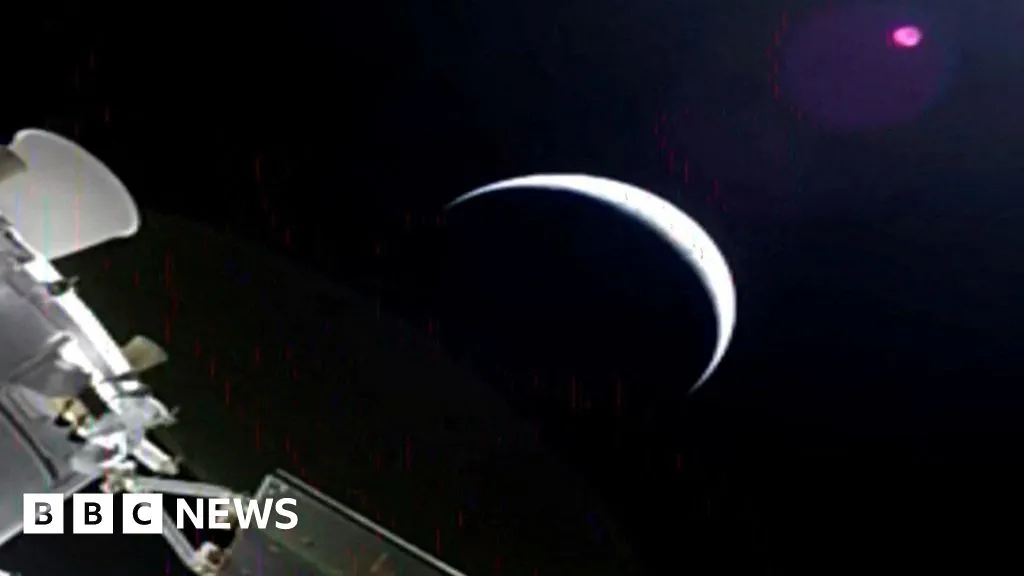
24 minutes agoPallab Ghosh,Science Correspondent, Cape Canaveral,Alison Francis,Senior Science Journalist,Kevin ChurchandEmily SelvaduraiGettyThe Orion spacecraft thrusts out of Earth orbit and on to the Moon (artwork)The four astronauts on the Artemis II mission have now left the Earth's orbit, after their Orion spacecraft fired its main engine for a final push towards the Moon.The five minute and 55 second engine burn, known as the translunar injection (TLI), went "flawlessly", NASA's Dr Lori Glaze said afterwards.And from the Orion capsule, Canadian astronaut Jeremy Hansen said the crew was "feeling pretty good up here on our way to the Moon".Artemis II is now on a looping path that will carry the crew around the far side of the Moon and back again. It is the first time since 1972 that humans have travelled outside of the Earth's orbit.On the livestream from Orion, Earth is slowly shrinking, as the capsule moves further and further into space.Hansen, who is the first non-American to travel to the Moon - told NASA's mission control that the crew "firmly felt the power" of those who have persevered and worked so hard on this mission."Humanity has once again shown what we are capable of," he said. "It's your hopes for the future that carry us now on this journey around the Moon."After spending roughly a day in a stretched‑out "high Earth orbit", Orion's engines, navigation and life-support systems were checked, while the capsule looped our planet.At last, the final approval was given, and the engine burn could begin - the mission's last, big move towards the Moon.Behind the crew's seats, the service module lit its single main engine in a long, steady push that added thousands of kilometres per hour to Orion's speed.The TLI propelled the spacecraft on a journey that is expected to carry the crew farther from Earth than anyone has been before - more than 4,700 miles (7,600 km) beyond the Moon - before gravity swings them back.NASA estimates that this could edge past the record set by Apollo 13 in 1970, depending on the fine details of the timing and trajectory.TLI is not a point of no return for Orion - even after the big burn to the Moon, controllers can still carry out the equivalent of a handbrake turn in space and bring the crew back to Earth if something goes seriously wrong.In the event of an emergency, the U-turn is the fastest way home in the first 36 hours after the TLI. After that it can be just as quick, and often simpler, to stay on course around the Moon and fall back to Earth, Orion programme manager Howard Hu said before the launch.He added that the team have "run hundreds of thousands of [simulations] to ensure that we are able to get the crew home safely."At a briefing after the successful engine burn, he was all smiles, telling reporters: "What a great couple of days!"NASAThe Artemis II mission plans to take the astronauts further into space that humans have been before - more than 4,700 miles beyond the MoonAs Orion surges into deep space, the views through its windows will become steadily more inspirational: the Earth shrinking to a small blue and white marble behind them, while the Moon grows from a bright disc into a heavily cratered world filling the frame. On about the sixth day of the mission, as Orion cruises beyond the Moon, the astronauts will get to see a total solar eclipse. The Moon will slide directly in front of the Sun so its bright face is completely covered to reveal its normally concealed shimmering halo, with Earth hanging off to one side. There's a lot of astro-jargon involved in space missions, and TLI is the latest space lingo many of those following this mission have come to know. Hopefully it will be remembered as the giant push that took humanity one small step closer to walking on the lunar surface again.ReutersThe astronauts' orange suits can provide life support for up to six days in the event of an emergency
SRCBBC News - World
LANGEN
LEANCenter
WORDS672
ENT12
FRI · 2026-04-03 · 03:35 GMTBRIEF NSR-2026-0403-50147
NSR-2026-0403-50147News Report·EN·Technology
Artemis II blasts ever closer to the far side of the Moon
The Artemis II mission, carrying four astronauts, has successfully left Earth's orbit and is now en route to the Moon. The Orion spacecraft executed a flawless translunar injection (TLI), a nearly six-minute engine burn that propelled it towards its lunar trajectory.
BBC News - WorldFiled 2026-04-03 · 03:35 GMTLean · CenterRead · 3 min
BBC News - WorldFIG 01
Reading time
3min
Word count
672words
Sources cited
4cited
Entities identified
12entities
Quality score
100%
§ 01
Briefing Summary
AI-generatedNEWSAR · AI
The Artemis II mission, carrying four astronauts, has successfully left Earth's orbit and is now en route to the Moon. The Orion spacecraft executed a flawless translunar injection (TLI), a nearly six-minute engine burn that propelled it towards its lunar trajectory. This mission marks the first time since 1972 that humans have ventured beyond Earth's orbit. The spacecraft will loop around the far side of the Moon before returning to Earth. The mission aims to test Orion's systems and pave the way for future lunar landings, potentially breaking the distance record set by Apollo 13. While en route, controllers retain the ability to execute a return to Earth in case of emergency.
Confidence 0.90Sources 4Claims 5Entities 12
§ 02
Article analysis
Model · rule-basedFraming
Technology
Human Interest
Tone
Measured
AI-assessed
CalmNeutralAlarmist
Factuality
0.80 / 1.00
Factual
LowHigh
Sources cited
4
Well sourced
FewMany
§ 03
Key claims
5 extracted01
TLI is not a point of no return for Orion - controllers can still carry out the equivalent of a handbrake turn in space.
factual
Confidence
1.00
02
Artemis II mission plans to take the astronauts further into space that humans have been before - more than 4,700 miles beyond the Moon
factual
Confidence
1.00
03
It is the first time since 1972 that humans have travelled outside of the Earth's orbit.
factual
Confidence
1.00
04
The five minute and 55 second engine burn, known as the translunar injection (TLI), went "flawlessly".
quoteNasa's Dr Lori Glaze
Confidence
1.00
05
The four astronauts on the Artemis II mission have now left the Earth's orbit.
factual
Confidence
1.00
§ 04
Full report
3 min read · 672 words§ 05
Entities
12 identifiedKey playerOppositionContextPositiveNeutralNegative
People6
§ 06
Keywords & salience
8 termsartemis ii
1.00
moon mission
0.90
orion spacecraft
0.80
translunar injection
0.70
earth orbit
0.60
far side of the moon
0.50
space travel
0.50
nasa
0.40
§ 07
Topic connections
Interactive graph Network visualization showing 4 related topics
View Full Graph Person Organization Location Event|Click node to navigate|Edge numbers = shared articles