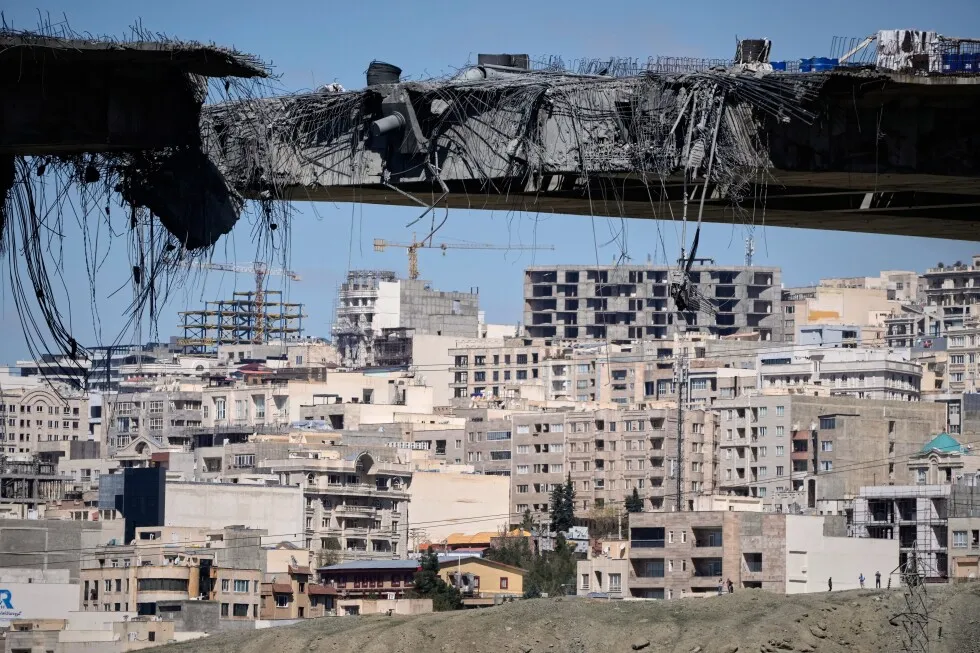
Iran fires on targets across the Mideast while Israel and US hit Tehran as war nears end of 5th week 1 of 7 | The narrow, bending waterway in the Persian Gulf is a key trade route between the Middle East and the rest of the world, with global impact. It links crude oil producers in the Middle East to key markets in Asia, Europe, North America and beyond, with around 20% of the world’s traded crude oil, and a similar share of natural gas passing through it. The AP’s Luke Garratt explains. 2 of 7 | Iran state media reported that strikes on the B1 bridge, which was still under construction, killed at least eight people and wounded 95. 3 of 7 | The annual public picnic day, called Sizdeh Bedar, which comes from the Farsi words for “thirteen” and “day out,” is a legacy from Iran’s pre-Islamic past that hard-liners in the Islamic Republic never managed to erase from calendars. Many say it’s bad luck to stay indoors for the holiday. (AP video by Mohsen Ganji) 4 of 7 | A bridge struck by U.S. airstrikes on Thursday is seen in the town of Karaj, west of Tehran, Iran, Friday, April 3, 2026. (AP Photo/Vahid Salemi) 5 of 7 | Israeli security forces and rescue teams inspect a site struck by an Iranian missile in Petah Tikva, Israel,Thursday, April 2, 2026. (AP Photo/Ohad Zwigenberg) 6 of 7 | A boy who fled with his family following Israeli strikes in southern Lebanon sits inside the van they are using as shelter in Sidon, Lebanon, Thursday, April 2, 2026. (AP Photo/Emilio Morenatti) 7 of 7 | Israeli security forces and rescue teams inspect a site struck by an Iranian missile in Petah Tikva, Israel,Thursday, April 2, 2026. (AP Photo/Ohad Zwigenberg) 1 of 7 The narrow, bending waterway in the Persian Gulf is a key trade route between the Middle East and the rest of the world, with global impact. It links crude oil producers in the Middle East to key markets in Asia, Europe, North America and beyond, with around 20% of the world’s traded crude oil, and a similar share of natural gas passing through it. The AP’s Luke Garratt explains. Add AP News on Google Add AP News as your preferred source to see more of our stories on Google. 2 of 7 Iran state media reported that strikes on the B1 bridge, which was still under construction, killed at least eight people and wounded 95. Add AP News on Google Add AP News as your preferred source to see more of our stories on Google. 3 of 7 The annual public picnic day, called Sizdeh Bedar, which comes from the Farsi words for “thirteen” and “day out,” is a legacy from Iran’s pre-Islamic past that hard-liners in the Islamic Republic never managed to erase from calendars. Many say it’s bad luck to stay indoors for the holiday. (AP video by Mohsen Ganji) Add AP News on Google Add AP News as your preferred source to see more of our stories on Google. 4 of 7 A bridge struck by U.S. airstrikes on Thursday is seen in the town of Karaj, west of Tehran, Iran, Friday, April 3, 2026. (AP Photo/Vahid Salemi) Add AP News on Google Add AP News as your preferred source to see more of our stories on Google. 5 of 7 Israeli security forces and rescue teams inspect a site struck by an Iranian missile in Petah Tikva, Israel,Thursday, April 2, 2026. (AP Photo/Ohad Zwigenberg) Add AP News on Google Add AP News as your preferred source to see more of our stories on Google. 6 of 7 A boy who fled with his family following Israeli strikes in southern Lebanon sits inside the van they are using as shelter in Sidon, Lebanon, Thursday, April 2, 2026. (AP Photo/Emilio Morenatti) Add AP News on Google Add AP News as your preferred source to see more of our stories on Google. 7 of 7 Israeli security forces and rescue teams inspect a site struck by an Iranian missile in Petah Tikva, Israel,Thursday, April 2, 2026. (AP Photo/Ohad Zwigenberg) Add AP News on Google Add AP News as your preferred source to see more of our stories on Google. Updated [hour]:[minute] [AMPM] [timezone], [monthFull] [day], [year] DUBAI, United Arab Emirates (AP) — Iran fired on targets Friday across the Middle East, damaging a desalination plant and setting a refinery ablaze in Kuwait, while American and Israeli airstrikes hit the Islamic Republic as the war neared the end of its fifth week.Tehran has kept the pressure on Israel and its Gulf Arab neighbors, despite U.S. and Israeli insistence that Iran’s military capabilities have been all but destroyed. In a sign that part of Iran’s theocracy could be willing to negotiate, the country’s former top diplomat published a proposal for ending the conflict in an influential American magazine.Iran’s attacks on Gulf energy infrastructure and its tight grip on the Strait of Hormuz, through which a fifth of the world’s oil and natural gas transits in peacetime, have roiled stock markets, sent oil prices skyrocketing, and threatened to raise the cost of many basic goods, including food. Iran’s ability to wreak havoc in the global economy has proved a major strategic advantage, and world leaders have struggled to figure out how to reopen the waterway. The U.N. Security Council was expected to look at a new proposal. Iran’s former top diplomat suggests terms to end the warFormer Iranian Foreign Minister Mohammad Javad Zarif — a diplomat with long experience negotiating with the West who remains close to a pragmatic wing of Iran’s leadership — wrote on Friday that the time has come to end the suffering.“Prolonged hostility will cause a greater loss of precious lives and irreplaceable resources without actually altering the existing stalemate,” Zarif, who helped negotiate Iran’s 2015 nuclear deal with world powers, wrote in Foreign Affairs magazine.The U.S. has presented Iran with a 15-point plan for a ceasefire that includes reopening the Strait of Hormuz, dismantling Iran’s nuclear facilities and limiting its missile production in exchange for sanctions relief. But no signs of progress were apparent in the diplomatic effort. Iran’s initial five-point counterproposal aired by hard-line state television included recognizing Iran’s sovereignty over the strait, the removal of U.S. bases from the region, compensation for war damage, and a guarantee against further aggression — all things likely unpalatable to the Trump administration. Zarif’s proposal included elements of both of the plans. Iran “should offer to place limits on its nuclear program and to reopen the Strait of Hormuz in exchange for an end to all sanctions — a deal Washington wouldn’t take before but might accept now,” he wrote.Tehran and Washington were in talks about Iran’s nuclear program when the U.S. and Israel began bombing on Feb. 28 — the second time under President Donald Trump that the U.S. has attacked while in negotiations.It’s not clear how much to read into Zarif’s proposal. While he has no official position in Iran’s government, he helped get reformist President Masoud Pezeshkian elected and would likely not have published such a piece without at least some authorization from senior leaders. But it also remains clear who in Iran has the authority to negotiate since many leaders have been killed in the war. Immediately after the piece came out, Zarif wrote he had been “torn” about it — a sign he may already face pressure at home.What’s more, it’s not clear how Trump will respond. He has vacillated between saying the U.S. is negotiating an end to the war and threatening to expand it. Thousands of U.S. Marines and paratroopers have been ordered to the region, raising speculation that there could be a ground offensive. Iran targets a desalination plant and a refineryKuwait’s Mina al-Ahmadi oil refinery came under Iranian attack, and the state-run Kuwait Petroleum Corp. said firefighters were working to control several blazes. Kuwait also said that an Iranian attack caused “material damage” to a desalination plant. Such plants are responsible for most of the drinking water for Gulf states, and they have become a major target in the war.Sirens also sounded in Bahrain, Saudi Arabia said it had destroyed several Iranian drones, and Israel reported incoming missiles. Authorities in the United Arab Emirates shut down a gas field after a missile interception reportedly rained debris on it and started a fire.Activists reported strikes around Tehran and the central city of Isfahan, but it wasn’t immediately clear what was hit. A day earlier, Iran said the U.S. hit a major bridge, which was still under construction, killing eight people.More than 1,900 people have been killed in Iran during the war. In a review released Friday, the Armed Conflict Location and Event Data, a U.S-based group, said they found that civilian casualties were clustered around strikes on security and state-linked sites “rather than indiscriminate bombardment” of urban areas.More than two dozen people have died in Gulf states and the occupied West Bank, while 13 U.S. service members have been killed, while 19 have been reported dead in Israel.More than 1,300 people have been killed and more than 1 million displaced in Lebanon, where Israel has launched a ground invasion in its fight with the pro-Iranian Hezbollah militant group. Ten Israeli soldiers have also died there. UN Security Council to take up Strait of Hormuz security questionSpot prices of Brent crude, the international standard, were around $109 Friday, up more than 50% since the start of the war, when Iran began restricting traffic through the Strait of Hormuz.The U.N. Security Council was expected to vote Saturday on a proposal from Bahrain that would authorize defensive action to ensure vessels can safely transit the waterway. Bahrain’s initial draft would have allowed countries to “use all necessary means” to secure the strait, but Russia, China and France — who have veto power on the Council — expressed opposition to approving the use of force. Following meetings in Seoul between South Korean President Lee Jae Myung and French President Emmanuel Macron, the two leaders said they resolved to “cooperate to ensure safe passage” through the strait but did not offer specifics.___Rising reported from Bangkok. AP journalists Sylvie Corbet in Paris, Sarah El Deeb in Beirut, Tong-hyung Kim in Seoul, South Korea, and Edith M. Lederer at the United Nations contributed to this report. Gambrell is the news director for the Gulf and Iran for The Associated Press. He has reported from each of the Gulf Cooperation Council countries, Iran and other locations across the world since joining the AP in 2006. Rising covers regional Asia-Pacific stories for The Associated Press. He has worked around the world, including covering the wars in Iraq, Afghanistan and Ukraine, and was based for nearly 20 years in Berlin before moving to Bangkok.
SRCAssociated Press (AP)
LANGEN
LEANCenter
WORDS1 806
ENT10
FRI · 2026-04-03 · 11:23 GMTBRIEF NSR-2026-0403-50697
NSR-2026-0403-50697News Report·EN·Conflict
Iran fires on targets across the Mideast while Israel and US hit Tehran as war nears end of 5th week
As the war nears its fifth week, Iran, Israel, and the US have exchanged attacks across the Middle East. Iran has fired on targets in the region, while Israel and the US have struck targets within Iran, including a bridge under construction in Karaj, west of Tehran, resulting in casualties.
By
JON GAMBRELL and DAVID RISINGAssociated Press (AP)Filed 2026-04-03 · 11:23 GMTLean · CenterRead · 8 min
Associated Press (AP)FIG 01
Reading time
8min
Word count
1 806words
Sources cited
2cited
Entities identified
10entities
Quality score
100%
§ 01
Briefing Summary
AI-generatedNEWSAR · AI
As the war nears its fifth week, Iran, Israel, and the US have exchanged attacks across the Middle East. Iran has fired on targets in the region, while Israel and the US have struck targets within Iran, including a bridge under construction in Karaj, west of Tehran, resulting in casualties. The strikes come amidst ongoing conflict, with impacts felt in locations such as Petah Tikva, Israel, and southern Lebanon, where families are displaced. The Persian Gulf, a crucial global trade route for oil and natural gas, remains a key strategic area in the conflict. The fighting continues despite the annual Sizdeh Bedar public holiday in Iran.
Confidence 0.90Sources 2Claims 4Entities 10
§ 02
Article analysis
Model · rule-basedFraming
Conflict
Economic Impact
Tone
Mixed Tone
AI-assessed
CalmNeutralAlarmist
Factuality
0.80 / 1.00
Factual
LowHigh
Sources cited
2
Limited
FewMany
§ 03
Key claims
4 extracted01
A bridge struck by U.S. airstrikes on Thursday is seen in the town of Karaj, west of Tehran, Iran, Friday, April 3, 2026.
factualAP Photo/Vahid Salemi
Confidence
1.00
02
The Persian Gulf is a key trade route, with around 20% of the world’s traded crude oil passing through it.
statisticAP's Luke Garratt
Confidence
0.90
03
Iran fires on targets across the Mideast while Israel and US hit Tehran.
factualArticle Title
Confidence
0.90
04
Strikes on the B1 bridge killed at least eight people and wounded 95.
factualIran state media
Confidence
0.80
§ 04
Full report
8 min read · 1 806 words§ 05
Entities
10 identifiedKey playerOppositionContextPositiveNeutralNegative
§ 06
Keywords & salience
8 termsiran
1.00
israel
0.90
us
0.80
strikes
0.80
middle east
0.70
war
0.60
persian gulf
0.50
trade route
0.40
§ 07
Topic connections
Interactive graph Network visualization showing 51 related topics
View Full Graph Person Organization Location Event|Click node to navigate|Edge numbers = shared articles