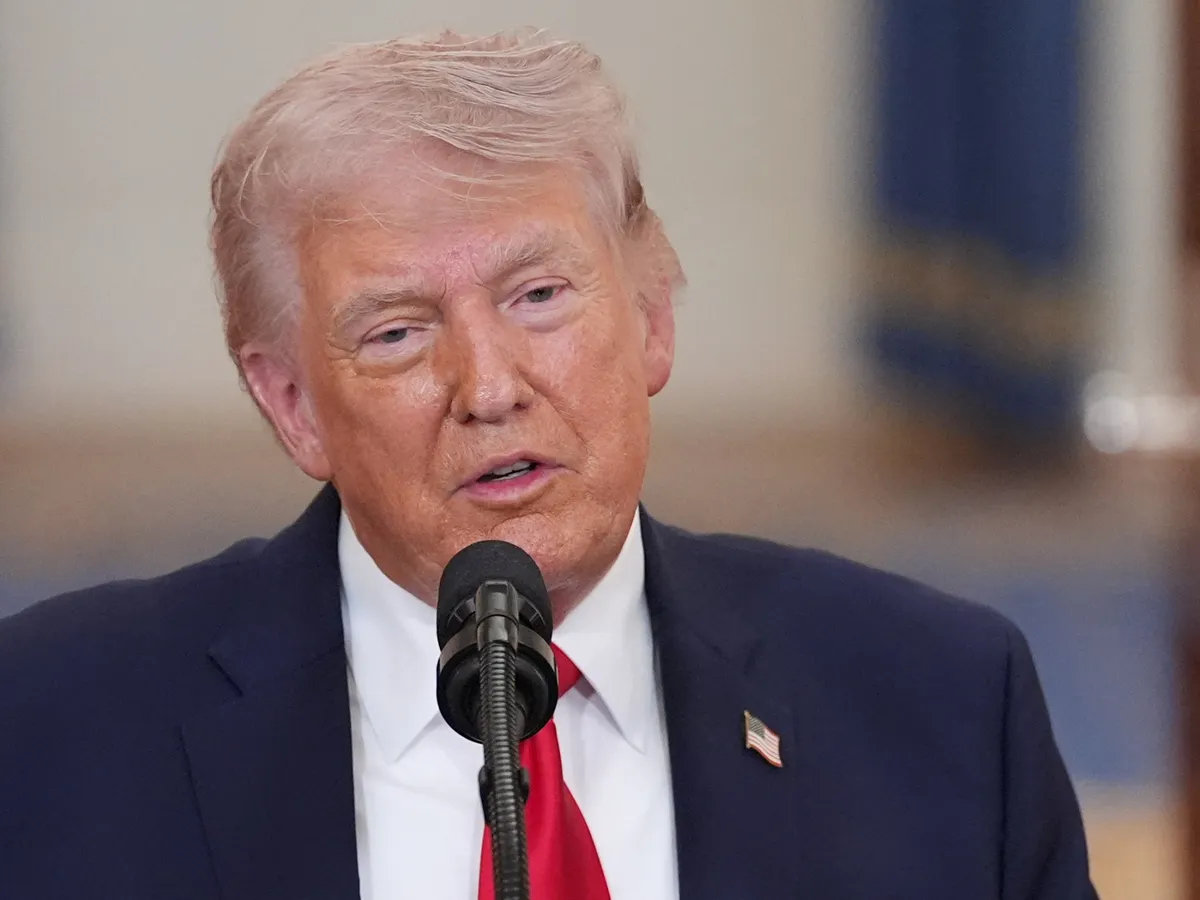
Trump does not reference downed jet in post but points to a US-set deadline for Iran to make deal and open the Strait of Hormuz.US President Donald Trump speaks during a televised address on the conflict in the Middle East in Washington, DC [AFP]Published On 4 Apr 2026United States President Donald Trump has issued another threat to Iran, writing that it has two days to “make a deal or open up the Hormuz Strait”.Saturday’s brief, three-sentence post on Truth Social did not reference the ongoing search for a US pilot who is believed to have ejected over Iran after an F-15 fighter jet crashed in the country. Iran has taken responsibility for the downing, the first of its kind since the US and Israeli launched attacks on Iran on February 28.Recommended Stories list of 3 itemslist 1 of 3What we know about the US fighter jet shot down in Iranlist 2 of 3Israel’s unchecked war machinelist 3 of 3Projectile hits near Iran’s Bushehr nuclear plant, killing one: IAEAend of listA separate incident on Friday saw Iran claim it shot down an A-10 Warthog near the Strait of Hormuz, raising questions about Trump’s earlier assertion that the US has established dominance over Iran’s airspace.Rather than remark on the recent crashes, Trump’s post focused on a 10-day deadline he announced on March 26.He had called on Iran to open the Strait of Hormuz to international traffic, or else face the “destruction” of its energy plants. That 10-day period is set to expire on Monday.“Remember when I gave Iran ten days to MAKE A DEAL or OPEN UP THE HORMUZ STRAIT,” Trump wrote. “Time is running out – 48 hours before all Hell will reign down on them. Glory be to GOD!”Stalled negotiationsWhile Trump did not provide further details about Saturday’s threat, in a series of posts this week, he pledged to attack Iran’s power plants, oil facilities and “possibly all desalinization plants”.During a national address on Wednesday, he also threatened to bomb Iran “back to the Stone Ages”, and on Friday, he cheered a strike on a bridge that connects Tehran to the Caspian Sea.Just this week, more than 100 international law experts published an open letter, warning that targeting civilian infrastructure is a violation of the Geneva Convention and could constitute war crimes.The Trump administration has also offered shifting objectives and plans for ending the war.Administration officials have repeatedly said that the US prefers a diplomatic solution. Trump, meanwhile, has touted “victories” even as he has hinted at more weeks of attacks.At the same time, Iran and the US have sent contradictory messages on the progress of peace talks.On Saturday, Iranian Foreign Minister Abbas Araghchi said Tehran remained open to diplomacy, after Iran rejected an “unreasonable” 15-point plan put forward by the Trump administration.“What we care about are the terms of a conclusive and lasting END to the illegal war that is imposed on us,” Araghchi said in a post on X.The US, however, has argued that Iran’s demand that it maintain “sovereignty” over the Strait of Hormuz is a non-starter.Pakistan has indicated it will continue to try to support ceasefire negotiations despite the ongoing “obstacles”.No mention of downed pilotWhile Trump has not publicly addressed the ongoing search for the US pilot, NBC News reported on Friday that he did not believe the incident would affect any negotiations with Iran.“No, not at all. No, it’s war,” he reportedly told the network in a phone call.Nevertheless, experts have warned that the possible Iranian capture of the pilot could create a crisis for Washington, giving Tehran a major leverage point that could snarl any diplomatic resolution.The incident could also undermine US claims it has a dominant position in negotiations.Marina Miron, a researcher at King’s College London, said the shooting down of the F-15 undercuts statements from Trump and Pentagon chief Pete Hegseth that the US has established complete control over Iranian airspace.“Now we have a visible example that Iran still has the capability to target and successfully shoot down US aircraft, making this, of course, very important for Iran to demonstrate the capability to resist,” Miron told Al Jazeera.“Most likely, the kinds of air defences that Iran is using, such as man-portable air defences, will be much more difficult to locate.”Any US efforts to rescue the pilot would risk US casualties, Miron added, heightening the risk of further military escalation.“It’s a race for time, because right now we have this critical window of up to 72 hours where both sides are trying to get hold of the pilot for both military and political purposes,” she said.
SRCAl Jazeera
LANGEN
LEANCenter
WORDS763
ENT8
SAT · 2026-04-04 · 16:35 GMTBRIEF NSR-2026-0404-52466
NSR-2026-0404-52466News Report·EN·Conflict
Trump says Iran has 48 hours to make deal as search for US pilot continues
On April 4, 2026, US President Donald Trump issued a threat to Iran on Truth Social, giving them 48 hours to "make a deal or open up the Hormuz Strait." This ultimatum comes as the search continues for a US pilot whose F-15 fighter jet crashed in Iran, the first downing since US and Israeli attacks began in February. Trump's post did not mention the downed jet but referenced a previous 10-day deadline for Iran to open the Strait of Hormuz or face consequences.
Joseph StepanskyAl JazeeraFiled 2026-04-04 · 16:35 GMTLean · CenterRead · 4 min
Al JazeeraFIG 01
Reading time
4min
Word count
763words
Sources cited
3cited
Entities identified
8entities
Quality score
100%
§ 01
Briefing Summary
AI-generatedNEWSAR · AI
On April 4, 2026, US President Donald Trump issued a threat to Iran on Truth Social, giving them 48 hours to "make a deal or open up the Hormuz Strait." This ultimatum comes as the search continues for a US pilot whose F-15 fighter jet crashed in Iran, the first downing since US and Israeli attacks began in February. Trump's post did not mention the downed jet but referenced a previous 10-day deadline for Iran to open the Strait of Hormuz or face consequences. This follows a separate incident where Iran claimed to have shot down a US A-10 Warthog near the Strait of Hormuz. Trump has also threatened to attack Iranian infrastructure, despite warnings from international law experts about potential war crimes.
Confidence 0.90Sources 3Claims 5Entities 8
§ 02
Article analysis
Model · rule-basedFraming
Conflict
National Security
Tone
Mixed Tone
AI-assessed
CalmNeutralAlarmist
Factuality
0.70 / 1.00
Factual
LowHigh
Sources cited
3
Well sourced
FewMany
§ 03
Key claims
5 extracted01
Iranian Foreign Minister Abbas Araghchi said Tehran remained open to diplomacy.
quoteAbbas Araghchi
Confidence
1.00
02
More than 100 international law experts warned that targeting civilian infrastructure is a violation of the Geneva Convention.
factual
Confidence
1.00
03
Trump says Iran has two days to 'make a deal or open up the Hormuz Strait'.
quoteDonald Trump
Confidence
1.00
04
Iran claims it shot down an A-10 Warthog near the Strait of Hormuz.
factualIran
Confidence
0.90
05
Iran has taken responsibility for the downing of a US F-15 fighter jet.
factual
Confidence
0.90
§ 04
Full report
4 min read · 763 words§ 05
Entities
8 identifiedKey playerOppositionContextPositiveNeutralNegative
Organizations1
Locations5
§ 06
Keywords & salience
9 termsiran
1.00
donald trump
0.90
strait of hormuz
0.80
us pilot
0.70
military conflict
0.70
threat
0.60
war crimes
0.50
negotiations
0.50
geneva convention
0.40
§ 07
Topic connections
Interactive graph Network visualization showing 51 related topics
View Full Graph Person Organization Location Event|Click node to navigate|Edge numbers = shared articles