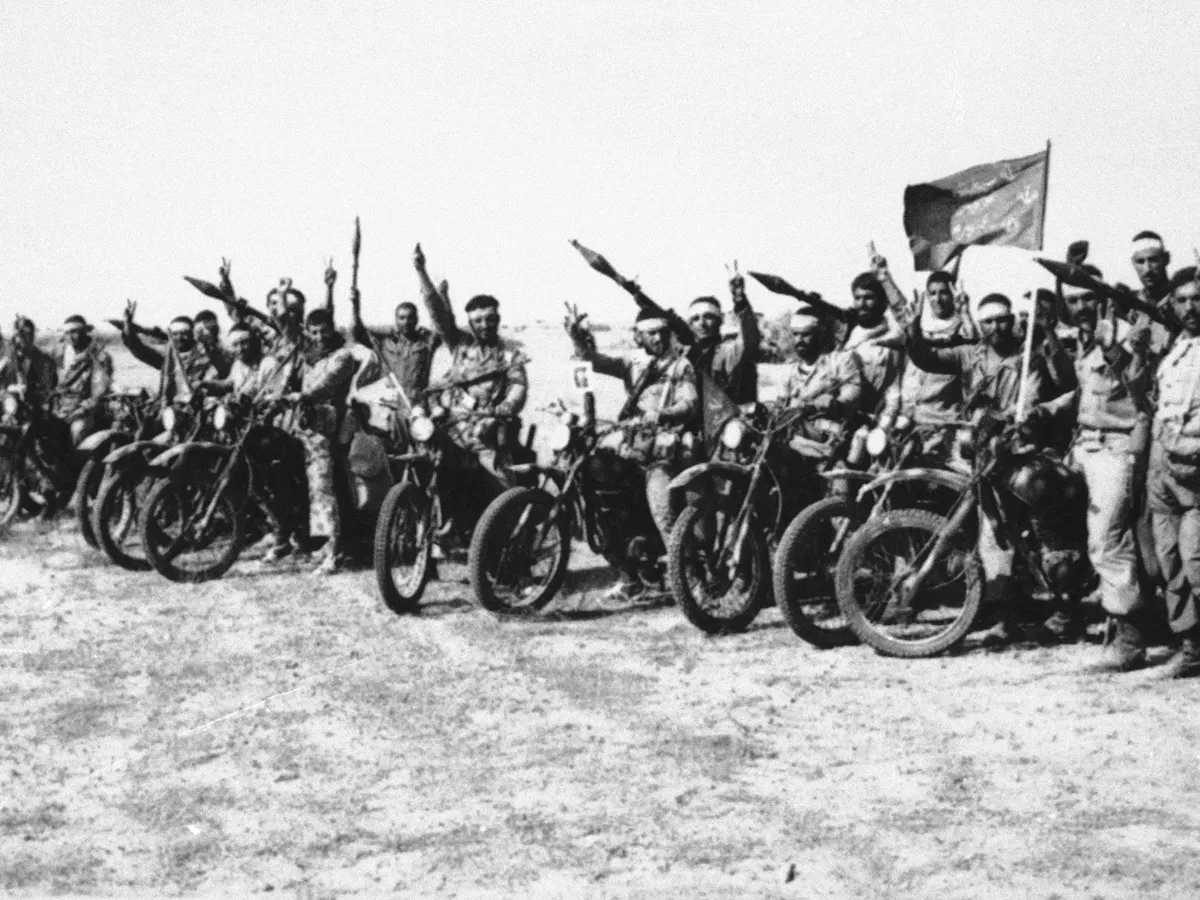
Trump and Netanyahu are harbouring the same illusions Saddam Hussein had in 1980 when he invaded Iran.Published On 4 Apr 2026A group of Iranian Revolutionary Guards and volunteer tank hunters on motorcycles give victory signs on the southern front of the Iran-Iraq-war" class="entity-link entity-event" data-entity-id="10188" data-entity-type="event">Iran-Iraq War in December 1982 [AP]When the United States and Israel launched their illegal war on Iran on February 28, they called on the Iranian people to rise up. They then proceeded to bomb not just military targets, but civilian housing, universities, schools, hospitals, commercial buildings and historical sites.In the sound of explosions today, many Iranians hear echoes from the past: from the Iran-Iraq-war" class="entity-link entity-event" data-entity-id="10188" data-entity-type="event">Iran-Iraq War of 1980-1988.In the fall of 1980, when Iraq invaded Iran, I was a 20-year-old student at Tehran Polytechnic University and a member of an opposition group. The first time I saw the impact of war firsthand was in October of that year. One evening, my friend Farhad and I were standing in line to load two boxes of antigovernment pamphlets onto a bus heading to Isfahan; given the restriction of movement and the checkpoints set up by the Revolutionary Guard, this was the only safe way to transport such materials.Suddenly, the thunderous shots of air defence systems shook the ground and lit the sky with blue, orange, yellow, and red rays of light. The sirens went off. I had never felt so fearful, helpless, and disoriented. Running around to find a possible shelter, the ground shaking under my feet, the smashing booms of unremitting air defence, and multidirectional screams of a terrorised crowd closed off all space to think what exactly was happening.Once the air defence ceased, Farhad and I jumped on his motorcycle and rode back to our own neighbourhood. My mother had been convinced that I was killed.The second time I experienced the war directly came a few weeks later. Another friend and I were sitting on a bench in a park in central Tehran, discussing how to simultaneously protest the war and mobilise against the regime.Suddenly, an Iraqi fighter jet showed up, flying at such a low altitude that we could actually see the pilot. As people began running in fear, the Iraqi bomber circled around us and dropped leaflets in Persian asking Iranians to rise up against their government. That was the only possible way that Iranians could stop the war: “Topple your own government.” We both thought that Saddam Hussein was hijacking our struggle. We were under no illusion that the Iraqis could somehow turn into our liberators.At the time, there were heated conversations within the opposition groups on whether those of us who found ourselves in opposition to the Islamic Republic should participate in defending the country against the Iraqi aggression, or we should exploit the war and advance our own anti-regime agenda. I belonged to the second group, taking advantage of the war to topple the state.The government at that time was barely a year old, but it enjoyed vast popular support. The very notion that halting the bombing of the cities was contingent upon the masses overthrowing the state was nothing more than a delusional fantasy. Saddam Hussein learned very quickly that despite the chaotic conditions of the postrevolutionary state, the Islamic Republic could mobilise millions to defend the country and hold on to political power.We learned that lesson very quickly, too. Not only did the Islamic Republic mobilise the masses to check the invasion, it also successfully consolidated power by eliminating the opposition. Tens of thousands were arrested, many more exiled, and thousands were executed. Even those in the opposition who defended the war effort but remained critical of the state were purged or exiled.Now, 46 years later, American and Israeli leaders seem to harbour similar illusions. The difference this time is that, unlike Saddam Hussein, US President Donald Trump and Israeli Prime Minister Benjamin Netanyahu are waging a war of bombing campaigns without any war fronts and soldiers on the ground. In so many ways, this kind of war poses deeper uncertainties and more intense anxieties. Anyone, anywhere, at any time could be a target. An air war, as it has been demonstrated in the past few weeks, could be significantly more indiscriminate.The other difference is that, by the time this war began, the Islamic Republic had squandered what was once the overwhelming support of its citizens. Years of crippling sanctions had led to widespread impoverishment of people from all walks of life and an economy infested by persistent corruption. That bitter economic pill, combined with brutal suppression of dissent, had created an irrevocable divide between the state and many of its citizens.That, however, did not mean that a US-Israeli act of aggression would easily topple the regime. The Trump administration misread that reality and bought into an Israeli plan to launch a war with the same prognosis — that it will hasten the collapse of the Islamic Republic.The Trump administration’s failure was twofold. First, it demonstrated a total lack of understanding of the structure of state power in Iran. Despite its appearance, the Islamic Republic is not a totalitarian state that relies on the tyrannical rule of one man.Constitutionally, it is true that the office of the supreme leader holds immeasurable authority over all three branches of the government. But that does not mean that decapitating the state would lead to its collapse. The experts at Washington think tanks somehow missed that there are multiple sources of power in the Islamic Republic, the aggregate of which holds the entire polity together. Now it has become evident that the assassination of Ayatollah Ali Khamenei could not crumble the regime. This was a war crime with little payoff.The second failure was not understanding how a war fought so indiscriminately from the air would collapse the distinction between the nation and the state. Many Iranians very quickly realised that the imposed war had nothing to do with their grievances. Rather, this was a war against the sovereignty of the nation.The Israeli and American propaganda machine tried hard to blame the war on the Islamic Republic and its belligerent policies in the region. But punishing the nation for the sins of the state was a decree against which a majority in the country remained defiant.Like Saddam Hussein in the 1980s, the Trump-Netanyahu alliance today claim that they have paved the road for Iranians to overthrow the Islamic Republic. They punish the nation for not doing so by blanket bombing of the cities and destroying vital economic infrastructure.The cruelty of the worn-out logic of piling misery onto people’s lives – through bombs, sanctions, and assassinations – in the hope of forcing them to topple their government is evident. It did not work for Saddam Hussein; it will not work for Trump and Netanyahu.There are no differences between the people who ran aimlessly at the bus terminal in 1980 and those whose lives are destroyed by American and Israeli bombs today. They hold those who push the button to drop the bombs responsible for the destruction of their lives and the murder of their loved ones.Rather than liberating the nation, the immediate consequence of those bombs is further militarisation of the state and the collapse of whatever remains of civil society. The Islamic Republic has shown that it is well-equipped to sustain a war of attrition, an experience it inherited from the eight-year war with Iraq. But we need to remember that a war of attrition is fought against foreign aggressors by consolidating power and tightening the repressive apparatus.This war began with false premises and continues to unfold against all basic principles of a rules-based world order. As with the Iraqi aggression of 1980, the US and Israel have openly violated a foundational tenet of the United Nations, that of respect for another nation’s sovereignty. They have disregarded the prohibition on the assassination of political leaders and are now threatening to obliterate Iran’s civilian energy infrastructure, which would be a blatant war crime.It is hard to predict with any level of certainty how this war would end and who the winner and losers will be. One thing, however, is quite certain that on the other side of this war lays a different world order.The views expressed in this article are the author’s own and do not necessarily reflect Al Jazeera’s editorial stance.
SRCAl Jazeera
LANGEN
LEANCenter
WORDS1 383
ENT11
SAT · 2026-04-04 · 16:32 GMTBRIEF NSR-2026-0404-52467
NSR-2026-0404-52467Opinion·EN·Conflict
What the Iran-Iraq war can tell us about the US-Israeli war on Iran
In February 2026, the United States and Israel launched a war on Iran, bombing military and civilian targets. The article draws parallels between this conflict and the Iran-Iraq war of 1980-1988.
Behrooz Ghamari-TabriziAl JazeeraFiled 2026-04-04 · 16:32 GMTLean · CenterRead · 6 min
Al JazeeraFIG 01
Reading time
6min
Word count
1 383words
Sources cited
0cited
Entities identified
11entities
Quality score
100%
§ 01
Briefing Summary
AI-generatedNEWSAR · AI
In February 2026, the United States and Israel launched a war on Iran, bombing military and civilian targets. The article draws parallels between this conflict and the Iran-Iraq war of 1980-1988. The author recounts personal experiences during the earlier war, including witnessing air strikes in Tehran as a student. During the Iran-Iraq war, the Iraqi military dropped leaflets urging Iranians to overthrow their government to end the war. The author suggests that the current US-Israeli strategy mirrors Saddam Hussein's failed attempt to incite an uprising in Iran during the 1980s.
Confidence 0.90Claims 4Entities 11
§ 02
Article analysis
Model · rule-basedFraming
Conflict
Political Strategy
Tone
Sensational
AI-assessed
CalmNeutralAlarmist
Factuality
0.20 / 1.00
Opinion-Heavy
LowHigh
Sources cited
0
No named sources
FewMany
§ 03
Key claims
4 extracted01
When the United States and Israel launched their illegal war on Iran on February 28, they called on the Iranian people to rise up.
factualArticle's own claim
Confidence
0.80
02
They then proceeded to bomb not just military targets, but civilian housing, universities, schools, hospitals, commercial buildings and historical sites.
factualArticle's own claim
Confidence
0.70
03
The government at that time was barely a year old, but it enjoyed vast popular support.
factualArticle's own claim
Confidence
0.60
04
Trump and Netanyahu are harbouring the same illusions Saddam Hussein had in 1980 when he invaded Iran.
factualArticle's own claim
Confidence
0.60
§ 04
Full report
6 min read · 1 383 words§ 05
Entities
11 identifiedKey playerOppositionContextPositiveNeutralNegative
People3
Organizations1
Locations6
§ 06
Keywords & salience
9 termsiran-iraq war
1.00
us-israeli war on iran
0.90
iranian people
0.70
saddam hussein
0.60
bombing civilians
0.50
air defence
0.50
revolutionary guard
0.50
tehran
0.40
political opposition
0.40
§ 07
Topic connections
Interactive graph Network visualization showing 51 related topics
View Full Graph Person Organization Location Event|Click node to navigate|Edge numbers = shared articles