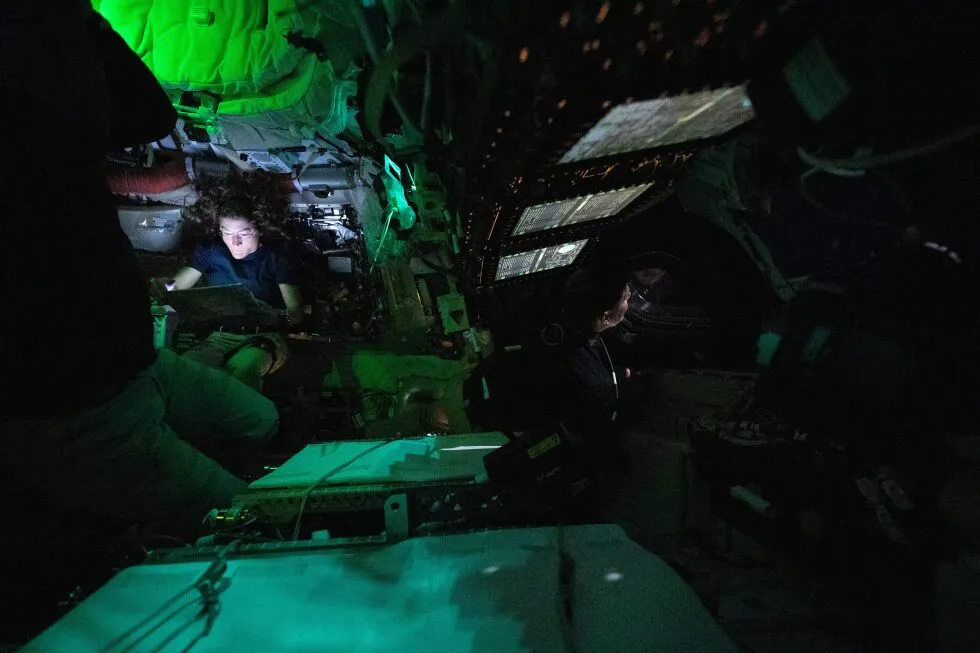
Artemis II astronauts are more than halfway to the Moon as they seek to break Apollo 13’s record 1 of 3 | This image from video provided by NASA shows a view of Earth taken by NASA astronaut and Artemis II Commander Reid Wiseman from one of the Orion spacecraft’s four windows after completing the translunar injection burn, Thursday, April 2, 2026. (NASA via AP) 2 of 3 | This image from video provided by NASA shows the Artemis II crew Commander Reid Wiseman, second from left, thanking the families of the crew while speaking with NASA Mission Control in a video conference while en route to the Moon, Thursday, April 2, 2026, as Canadian astronaut and mission specialist Jeremy Hansen, far left, looks on and mission specialist Christina Koch and pilot Victor Glover, far right, make hearts with their hands. (NASA via AP) CORRECTION: headed to the Moon, not in Moon’s orbit 3 of 3 | This image provided by the Canadian Space Agency, Artemis II astronaut Jeremy Hansen of Canada, connects live from the Orion spacecraft and speaks with Canadian media along with astronauts Victor Glover, left, and Reid Wiseman on Saturday, April 4, 2026. (Canadian Space Agency via AP) 1 of 3 This image from video provided by NASA shows a view of Earth taken by NASA astronaut and Artemis II Commander Reid Wiseman from one of the Orion spacecraft’s four windows after completing the translunar injection burn, Thursday, April 2, 2026. (NASA via AP) Add AP News on Google Add AP News as your preferred source to see more of our stories on Google. 2 of 3 This image from video provided by NASA shows the Artemis II crew Commander Reid Wiseman, second from left, thanking the families of the crew while speaking with NASA Mission Control in a video conference while en route to the Moon, Thursday, April 2, 2026, as Canadian astronaut and mission specialist Jeremy Hansen, far left, looks on and mission specialist Christina Koch and pilot Victor Glover, far right, make hearts with their hands. (NASA via AP) CORRECTION: headed to the Moon, not in Moon’s orbit Add AP News on Google Add AP News as your preferred source to see more of our stories on Google. 3 of 3 This image provided by the Canadian Space Agency, Artemis II astronaut Jeremy Hansen of Canada, connects live from the Orion spacecraft and speaks with Canadian media along with astronauts Victor Glover, left, and Reid Wiseman on Saturday, April 4, 2026. (Canadian Space Agency via AP) Add AP News on Google Add AP News as your preferred source to see more of our stories on Google. Updated [hour]:[minute] [AMPM] [timezone], [monthFull] [day], [year] HOUSTON (AP) — Now more than halfway to the Moon, the Artemis II astronauts were toasted by Canada on Saturday as they prepared for their historic lunar fly-around to push deeper into space than even the Apollo astronauts. The three Americans and one Canadian will reach their destination Monday, photographing the mysterious lunar far side as they zoom around. It’s the first moonbound crew in more than 53 years, picking up where NASA’s Apollo program left off.“The Earth is quite small and the Moon is definitely getting bigger,” reported pilot Victor Glover.Artemis II is poised to set a distance record for humans, traveling more than 252,000 miles (400,000 kilometers) from Earth before hanging a U-turn behind the Moon and heading home without stopping or entering lunar orbit. The record is currently held by Apollo 13. The Canadian Space Agency celebrated the country’s role in the mission, speaking from Quebec with astronaut Jeremy Hansen as he headed toward his lunar rendezvous. Hansen is the first non-U.S. citizen to fly to the Moon. “Today he is making history for Canada,” said Canadian Space Agency President Lisa Campbell. “As we watch him taking this bold step into the unknown, let his journey remind us that Canada’s future is written by those who dare to reach for more.” In the live televised linkup, Hansen said he’s already witnessed “extraordinary” views from NASA’s Orion capsule. Hansen, Glover, Reid Wiseman and Christina Koch are the world’s first lunar astronauts since Apollo 17’s crew of three in 1972. Koch and Glover are the first female and first Black astronauts to the Moon, respectively.Their nearly 10-day mission — ending with a Pacific splashdown on April 10 — is the first step in NASA’s bold plans for a sustainable Moon base. The space agency is aiming for a Moon landing by two astronauts near the lunar south pole in 2028. ___The Associated Press Health and Science Department receives support from the Howard Hughes Medical Institute’s Department of Science Education and the Robert Wood Johnson Foundation. The AP is solely responsible for all content.
SRCAssociated Press (AP)
LANGEN
LEANCenter
WORDS794
ENT12
SAT · 2026-04-04 · 19:53 GMTBRIEF NSR-2026-0404-52591
NSR-2026-0404-52591News Report·EN·Technology
Artemis II astronauts are more than halfway to the moon as they seek to break Apollo 13’s record
The Artemis II mission, carrying a crew of four astronauts including Reid Wiseman, Jeremy Hansen, Christina Koch, and Victor Glover, is more than halfway to the moon as of April 4, 2026. The crew successfully completed the translunar injection burn on April 2, 2026, propelling them towards their destination.
By
MARCIA DUNNAssociated Press (AP)Filed 2026-04-04 · 19:53 GMTLean · CenterRead · 4 min
Associated Press (AP)FIG 01
Reading time
4min
Word count
794words
Sources cited
1cited
Entities identified
12entities
Quality score
100%
§ 01
Briefing Summary
AI-generatedNEWSAR · AI
The Artemis II mission, carrying a crew of four astronauts including Reid Wiseman, Jeremy Hansen, Christina Koch, and Victor Glover, is more than halfway to the moon as of April 4, 2026. The crew successfully completed the translunar injection burn on April 2, 2026, propelling them towards their destination. During their journey, the astronauts have been communicating with NASA Mission Control and connecting with media outlets. The mission aims to surpass the distance record set by Apollo 13. The crew has been sharing images of Earth taken from the Orion spacecraft.
Confidence 0.90Sources 1Claims 5Entities 12
§ 02
Article analysis
Model · rule-basedFraming
Technology
Human Interest
Tone
Measured
AI-assessed
CalmNeutralAlarmist
Factuality
0.90 / 1.00
Factual
LowHigh
Sources cited
1
Limited
FewMany
§ 03
Key claims
5 extracted01
The Artemis II mission will push deeper into space than even the Apollo astronauts.
factualAP
Confidence
1.00
02
The Artemis II mission aims to photograph the lunar far side.
factualAP
Confidence
1.00
03
The Artemis II mission includes three Americans and one Canadian astronaut.
factualAP
Confidence
1.00
04
Artemis II astronauts are more than halfway to the moon.
factualAP
Confidence
1.00
05
The Artemis II astronauts will reach their destination on Monday.
predictionAP
Confidence
0.90
§ 04
Full report
4 min read · 794 words§ 05
Entities
12 identifiedKey playerOppositionContextPositiveNeutralNegative
People4
§ 06
Keywords & salience
7 termsartemis ii
1.00
moon
0.90
astronauts
0.80
nasa
0.70
apollo 13
0.60
spacecraft
0.50
mission
0.40
§ 07
Topic connections
Interactive graph No topic relationship data available yet. This graph will appear once topic relationships have been computed.