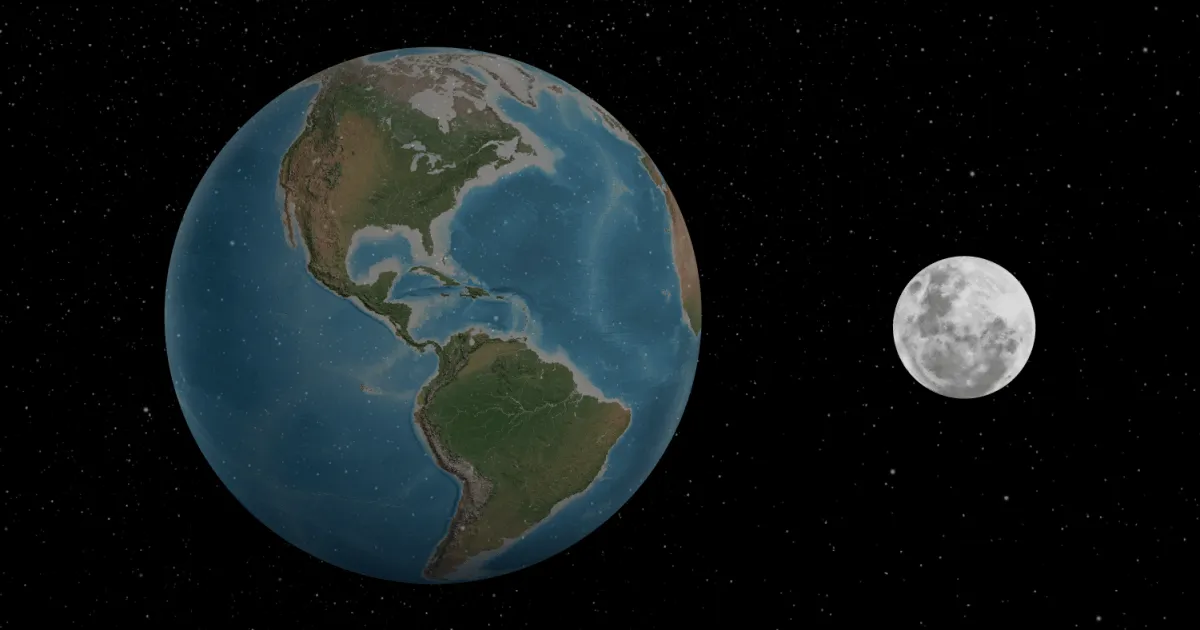
EXPLAINERArtemis II is expected to break the record for the farthest distance humans have travelled from Earth.Earth is 3.7 times the width of the Moon. If the Earth were a basketball, the Moon would be the size of a tennis ball [Al Jazeera]Published On 6 Apr 2026Monday, April 6, 2026, is one of the most significant days for human spaceflight in more than 50 years.At 13:56 EDT (17:56 GMT) Artemis II mission is expected to break the record for the farthest distance humans have travelled from Earth, originally set by Apollo 13 at 400,171km (248,655 miles).The crew is expected to eventually reach a maximum distance of 406,773 km (252,760 miles) from Earth at 19:07 EDT (23:07 GMT) as they perform a lunar flyby aboard the Orion spacecraft. This means Artemis II will travel about 6,602km (4,105 miles) further into space than any human in history.What is NASA’s Artemis programme?The Artemis programme is NASA’s multi-decade mission to return men and women to the Moon for the first time since 1972, establish a long-term base there and eventually enable future missions to Mars by crews.The programme is currently divided into five missions: Artemis I, II, III, IV and V.Artemis I was the inaugural uncrewed test flight, which launched on November 16, 2022, and lasted 25 days. It successfully placed the Orion spacecraft into Earth’s orbit and provided crucial data for Artemis II.What is Artemis II and when did it launch?Artemis II is the first human mission of the Artemis programme.On April 1 at 18:35 EDT (22:35 GMT), the mission lifted off from the Kennedy Space Centre in Florida, carrying four astronauts for the 10-day mission.(Al Jazeera)Who are the Artemis II astronauts?The four astronauts onboard are: Reid Wiseman, 50, commander: The NASA veteran and former International Space Station commander is leading the Artemis II mission. The test pilot-turned-astronaut has leadership and deep spaceflight experience. Victor Glover, 49, pilot: The US Navy aviator is the first Black astronaut assigned to a lunar mission and flew on SpaceX Crew-1. Christina Koch, 47, mission specialist: The record holder for the longest single spaceflight by a woman at 328 days is a veteran of multiple spacewalks and has scientific and deep-space mission expertise. Jeremy Hansen, 50, mission specialist: The first Canadian set to travel to the Moon is a former fighter pilot and represents international collaboration in deep space exploration. (Al Jazeera)What will the astronauts do?The Artemis II astronauts will verify that the spacecraft and its life-support systems are ready for deep-space missions by manually flying at times, overseeing automated systems and testing key functions such as propulsion, power, thermal control, navigation and proximity operations.They will also conduct scientific investigations on lunar observations and human health in space, while rehearsing critical steps such as course changes, long-distance communications and managing re-entry and splashdown to demonstrate Orion’s readiness for future missions.Taking photographs is one of the other things the astronauts will be doing a lot of.On April 2, Commander Reid Wiseman captured a photo of Earth from Orion, which has been dubbed “Hello, World”. Because the spacecraft is rotated about 180 degrees from the usual “north-up” orientation, Earth appears upside down.The photograph captures: The Northern and Southern Aurora Lights with their vivid green lights. The night lights from various cities across Africa, Europe and South America. A faint patch of zodiacal light as the Earth eclipses the sun. (Al Jazeera)What are the astronauts eating onboard?NASA say the Artemis II crew will eat from a fixed menu of 189 shelf‑stable items, including drinks, tortillas, nuts, main dishes such as beef brisket and macaroni and cheese, as well as desserts such as cookies and chocolate, designed to meet nutritional and hydration needs on a no‑resupply lunar mission.Because Orion has no fridge or late‑load capability, only ready‑to‑eat or rehydratable foods can fly, which the crew will rehydrate with a water dispenser, warm in a small heater, and keep crumb‑free for safety in microgravity.When will the astronauts return?NASA’s Artemis II mission is planned to land in the Pacific ocean near San Diego at about 20:07 EDT on Friday, April 10 (0:00 GMT, Saturday, April 11). After splashdown, helicopters will pick up the crew to get medical checkups aboard the USS John P Murtha. Then they’ll step ashore and board a plane to NASA’s Johnson Space Centre in Houston.How big is the Moon and how far away is it?The average distance between the Earth and the Moon is about 384,400km (238,855 miles), similar to circling Earth’s equator nearly 10 times.Earth is approximately 3.7 times the width of the Moon. To put that in perspective, if the Earth were a basketball, the Moon would be the size of a tennis ball.Because the Moon has virtually no atmosphere to hold heat or circulate it, the temperature on the surface fluctuates drastically from night to day. Its temperature ranges from -173C (-180F) at night to 127C (260F) during the day, making it much colder than anywhere on Earth at night and hotter than boiling water during the day.Because of its lower mass, the Moon’s surface gravity is about one‑sixth that of Earth (16-17 percent), so a person with a mass of 60kg (132lbs) would weigh about the same as a 10kg (22lbs) mass on Earth.(Al Jazeera)How many Moon missions have there been?Between 1961 and 1972, NASA ran the Apollo Moon programme. Its 33 missions included 11 crewed and 22 uncrewed.The most notable was Apollo 11, which carried Neil Armstrong and Buzz Aldrin who became the first men to walk on the Moon on July 20, 1969.Six successful Moon landings followed: Apollo 11, 12, 14, 15, 16 and 17.The last people to walk on the lunar surface were Eugene Cernan and Harrison Schmitt, with their third and final moonwalk on December 14, 1972, as part of the Apollo 17 mission.In Greek mythology, Artemis is the twin sister of Apollo and the goddess of the Moon. The name symbolises the programme’s connection to the original Apollo lunar missions.(Al Jazeera)Some other notable missions from other countries include:Luna 9 (USSR, 1966): The first spacecraft to soft-land and send images from the Moon, highlighting the USSR’s early lead and growing competition with the US.Chang’e 4 (China, 2019): The first soft landing and rover on the Moon’s far side tested relay links, precision landing and rover operations.Chandrayaan-3 (India, 2023): The first successful soft landing near the Moon’s south polar region, making India the first to reach it.The south pole contains deep craters that have not seen sunlight for billions of years. Temperatures there can drop to -230C (-382F), allowing water ice to remain stable.How many astronauts have walked the Moon?Twelve US astronauts have walked on the Moon, all during NASA’s Apollo programme (1969–1972): Apollo 11 (1969) – Neil Armstrong, Buzz Aldrin: First humans on the Moon. Apollo 12 (1969) – Charles “Pete” Conrad, Alan Bean: Precision landing near Surveyor 3 probe. Apollo 14 (1971) – Alan Shepard, Edgar Mitchell: Shepard famously hit golf balls on the Moon. Apollo 15 (1971) – David Scott, James Irwin: First use of the lunar rover; focused on geology. Apollo 16 (1972) – John Young, Charles Duke: Explored the lunar highlands. Apollo 17 (1972) – Eugene Cernan, Harrison Schmitt: Last Moonwalkers; Schmitt was the only professional geologist to walk on the Moon. (Al Jazeera)Why is NASA going back to the Moon?The mission reflects broader long-term goals. NASA plans to establish a sustained human presence on and around the Moon, particularly near the lunar south pole, where water in the form of ice is believed to be.This is seen as a stepping stone towards future human missions to Mars. At the same time, Artemis is unfolding within a wider geopolitical context as the United States seeks to maintain leadership in space exploration amid growing competition, particularly from China.When are the next Artemis missions?Artemis III – 2027 NASA recently overhauled the mission profile of Artemis III. The mission, scheduled for next year, will no longer land on the Moon but rather send a crew into low Earth orbit, where it will test integrated operations between the Orion spacecraft and one or both commercial landers from SpaceX and Blue Origin.Artemis IV – early 2028 The mission is due to be the first crewed lunar landing since Apollo 17. NASA plans to send its crew into lunar orbit and two astronauts down to the lunar south pole.Artemis V – late 2028 With this mission, NASA plans a second crewed lunar landing and the start of a lunar base.
SRCAl Jazeera
LANGEN
LEANCenter
WORDS1 407
ENT12
MON · 2026-04-06 · 09:04 GMTBRIEF NSR-2026-0406-54511
NSR-2026-0406-54511News Report·EN·Technology
A visual guide to Artemis II and previous missions to the moon
On April 1, 2026, NASA's Artemis II mission launched from the Kennedy Space Centre in Florida, marking the first crewed mission of the Artemis program. The 10-day mission, carrying astronauts Reid Wiseman, Victor Glover, Christina Koch, and Jeremy Hansen, aims to break the record for the farthest distance humans have traveled from Earth, exceeding the Apollo 13 mission.
Yara Algosaibi,Mohammed HaddadAl JazeeraFiled 2026-04-06 · 09:04 GMTLean · CenterRead · 6 min
Al JazeeraFIG 01
Reading time
6min
Word count
1 407words
Sources cited
1cited
Entities identified
12entities
Quality score
100%
§ 01
Briefing Summary
AI-generatedNEWSAR · AI
On April 1, 2026, NASA's Artemis II mission launched from the Kennedy Space Centre in Florida, marking the first crewed mission of the Artemis program. The 10-day mission, carrying astronauts Reid Wiseman, Victor Glover, Christina Koch, and Jeremy Hansen, aims to break the record for the farthest distance humans have traveled from Earth, exceeding the Apollo 13 mission. Artemis II is expected to reach a maximum distance of 406,773 km (252,760 miles) from Earth during a lunar flyby. The Artemis program is a multi-decade effort to return humans to the moon, establish a long-term lunar base, and prepare for future missions to Mars. Artemis I, the uncrewed test flight, preceded Artemis II and provided crucial data for the current mission.
Confidence 0.90Sources 1Claims 5Entities 12
§ 02
Article analysis
Model · rule-basedFraming
Technology
Human Interest
Tone
Measured
AI-assessed
CalmNeutralAlarmist
Factuality
0.90 / 1.00
Factual
LowHigh
Sources cited
1
Limited
FewMany
§ 03
Key claims
5 extracted01
The Artemis II mission lifted off from the Kennedy Space Centre in Florida on April 1.
factualAl Jazeera
Confidence
1.00
02
Artemis II is the first human mission of the Artemis programme.
factualAl Jazeera
Confidence
1.00
03
Artemis II will travel about 6,602km further into space than any human in history.
predictionAl Jazeera
Confidence
0.90
04
The crew is expected to eventually reach a maximum distance of 406,773 km from Earth.
predictionAl Jazeera
Confidence
0.90
05
Artemis II is expected to break the record for the farthest distance humans have travelled from Earth.
predictionAl Jazeera
Confidence
0.90
§ 04
Full report
6 min read · 1 407 words§ 05
Entities
12 identifiedKey playerOppositionContextPositiveNeutralNegative
People4
Organizations2
Locations4
§ 06
Keywords & salience
9 termsartemis ii
1.00
moon mission
0.80
artemis program
0.80
nasa
0.70
human spaceflight
0.70
lunar flyby
0.60
astronauts
0.60
deep space exploration
0.50
orion spacecraft
0.50
§ 07
Topic connections
Interactive graph No topic relationship data available yet. This graph will appear once topic relationships have been computed.